
In the competitive landscape of 2026, a company’s success is no longer defined solely by its product or service, but by the quality of the team behind it. For small and mid-sized businesses, the “Group Benefits Package” is the most powerful tool in the shed for attracting and keeping top-tier talent.
However, many business owners set up their benefits once and never revisit them. If your plan hasn’t changed in three years, it likely no longer meets the needs of your workforce or your bottom line.
Why Group Benefits Matter in 2026
A group benefits package is more than just health insurance; it reflects your company culture. From life insurance to mental health support, these perks form a safety net that allows your employees to focus on their work rather than their personal medical costs.
If you aren’t sure if your current plan is still effective, look for these seven red flags.
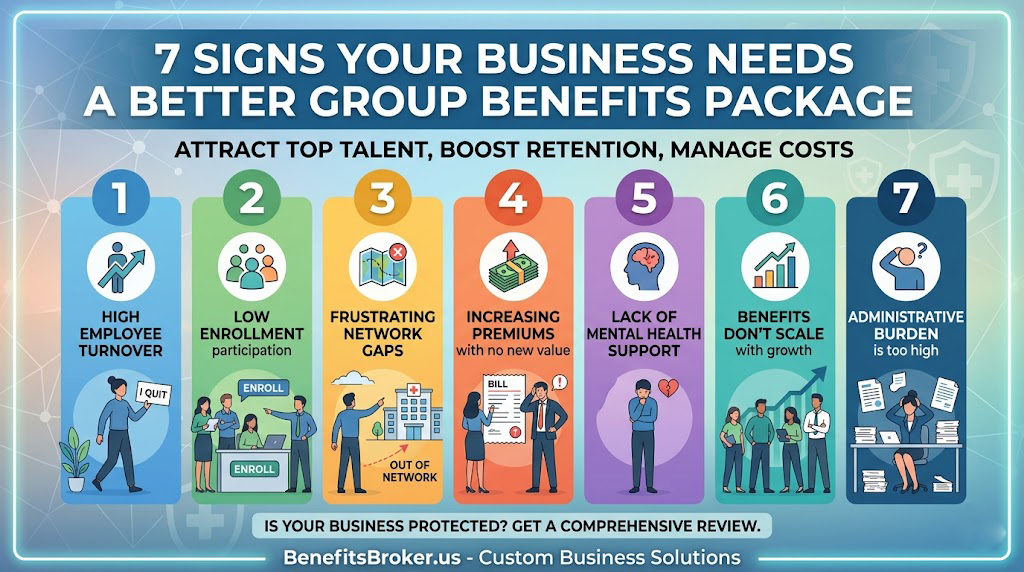
1. High Employee Turnover Rates
If you are losing talented staff to competitors, the reason might not be the salary. Modern workers prioritize “Total Compensation.” If a rival firm offers better dental, vision, or a lower deductible, your best employees will notice. A high-quality benefits package creates “golden handcuffs” that make it difficult for employees to leave.
2. Low Participation in Current Plans
If only a small fraction of your team is enrolling in your health or retirement plans, it’s a sign that the plans are either too expensive or irrelevant. If your employees are opting to stay on a spouse’s plan or go without coverage entirely, your current offering is providing zero value to your retention strategy.
3. Frequent Complaints About “Network Gaps”
Are your employees constantly frustrated because their primary care doctor or local pharmacy is “Out-of-Network”? If your provider network is too restrictive, the benefit feels more like a burden. A better package should offer flexibility, such as PPO options that allow for wider physician access.
4. Increasing Premiums with No Improved Value
Insurance costs naturally rise, but if you are seeing double-digit premium increases every year without any added features (like wellness programs or telemedicine), you are overpaying. A professional broker can often find alternative funding strategies, such as level-funded or self-funded plans, to stabilize these costs.
5. Lack of Mental Health or Wellness Support
The definition of “health” has shifted. A 2026 workforce expects more than just hospital coverage. If your package lacks an Employee Assistance Program (EAP), mental health counseling, or digital wellness tools, you are missing a critical component of modern employee care.
6. Your Benefits Don’t Scale with Your Growth
What worked when you had 10 employees will not work when you have 50 or 100. As your business grows, you gain access to different “risk pools” and more sophisticated insurance products. If you are still on a “small group” plan intended for startups, you are likely leaving money on the table.
7. Complexity is Affecting Productivity
If your HR manager spends half their week answering basic insurance questions or fixing enrollment errors, your plan is too complex. A modern benefits package should come with a streamlined digital enrollment platform and dedicated support from an independent agency to take the administrative load off your team.
Comparing Your Current Plan to Modern Standards
| Feature | Standard Package (Often Outdated) | Modern Group Package (High Retention) |
| Health Options | One “Take it or Leave it” Plan | Choice of HMO, PPO, and HSA-compatible plans |
| Ancillary Coverage | Dental & Vision only | Dental, Vision, Life, and Disability |
| Wellness | None | Mental health apps, Gym reimbursements |
| Enrollment | Paper forms / Manual entry | 100% Digital / Mobile-friendly |
| Cost Control | Fixed annual increases | Level-funded or Gap-funded options |
How to Transition to a Better Package
Upgrading your benefits doesn’t necessarily mean spending more money; it means spending it more wisely.
- Survey Your Team: Ask your employees what they actually value. You might find they prefer a lower premium over a fancy gym membership.
- Audit Your Claims Data: Look at how the plan is being used to identify where you are overpaying for unused services.
- Consult an Independent Broker: Unlike “captive” agents who only sell one brand, an independent broker can shop the entire market to find the best fit for your specific headcount and budget.
FAQ’s
Can a business with fewer than 50 employees get a custom plan?
Absolutely. While the ACA mandates certain requirements for larger groups, “Small Group” plans are highly customizable and can include supplemental benefits tailored to your industry.
Will a better plan always cost more?
Not necessarily. By switching to a different funding model or carrier, many businesses actually lower their per-employee cost while increasing the level of coverage.
How often should I review my group benefits?
At a minimum, you should conduct a full market review 90 days before your annual renewal date to ensure you aren’t being hit with “auto-renewal” price hikes.