Category: Blog

  • Can You Sell Your Term Life Insurance Policy? Rules, Steps & Alternatives (2026)

    Can You Sell Your Term Life Insurance Policy? Rules, Steps & Alternatives (2026)

    Can You Sell Your Term Life Insurance Policy? What Every Policy Owner Should Know

    You bought term life insurance to protect your family. Now your situation has changed. Maybe you are older, your health has shifted, the kids are independent, or you simply do not want to keep paying premiums. So the question comes up: can you sell your term life insurance policy?

    The short answer is yes, sometimes. But unlike a whole life policy, a term policy has no cash value, so the rules, the buyers, and the payouts look very different. Most people never learn that a market exists for policies they were about to cancel.

    At BenefitsBrokerDotUS, we help policy owners look at every option before they cancel, lapse, or sell. This guide explains who can sell a term policy, how the process works, what taxes may apply, and which alternatives may be worth more than a sale.

    Quick answer: You can sell a term life insurance policy through a life settlement if the policy is still in force and, usually, if it is convertible to permanent coverage. Buyers generally look for insureds who are older (often 65 or above) and policies with a meaningful death benefit. If the policy is about to expire and cannot be converted, it typically has little or no resale value.
    Can You Sell Your Term Life Insurance Policy

    Can You Really Sell a Term Life Insurance Policy?

    Yes. As the policy owner, you generally have the right to transfer ownership of your policy. In the life insurance world, selling a policy to a third party is called a life settlement. The buyer, usually a life settlement provider operating in the secondary market, takes over the premiums and becomes the beneficiary. When the insured passes away, the buyer collects the death benefit.

    The complication is the type of policy. Term insurance is temporary and has no cash surrender value. That means buyers only pay when they believe the policy will still be in force when the insured dies. For a term policy, that usually depends on one feature: convertibility.

    Policy typeCan it be sold?Typical buyer interest
    Term, convertible, still in conversion windowYesModerate to strong, especially for older insureds
    Term, not convertible, years remainingRarelyLow
    Term, about to expireAlmost neverVery low
    Whole lifeYesStrong
    Universal lifeYesStrong
    Group term (employer)Only if convertible to an individual policyLow to moderate

    Why Buyers Want Term Policies (and Why Many Don’t)

    A buyer profits only if the insured dies while the policy is in force. A term policy ends on a fixed date, so a buyer taking on a plain term policy could pay premiums for years and collect nothing.

    Here is what changes the math:

    • Conversion privilege: If your policy can be converted to whole or universal life, the buyer can convert it and keep coverage for life. That is what makes the policy valuable.
    • Conversion deadline: Many contracts limit conversion to a certain number of years or a certain age. Buyers care about how much time is left.
    • Insured’s age and health: Higher risk of a claim in the near term means higher value.
    • Face amount: Larger policies attract more buyers.
    • Premium cost after conversion: Because the insured is older, converted premiums can be high, which lowers the offer.

    If your term policy has none of these features, cancelling it or letting it end may be the practical outcome.

    Who Qualifies to Sell a Term Life Insurance Policy?

    Requirements vary by provider and by state, but most life settlement buyers look for the following:

    RequirementTypical expectation
    Age of the insuredOften 65 or older (some accept younger insureds with serious health conditions)
    Death benefitCommonly $100,000 or more (varies by buyer)
    Policy statusIn force, with premiums current
    ConvertibilityTerm policy must be convertible or already in its conversion window
    Policy ageMany states require the policy to be owned a minimum period, often around two years, before it can be sold
    Health profileMedical records that support a life expectancy evaluation
    OwnershipPolicy owner (or legal representative) must consent, and irrevocable beneficiaries or assignees may need to sign

    These are general guidelines, not guarantees. Always confirm details with a licensed professional and your state insurance department.

    Life Settlement vs Viatical Settlement

    People often mix up these two terms. Both involve selling a policy, but they apply to different situations.

    FeatureLife settlementViatical settlement
    Who it is forGenerally seniors with changing needsInsureds with a terminal or chronic illness
    Health requirementNot necessarily seriously illTerminal illness (often a life expectancy of 24 months or less) or qualifying chronic illness
    Typical age65 and olderAny age
    Payout logicBased on life expectancy, premiums, and death benefitUsually a higher percentage of the death benefit because life expectancy is shorter
    Tax treatmentPartly taxable in many casesOften tax-free under IRC Section 101(g) when requirements are met

    If a serious illness is part of your story, a viatical settlement or an accelerated death benefit rider may offer better terms than a standard life settlement.

    How to Sell Your Term Life Insurance Policy: Step by Step

    Step 1: Confirm Whether Your Policy Is Convertible

    Read your policy or call your insurer. Ask three questions: Can it be converted? Until what date or age? To which permanent products? This single detail determines whether a sale is realistic.

    Step 2: Request an In-Force Illustration

    Ask the insurer for an in-force illustration or policy statement. It shows the current premium, the death benefit, the term length, and the conversion terms. Buyers will ask for it.

    Step 3: Gather Documents

    You will typically need:

    • A copy of the policy and any riders
    • Your most recent premium notice
    • Basic personal and contact information
    • Authorization for the buyer to review your medical records

    Step 4: Work With a Licensed Professional

    Use a licensed life settlement broker or a licensed insurance professional who is required to act in your interest. A good broker requests bids from several buyers, so you are not stuck with one offer. To talk through your situation, you can contact our team here.

    Step 5: Undergo a Life Expectancy Review

    Buyers order a life expectancy estimate based on your medical records, age, and health history. This is how they price the policy.

    Step 6: Compare Offers

    Do not accept the first bid. Compare the payout amount, fees and commissions, timeline, and whether the offer is guaranteed or conditional on a final review.

    Step 7: Review the Contract Carefully

    Look at the purchase price, the broker’s compensation, deadlines, and the rescission period. Many states give sellers a window to cancel after signing, but the length varies. If the deal is large, have an attorney or tax professional review it.

    Step 8: Close Through Escrow

    The buyer typically deposits funds with an independent escrow agent. After the insurer processes the change of ownership and beneficiary designation, the funds are released to you.

    Step 9: Keep Your Records

    Save your signed agreement, payment confirmation, and any tax forms. You may receive a Form 1099-LS reporting the sale.

    How Much Can You Get for a Term Life Insurance Policy?

    There is no fixed price. Offers depend on several factors:

    FactorEffect on your offer
    Age and health of the insuredShorter life expectancy generally increases the offer
    Death benefit (face amount)Higher face amount generally increases the offer
    Premiums the buyer must payHigher ongoing costs, especially after conversion, reduce the offer
    Time left to convertMore time remaining supports a stronger offer
    Insurer’s financial strengthHigher-rated carriers are more attractive
    Market demandBuyer appetite changes over time

    Because term policies have no cash value, offers are often a modest share of the death benefit compared with permanent policies. Anything a buyer pays is money you would not have received by cancelling. Just make sure the sale price beats what you could gain from keeping or converting the policy yourself.

    Tax Rules When You Sell a Life Insurance Policy

    Taxes can change how much you actually keep. The following is a general overview for U.S. policy owners, and you should confirm details with a tax professional.

    Portion of the proceedsGeneral tax treatment
    Up to your cost basis (premiums paid, adjusted as required)Generally tax-free return of basis
    Amount above basis, up to the cash surrender valueGenerally taxed as ordinary income
    Amount above the cash surrender valueGenerally taxed as capital gains
    Viatical settlement for a qualifying terminally ill insuredOften excluded from income under IRC Section 101(g)

    Two more points matter:

    • Transfer for value rule: In many cases, selling a policy can make part of the eventual death benefit taxable to the buyer, but that is generally the buyer’s concern, not the seller’s. It becomes important if you transfer a policy to certain parties without meeting exceptions.
    • Reporting: Expect tax paperwork such as Form 1099-LS in some situations.

    Because term policies usually have no cash surrender value, the split can look different than it does for whole life. A tax advisor can run the numbers.

    Risks and Downsides of Selling Your Term Policy

    Selling is not always the right move. Weigh these risks first:

    • You lose your coverage. Your family no longer receives a death benefit.
    • You may not be able to replace it. New coverage requires underwriting, and premiums rise with age and health changes.
    • Government benefits may be affected. A lump sum can impact Medicaid eligibility or other need-based programs.
    • Creditor and legal issues. Proceeds may be treated differently from death benefits in some states.
    • Fees can eat into proceeds. Broker commissions and provider fees vary, so ask for full disclosure.
    • Privacy. Buyers review your medical records, and your information is shared with several parties.
    • Fraud risk. Work only with licensed providers. Be cautious of anyone pushing a STOLI (stranger-originated life insurance) arrangement, which is illegal or restricted in many states.

    Alternatives to Selling Your Term Life Insurance Policy

    A sale is only one path. Compare it with these options:

    OptionHow it worksBest for
    Keep the policyContinue paying premiums until the term endsPeople who still need protection at a low cost
    Convert to permanent coverageSwitch to whole or universal life without new medical underwritingHealth has declined and coverage is still needed
    Use an accelerated death benefit riderAccess part of the death benefit early if you have a qualifying illnessTerminal or chronic illness, often at no extra cost
    Reduce coverageLower the face amount to cut premiumsNeeds have decreased but have not disappeared
    Let it expireCoverage ends at the end of the termDependents are independent and debts are paid
    CancelFormally end the policy nowPremiums are no longer worth it. See our guide on how to terminate a life insurance policy
    Gift or transfer ownershipMove the policy to a family member or trustEstate planning goals. See our overview of estate planning
    Sell (life settlement)Transfer the policy to a third-party buyer for a lump sumOlder, convertible policies you no longer need

    For many term policy owners, converting or using a rider can be more valuable than selling. A quick review of your options on our life insurance page can help you see the full picture.

    Special Situations

    Selling a Term Policy After Retirement

    Retirees often no longer need income replacement, but a convertible term policy may still have market value. Check your conversion deadline right away, because many contracts limit conversion to a specific age.

    Selling a Term Policy After a Health Diagnosis

    A significant diagnosis can raise the policy’s value to buyers, and it may open the door to a viatical settlement or an accelerated death benefit. It also makes replacement coverage harder to buy, so consider keeping the policy if your family still relies on it.

    Selling an Employer-Provided Term Policy

    Group term coverage is usually tied to your job. It is rarely sellable unless it can be converted into an individual policy. If you are leaving your employer, look into conversion or portability. See our overview of group insurance.

    Selling Because You Need Cash

    If you need money for a major expense, consider all sources first. Our article on using life insurance to buy a house explains how different policy types can support big purchases.

    Selling After Divorce

    A divorce decree may require you to maintain coverage or name a certain beneficiary. Review the decree, or ask an attorney, before selling.

    Common Mistakes to Avoid

    • Assuming every term policy can be sold. Convertibility is usually essential.
    • Waiting too long. Conversion windows close, and the policy loses its resale value.
    • Accepting the first offer. Bids vary, so compare several.
    • Working with an unlicensed buyer. Verify licensing with your state insurance department.
    • Ignoring tax consequences. Proceeds may be partly taxable.
    • Selling before securing other protection. Confirm what your family will have in place afterward.
    • Skipping the fine print. Fees, deadlines, and rescission rights all matter.
    • Confusing AD&D with life coverage. Read our comparison of life insurance vs AD&D insurance before deciding what to keep.

    Frequently Asked Questions

    Can you sell your term life insurance policy?

    Yes, in some cases. Term policies that are convertible to permanent coverage can be sold through a life settlement, usually by insureds who are older. Policies that cannot be converted, or that are about to expire, generally have little to no market value.

    What is the difference between selling and cancelling a term policy?

    Cancelling ends the policy and pays you nothing. Selling transfers ownership to a buyer for a lump sum, and the buyer takes over the premiums and the death benefit.

    Can I sell a term life policy if I am healthy?

    It is possible, but buyers tend to pay more when the insured is older or has health issues. Healthy, younger insureds usually receive low offers or none.

    How old do I have to be to sell my life insurance policy?

    Many buyers prefer insureds who are 65 or older, though some accept younger insureds with serious health conditions. Requirements vary by provider.

    Is the money from selling a life insurance policy taxable?

    Often partly. Proceeds up to your cost basis are generally tax-free, and amounts above that may be taxed as ordinary income or capital gains. Viatical settlements for qualifying terminally ill insureds are often tax-free. Consult a tax professional.

    How long does it take to sell a term life insurance policy?

    Timelines vary, but a life settlement often takes several weeks to a few months, depending on medical record collection, offers, and insurer processing.

    Will selling my policy affect my Medicaid or government benefits?

    It can. A lump-sum payment may count as an asset or income, so speak with a benefits advisor or attorney before you sell.

    Is it better to convert or sell my term policy?

    It depends. Converting keeps coverage in your family’s hands, while selling converts coverage to cash. If you still need protection, converting is often the better choice. If you do not, selling may beat cancelling.

    Talk to a Licensed Broker Before You Sell

    Selling a life insurance policy is a one-way decision. Before you sign anything, let the team at BenefitsBrokerDotUS help you review your policy, understand your conversion rights, and compare every option. As a multi-state licensed agency, we explain the trade-offs in plain language so you can choose with confidence.

    Get a Free Quote

    Disclaimer: This article is for educational purposes only and is not legal, tax, or financial advice. Policy terms, state laws, and tax treatment vary. Consult your insurer and a qualified tax or legal professional before making decisions.

  • Can You Use Life Insurance to Buy a House? 2026 Guide

    Can I Cash Out or Use My Life Insurance to Buy a House?

    Can You Use Life Insurance to Buy a House? 2026 Guide

    Buying a home requires a down payment, closing costs, and financial reserves. If you own permanent life insurance, its cash value may seem like a useful source of money. The idea can work, but the right answer depends on your policy type, available value, mortgage rules, tax position, and family protection needs.

    Many policyholders ask, “Can I use life insurance to buy a house?” Sometimes, yes. A policy loan, partial withdrawal, or full surrender may provide funds. Each method has a different effect on interest, taxes, cash value, and the death benefit. A choice that helps at closing could weaken coverage later.

    BenefitsBroker.US life insurance advisors recommend reviewing the full cost before moving money. A balanced decision should support both goals for your household. Use life insurance to buy a house carefully.

    Quick Answer

    You may be able to use life insurance to buy a house if you own permanent coverage with accessible cash value. Whole life, universal life, and some variable life policies can accumulate value. Term life insurance normally has no cash value, so it usually cannot provide money during your lifetime.

    Fannie Mae guidance says net proceeds from a life insurance loan or surrender may be acceptable for a down payment, closing costs, and reserves. Your mortgage lender must still verify ownership, the source of funds, the net amount, and any repayment obligation.

    Which Policies Can Provide Cash?

    Policy type Builds cash value? Access options Main concern
    Term life insuranceUsually noNoneProtection ends when the term expires
    Whole life insuranceUsually yesLoan, withdrawal, surrenderLoans can reduce guarantees and benefits
    Universal life insuranceOften yesLoan, withdrawal, surrenderLower value may increase lapse risk
    Variable life insuranceOften yesLoan, withdrawal, surrenderValue depends on investment performance

    If you own only term coverage, review term life insurance options before replacing or canceling it.

    Three Ways to Access the Money

    When people ask how to use life insurance to buy a house, they generally consider three methods.

    Policy Loan

    A policy loan uses cash value as collateral. You borrow from the insurer and usually avoid a traditional credit check. Repayment may be flexible, but interest starts accumulating under the contract.

    An unpaid balance generally reduces the death benefit. A large loan can also cause the policy to lapse if the remaining value cannot support insurance costs. Ask whether the rate is fixed or variable and request projections showing several repayment scenarios.

    Partial Withdrawal

    A withdrawal permanently removes part of the cash value and normally does not require repayment. It may reduce the death benefit, alter guarantees, or increase the chance that a universal policy will lapse later.

    Tax can apply when distributions exceed your investment in the contract, often called the cost basis. Fees and withdrawal limits may also apply. Ask the insurer for the net amount, not only the gross value shown on a statement.

    Full Surrender

    A full surrender ends the policy. The insurer pays the net cash surrender value after subtracting surrender charges and outstanding loans. Your family loses the death benefit and you may be unable to replace the coverage affordably.

    The IRS generally requires taxable income to be reported when surrender proceeds exceed your investment in the contract.

    Comparison of Funding Choices

    Use this table when deciding whether to use life insurance to buy a house.

    Funding choice Effect on insurance Possible cost Main risk
    Policy loanCoverage may continueInterestReduced benefit or lapse
    Partial withdrawalValue and benefit may fallFees or taxPermanent policy reduction
    Full surrenderCoverage endsCharges or taxComplete loss of protection
    Personal savingsNo policy effectLost interestSmaller emergency fund
    Secured asset loanNo direct policy changeInterest and paymentsAdded debt obligation

    Compare the net funds, long term cost, and effect on household security.

    Will a Mortgage Lender Accept the Funds?

    A lender may accept the funds when you use life insurance to buy a house, but documentation is essential. Fannie Mae identifies net proceeds from a cash value loan or surrender as a possible source for the down payment, closing costs, and reserves. Individual lenders and mortgage programs may impose additional rules.

    Prepare these records:

    • A current policy statement showing ownership and cash value
    • The insurer’s loan, withdrawal, or surrender confirmation
    • Proof that the money entered your bank account
    • Details of any required payment or interest charge
    • An explanation and paper trail for the large deposit
    • Evidence that you still meet reserve requirements

    The Consumer Financial Protection Bureau explains that lenders generally verify the source of down payment funds. Speak with your loan officer before initiating the transaction. This can prevent an acceptable asset from becoming a last minute underwriting delay.

    Tax Issues You Should Review

    Tax treatment matters when you use life insurance to buy a house. A policy loan is generally not taxable while the contract remains active. However, a later lapse or surrender with an outstanding loan can create taxable income when the policy gain exceeds the cost basis.

    A withdrawal may be received tax free up to basis in many standard policies. Different rules can apply to a modified endowment contract, and certain distributions may face additional tax.

    A full surrender can produce ordinary taxable income on the amount above your investment in the contract. Previous withdrawals, dividends, refunded premiums, and unpaid loans may affect the calculation. Your insurer may issue a tax form, but a qualified tax professional should review the full history.

    Important Risks

    When you use life insurance to buy a house, cash value is not the same as ordinary savings. Consider these risks:

    • The death benefit may be reduced.
    • Loan interest can compound over time.
    • Low cash value may cause a policy lapse.
    • Replacement coverage may be costly or unavailable.
    • Surrender charges can reduce usable funds.
    • Taxable gain can lower the amount available for closing.
    • Reduced reserves can make home repairs harder to manage.
    • Variable policy values can decline after the transaction.

    A home purchase should strengthen your finances, not leave dependents exposed or create a policy failure you did not expect.

    When the Strategy May Make Sense

    It may be reasonable to use life insurance to buy a house when the policy has substantial value, the remaining death benefit still meets family needs, and the transaction improves your overall financial plan. A manageable policy loan may be less expensive than unsecured borrowing.

    The strategy is more suitable when income is stable, emergency savings remain available, and you have a clear repayment plan. It should fit your mortgage budget, retirement goals, estate plan, and insurance needs.

    It may be unsuitable when the policy provides essential family protection, cash value is limited, income is uncertain, or taking funds could cause a lapse. Do not treat cash value as free money.

    A Practical Decision Process

    Before you use life insurance to buy a house, complete these steps:

    1. Confirm the policy type, owner, cash value, basis, and death benefit.
    2. Request current loan, withdrawal, and surrender illustrations.
    3. Calculate net proceeds after interest, charges, and estimated taxes.
    4. Ask the mortgage lender which method and documents are acceptable.
    5. Recalculate the remaining protection and projected policy duration.
    6. Compare savings, assistance programs, gifts, and other secured assets.
    7. Review the plan with insurance, mortgage, and tax professionals.
    8. Keep every policy, insurer, and bank document for underwriting.

    BenefitsBroker.US life insurance advisors can explain how each transaction may affect your coverage. For guidance based on your goals, contact our life insurance team before submitting a loan or surrender request.

    Final Answer

    You can sometimes use life insurance to buy a house through a policy loan, withdrawal, or surrender. The opportunity mainly applies to permanent policies with enough cash value. Properly documented net proceeds may be accepted for a down payment, closing costs, or reserves.

    The decision should consider more than the amount available today. Review taxes, interest, surrender charges, reduced benefits, lapse risk, lender requirements, and the cost of replacing coverage.

    Before you use life insurance to buy a house, obtain written figures from the insurer and discuss them with your lender and qualified advisers. Careful planning can help you pursue homeownership without sacrificing the financial protection your household still needs.

  • HIV & Life Insurance: How Underwriting Really Changed (2026)

    HIV & Life Insurance: How Underwriting Really Changed
    Insurance Education

    Life Insurance for People With HIV: What Modern Underwriting Really Looks Like

    Worried HIV will get your application rejected? It doesn’t have to anymore. Here’s how underwriting actually works today, and how to put together the strongest possible case.

    • 2026 underwriting standards
    • What carriers actually check
    • Application checklist
    HIV & Life Insurance: How Underwriting Really Changed (2026)

    If you’re HIV-positive and you’ve kept putting off the life insurance conversation, you’re definitely not the only one. A lot of people figure there’s no point even asking — like the diagnosis alone slams the door shut before anyone’s even had a real conversation. Honestly, that used to be true. It isn’t anymore, and the gap between what people expect and what’s actually possible right now is bigger than most folks realize.

    Antiretroviral therapy changed everything about what it means to live with HIV. People who stay consistent with treatment are living long, stable, genuinely healthy lives, and the insurance industry has had to rebuild its whole approach around that. Carriers that used to issue automatic declines now run entire programs built specifically for HIV-positive applicants — and some are offering rates that land surprisingly close to standard.

    At Benefits Broker.US, we see this play out all the time — someone braces for the worst, and the actual outcome ends up far better than they expected. This guide walks through how underwriting has changed, what insurers are really looking at in 2026, and how to put together an application that gives you the best possible shot.

    How We Got From ‘Automatic Decline’ to ‘Case-by-Case Review’

    It helps to understand why this shift happened, because it explains a lot about how underwriters think now. Life insurance pricing runs on mortality data — basically, how long someone with a given health profile is statistically expected to live. Decades ago, HIV mortality data was bleak, and insurers priced policies, or just declined them outright, based on that grim picture.

    That data looks completely different today. People diagnosed with HIV now, who start treatment early and stick with it, often end up with life expectancies that look a lot closer to the general population than anyone would’ve guessed years back. Once that showed up clearly in the actuarial numbers, insurers had real financial reasons to rethink their old guidelines — turning away an entire group of insurable people just stopped making sense.

    • Modern antiretroviral therapy keeps viral loads suppressed in the vast majority of patients who stay on it
    • Updated mortality tables now reflect treatment-stable HIV instead of decades-old, pre-treatment assumptions
    • Several top-tier insurers built formal HIV underwriting programs with their own specific guidelines
    • HIV is increasingly underwritten the way other manageable chronic conditions are — closer to diabetes or hypertension than to a terminal diagnosis

    None of this means underwriting turned loose or automatic — it’s still a real evaluation, and your individual numbers still carry a lot of weight. But the starting point has shifted. Instead of bracing for an automatic no, most well-managed HIV-positive applicants today have a genuinely realistic shot at coverage. The real question becomes which policy, at what rate, and how soon.

    What Underwriters Are Actually Evaluating

    So if you’re applying today, what’s actually driving the decision? Here’s what carriers will ask for, request from your doctor, or pull from your records:

    What carriers review:

    • Your current CD4 count, along with the lowest one you’ve ever recorded
    • Your viral load — undetectable status is the single strongest sign of stability you can show
    • How long you’ve been on antiretroviral therapy, and whether there have been any gaps
    • Whether you’ve ever had an AIDS-defining illness or a serious opportunistic infection
    • How consistently you’ve kept up with doctor visits, usually every three to six months
    • Any other health conditions sitting alongside your HIV status
    • Your age, smoking status, and general lifestyle factors — same as any other applicant
    Context matters

    Underwriters weigh all of this together, not any single piece on its own. A great viral load number paired with shaky follow-up care doesn’t read the same as that same number backed by years of steady, documented stability.

    If you’re thinking about your broader health and coverage picture rather than just life insurance, it’s worth taking a look at your health insurance options at the same time — consistent medical coverage and regular follow-up visits are exactly the kind of paper trail that strengthens a life insurance application down the line.

    HIV Underwriting: Past vs. Present

    Factor Older Underwriting Era Current Underwriting Approach
    Typical outcomeAutomatic decline, regardless of health statusIndividual case review, approval often realistic
    Available policy typesLittle to none, occasionally guaranteed issueTerm and whole life available through several carriers
    Main factor consideredDiagnosis itselfCD4 count, viral load, treatment history, and stability
    Best achievable rateRarely anything close to standardStandard or near-standard possible for well-managed cases
    Underlying data usedPre-treatment era mortality assumptionsModern mortality data reflecting ART outcomes

    Worth saying plainly: this reflects the general direction the industry has moved, not a promise for any one applicant. Every carrier sets its own internal guidelines, and your outcome still comes down to your specific health profile.

    The Two Numbers That Matter Most

    If you take away nothing else from this guide, remember these two: CD4 count and viral load. They carry more weight in an HIV underwriting decision than almost anything else on the application.

    1. An undetectable viral load held steady for a year or longer is about the strongest signal of stability you can hand an underwriter.
    2. A current CD4 count above 500 cells/mm³ generally opens the door to a more favorable rate class.
    3. A low CD4 count somewhere in your history can still show up in how your file gets read, even if it’s since recovered.
    4. Never having had an AIDS-defining illness works strongly in your favor.
    5. If your diagnosis is recent — generally under 12 months — expect a waiting period before full underwriting becomes realistic.

    One thing worth knowing ahead of time

    Most insurers want CD4 and viral load results from within the last six months, and the standard paramedical exam usually doesn’t test CD4 on its own. If your most recent labs are older than that, plan on being asked for updated testing before underwriting can really move forward.

    Policy Types Available to HIV-Positive Applicants

    Policy Type Who It Tends to Fit Trade-Off to Expect
    Fully underwritten term lifeStable, well-documented, undetectable casesRequires a medical exam and detailed records
    Fully underwritten whole lifeLong-term planning with a strong health historyHigher premium than term for equivalent coverage
    Guaranteed issue lifeRecent diagnoses or harder-to-place health profilesLower coverage limits, graded benefit early on
    Group or employer-sponsored lifeFast coverage with no individual underwritingUsually ends if you leave the employer

    Mistakes That Quietly Hurt Applications

    Honestly, most of the underwriting setbacks we see have very little to do with HIV itself — and a lot to do with how the application got handled. A few common, totally avoidable mistakes:

    • Applying without current CD4 and viral load results, which just delays or weakens the file from the get-go
    • Sticking with one carrier instead of seeing how different HIV underwriting programs treat the exact same case
    • Leaving things out of your medical history and hoping they slip through — they almost never do, since records and the Medical Information Bureau tend to catch up with you
    • Assuming one decline means every insurer will say no, when guidelines genuinely vary a lot between companies
    • Putting off the whole process out of fear of rejection, when plenty of cases turn out far better than people expect

    Building a Strong Application Before You Apply

    A little prep work goes a long way here, both for how smoothly things go and what kind of offer you end up with. Before you submit anything, try to have these ready:

    • Your most recent CD4 count and viral load numbers, ideally from within the last six months
    • A clear, documented timeline of how long you’ve been on antiretroviral therapy
    • Records showing consistent doctor visits, generally every three to six months
    • Full honesty about any other health conditions, even small or seemingly unrelated ones
    • A realistic sense of how much coverage you actually need, and for how long

    Once you’ve got that together, the smart move is usually getting an informal read from a few different carriers before you submit a full application. That way your whole outcome isn’t riding on one underwriter’s take on your file. Benefits Broker.US can look at your specific situation and give you a straight answer about which carriers are likely to view your case favorably, before you commit to anything formally.

    Why Working With an Independent Broker Matters Here

    This is one of those situations where going straight to a single insurance company can genuinely work against you. Captive agents can only sell you what their one carrier offers, and if that carrier happens to run conservative HIV guidelines, there’s nothing they can do about it — you’re stuck with whatever that one company decides, for better or worse.

    Comparing your case across several insurers at once can be the difference between a decline and an approval.

    An independent broker works differently. Instead of being boxed into one underwriting philosophy, we can compare your case against several insurers’ guidelines at once and point you toward the ones most likely to look favorably on your specific health profile. For something like HIV, where guidelines swing so much from company to company, that comparison can be the difference between a decline and an approval — or between a heavily rated policy and one that lands close to standard.

    One broker relationship, multiple carriers compared — no guessing which company to approach first.

    Why trust BenefitsBroker.US?

    Straight answers on a sensitive decision

    At BenefitsBroker.US, we understand how much courage it takes to even start this conversation. Our role is to give you a clear, honest read on where you actually stand — not a generic script, and not false reassurance either.

    We compare your specific health profile against the guidelines of several carriers at once, so you know which insurers are realistically likely to look favorably on your case before you commit to a formal application.

    Frequently Asked Questions

    Can people living with HIV actually qualify for life insurance in 2026?

    Yes, and more often than people expect. Several major carriers now approve HIV-positive applicants who are stable on treatment, and well-managed cases can sometimes land standard or near-standard rates.

    What matters most to an underwriter reviewing an HIV-positive application?

    Viral load and CD4 count, hands down. An undetectable viral load held steady over time is one of the strongest positive signals you can bring to an application.

    How long after diagnosis should someone wait before applying?

    Most carriers like to see at least 12 months of stable, consistent treatment before they’ll move forward with full underwriting, though the exact timeline depends on the individual carrier.

    Does a decline from one insurance company mean coverage isn’t possible anywhere?

    Not even close. Underwriting guidelines for HIV vary a lot between carriers, so a no from one company tells you very little about how another will respond to the same case.

    Is guaranteed issue life insurance the only realistic option for someone newly diagnosed?

    Often it’s the starting point, but plenty of people become eligible for fully underwritten term or whole life coverage once they’ve built up a documented history of stable treatment.

    Do applicants have to disclose their HIV status?

    Yes, every single time. Insurers review medical records and check the Medical Information Bureau, and leaving this out can void a policy later. Being upfront protects you and the policy both.

    Why use an independent broker instead of applying directly to one insurance company?

    Because HIV underwriting guidelines differ so much between carriers, an independent broker can compare your case across several companies at once and point you toward the ones most likely to offer favorable terms, instead of leaving your outcome up to a single carrier’s internal rules.

    Find out where you actually stand

    Guessing your odds only gets you so far.

    The real answer comes from having your specific case looked at against what carriers are actually offering right now. Reach out to Benefits Broker.US today, and let’s find coverage that genuinely fits your situation — no assumptions, no unnecessary delays.

    Contact Our Team
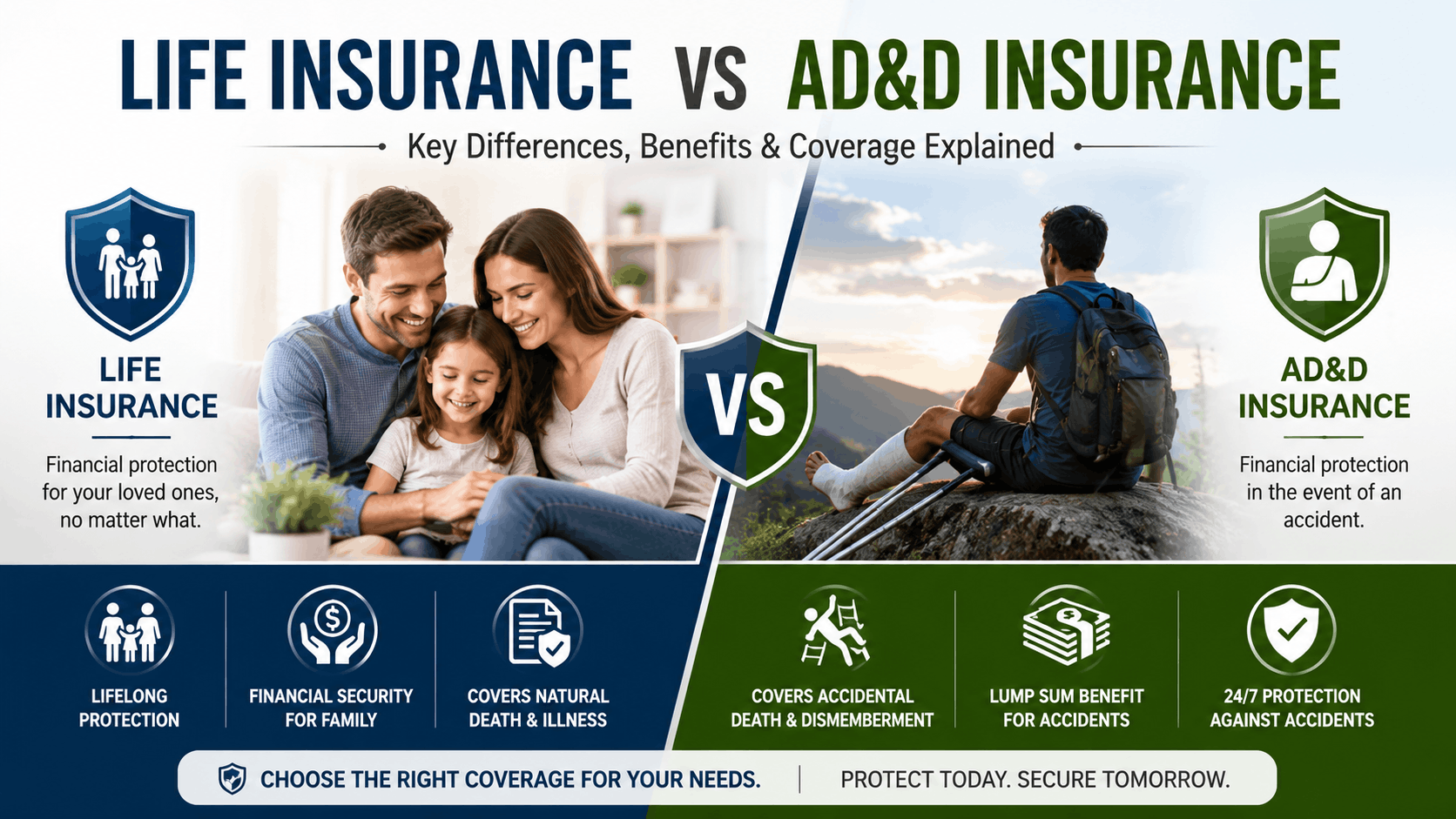
  • Life Insurance vs AD&D Insurance: Key Differences, Benefits & Coverage Explained

    Life Insurance vs AD&D Insurance: Key Differences, Benefits & Coverage Explained
    Insurance Education

    Life Insurance vs AD&D Insurance: What’s the Difference?

    Both policies can provide financial benefits after a covered event, but they protect your family in very different ways. This guide explains the key differences in plain language.

    • Clear coverage comparison
    • Real-life examples
    • Practical selection guidance
    Life Insurance vs AD&D Insurance: Key Differences, Benefits & Coverage Explained

    When it comes to protecting your family’s financial future, insurance is one of the most important investments you can make. However, many people get confused when comparing Life Insurance vs AD&D Insurance because both policies provide financial benefits after a covered event.

    At first glance, they may seem similar. After all, both are designed to provide money to your loved ones when something unexpected happens. But the reality is that these two types of coverage serve very different purposes.

    Understanding the difference between life insurance and accidental death and dismemberment insurance can help you make smarter financial decisions and avoid gaps in coverage that could leave your family vulnerable.

    At BenefitsBroker.US, we often hear questions like these. Let’s break everything down in simple terms.

    Common questions families ask

    • Is AD&D insurance the same as life insurance?
    • Do I need both policies?
    • Which one offers better protection?
    • Is AD&D insurance enough for my family?

    What Is Life Insurance?

    Life insurance is a contract between you and an insurance company. In exchange for regular premium payments, the insurer agrees to provide a death benefit to your beneficiaries if you pass away while the policy is active.

    The money can help your family:

    • Pay household expenses
    • Cover mortgage payments
    • Handle funeral costs
    • Pay off debts
    • Replace lost income
    • Fund children’s education
    Broad protection

    The biggest advantage of life insurance is that it covers most causes of death, including illness, disease, natural causes, and accidents.

    For a deeper understanding of coverage options, visit our guide on life insurance coverage options.

    What Is AD&D Insurance?

    AD&D stands for Accidental Death and Dismemberment Insurance. Unlike traditional life insurance, AD&D insurance only pays benefits when death or serious injury results from a covered accident.

    Examples may include:

    • Car accidents
    • Workplace accidents
    • Falls
    • Certain transportation accidents
    • Severe accidental injuries

    Partial benefits may apply to:

    • Loss of a hand
    • Loss of a foot
    • Loss of eyesight
    • Loss of hearing
    • Paralysis
    Important limitation: If someone dies from cancer, heart disease, stroke, or another illness, AD&D insurance typically does not provide coverage.

    Life Insurance vs AD&D Insurance: Quick Comparison

    The table below shows the main differences at a glance.

    Feature Life Insurance AD&D Insurance
    Covers natural deathYesNo
    Covers illness-related deathYesNo
    Covers accidental deathYesYes
    Covers loss of limbsUsually noYes
    Cash value optionsAvailable in some policiesNo
    CostHigherLower
    Coverage scopeBroadLimited
    Best usePrimary protectionSupplemental protection

    The Biggest Difference Most People Miss

    When comparing Life Insurance vs AD&D Insurance, many people focus on monthly premiums. AD&D insurance is often cheaper, which makes it appealing. But price alone shouldn’t determine your decision.

    Which policy is more likely to protect your family when they need financial support the most?

    Most deaths occur because of illnesses, chronic conditions, or natural causes—not accidents. That’s why financial professionals typically recommend life insurance as the foundation of a family’s protection strategy.

    AD&D insurance is valuable, but it’s usually designed to supplement life insurance rather than replace it.

    How Life Insurance Protects Your Family

    Imagine you’re the primary income earner in your household. If something happened to you tomorrow, would your family be able to:

    • Continue paying the mortgage?
    • Cover monthly bills?
    • Afford college tuition?
    • Maintain their current lifestyle?

    Life insurance helps answer those questions by providing financial stability during an incredibly difficult time. Many families use life insurance proceeds to bridge the gap between losing a loved one and adjusting to a new financial reality.

    How AD&D Insurance Works in Real Life

    Let’s look at two simple examples.

    Scenario 1

    Accidental Death

    John is involved in a fatal car accident.

    Result
    • Life insurance pays the death benefit.
    • AD&D insurance may also pay an accidental death benefit.
    Scenario 2

    Death from Illness

    John passes away after a battle with cancer.

    Result
    • Life insurance pays the death benefit.
    • AD&D insurance generally does not pay.

    This illustrates why understanding Life Insurance vs AD&D Insurance is so important.

    Advantages of Each Coverage Type

    Life Insurance

    Key benefits

    • Broad coverage
    • Income replacement
    • Debt protection
    • Estate planning benefits
    • Children’s education funding
    • Long-term financial security
    • Cash value growth in permanent policies

    Because of its flexibility, life insurance is often considered essential for families with financial dependents.

    AD&D Insurance

    Key benefits

    • Lower premiums
    • Additional accident coverage
    • Protection against severe injuries
    • Employer-sponsored options
    • Supplemental financial security

    People working in physically demanding jobs often appreciate the extra protection AD&D insurance can provide.

    Detailed Comparison Table

    Category Life Insurance AD&D Insurance
    Main purposeFamily financial protectionAccident-specific protection
    Coverage scopeBroadLimited
    Covers illnessYesNo
    Covers natural causesYesNo
    Covers accidentsYesYes
    Covers dismembermentUsually noYes
    Long-term protectionExcellentLimited
    Premium costHigherLower
    Cash value featureAvailable in some plansNot available

    Should You Choose Life Insurance or AD&D Insurance?

    The answer depends on your goals, responsibilities, and existing coverage.

    Life insurance may be ideal if:
    • You have children
    • You have a spouse who depends on your income
    • You own a home
    • You have outstanding debt
    • You want comprehensive protection
    AD&D insurance may make sense if:
    • You already have life insurance
    • You want additional accident protection
    • Your employer offers affordable coverage
    • You work in a higher-risk occupation

    For many families, the best solution is not choosing one over the other. Instead, it’s using both strategically.

    Can You Have Both Policies?

    Absolutely. Many people combine life insurance with AD&D coverage to create a stronger financial safety net.

    1
    Life Insurance

    Your primary layer of broad family protection.

    2
    AD&D Insurance

    An additional layer designed specifically for accidents.

    Together, they can provide broader protection and greater peace of mind.

    Why trust BenefitsBroker.US?

    Clear guidance for important insurance decisions

    At BenefitsBroker.US, we understand that insurance decisions can feel overwhelming. Choosing the right policy is not just about comparing premiums—it is about protecting the people who matter most.

    Our content is designed to simplify complex insurance topics using clear, practical information that consumers can actually understand. We focus on helping individuals and families make informed decisions based on real-world insurance principles and industry best practices.

    While policy details vary by provider, our goal is to provide trustworthy guidance that helps you confidently evaluate your coverage options and financial protection needs.

    Final Thoughts on Life Insurance vs AD&D Insurance

    When evaluating Life Insurance vs AD&D Insurance, the biggest difference comes down to coverage.

    Life insurance protects your family from a broad range of risks, including illness, disease, natural causes, and accidents. AD&D insurance focuses specifically on accidental death and certain serious injuries.

    For most people, life insurance should serve as the foundation of their financial protection plan. AD&D insurance can then be added as supplemental coverage to strengthen protection against accident-related risks.

    The right choice depends on your family situation, financial responsibilities, and long-term goals. If you’re unsure which coverage option is right for you, learning more about types of life insurance policies can be a great place to start.

    Ready to protect your family’s future?

    Choosing insurance does not have to be complicated.

    Whether you are exploring your first policy, reviewing existing coverage, or comparing Life Insurance vs AD&D Insurance, the experts at BenefitsBroker.US are here to help. Get personalized guidance and find the coverage that fits your family’s needs.

    Contact Our Team
  • Life Insurance After a Stroke: Can You Still Qualify?

    Can You Get Approved for Life Insurance After a Stroke?

    Life Insurance Guidance

    Can You Get Approved for Life Insurance After a Stroke?

    A stroke does not automatically disqualify you from life insurance. Approval usually depends on the type of event, time since it happened, recovery, and how well related health risks are controlled.

    Life Insurance After a Stroke: The Real Picture

    If you or someone you love has had a stroke, life insurance probably isn’t the first thing on your mind — recovery is. But at some point, the question creeps in: can you even get coverage anymore? It’s a fair worry. A stroke is a serious medical event, and it’s natural to assume insurers will take one look at your file and slam the door shut.

    Here’s the more hopeful truth: a stroke doesn’t automatically disqualify you from life insurance. It complicates things, sure — expect more questions, more paperwork, and probably a higher premium than you’d have paid before. But plenty of stroke survivors get approved every year, and the outcome usually comes down to a handful of specific factors rather than the diagnosis alone.

    At Benefits Broker.US, we work with stroke survivors regularly, and one thing we hear a lot is some version of “I figured I was uninsurable now.” Most of the time, that’s just not true. Let’s walk through what actually determines your eligibility, how underwriters think about strokes specifically, and what you can do to put your strongest application forward.

    Why Stroke History Doesn’t Mean Automatic Decline

    Underwriters don’t treat “had a stroke” as a single category. They’re looking at the specific details of your event and, just as importantly, what’s happened since. A stroke that occurred five years ago with a full recovery and well-controlled blood pressure looks completely different on paper than one that happened three months ago with ongoing complications — even though both technically count as “a stroke” on an application.

    • Whether it was a TIA, a mini-stroke with no lasting damage, or a full CVA with potential permanent effects.
    • How much time has passed since the event without any recurrence.
    • How complete your recovery has been, physically and cognitively.
    • Whether related conditions such as high blood pressure, high cholesterol, and diabetes are under control.
    • Your overall health profile, including smoking status, weight, and lifestyle.
    Time and stability are your two best friends. The longer you go without another event, and the more consistently you manage your risk factors, the better your odds may look to an underwriter.

    TIA vs. Full Stroke: Why the Distinction Matters So Much

    If there’s one thing worth understanding clearly before you apply, it’s this. A TIA, often called a mini-stroke, is temporary — symptoms resolve and there’s no lasting brain damage. A full stroke, or CVA, happens when blood flow to part of the brain is actually blocked or interrupted, and it can leave lasting effects.

    Insurers treat these very differently. TIAs are generally viewed as a warning sign rather than a disqualifying event, and many carriers will consider coverage within three to six months of a single TIA with full recovery. A full CVA is taken more seriously, often triggering postponement periods of six months to a year or longer, especially for hemorrhagic strokes.

    If you’re also weighing your broader health coverage needs while you sort this out, it’s worth reviewing your health insurance options at the same time. Staying consistently covered and keeping up with follow-up care can help your life insurance case later because it shows a documented pattern of managing your health.

    How Stroke Type Can Affect the Underwriting Path

    Stroke Type Typical Waiting Period General Underwriting Outlook
    TIA (mini-stroke) 3 to 6 months Often treated as a warning sign rather than a major risk if recovery is complete.
    Ischemic stroke (CVA) 6 to 12 months More scrutiny; outcome depends heavily on recovery and risk factor control.
    Hemorrhagic stroke 12 months or longer Most cautious category; specialist carriers often needed.
    Multiple strokes or TIAs Case-by-case, often longer Harder to place; guaranteed issue may be the realistic starting point.

    These are general industry patterns, not promises. Every insurer sets its own guidelines, and your recovery, age, and other conditions will shape the actual outcome.

    What Actually Moves the Needle on Your Application

    If you’re getting ready to apply, here’s where the real leverage is. A few things consistently make the biggest difference in how favorably underwriters view a stroke history:

    Blood pressure control

    This might be the single most influential factor. Consistently keeping your blood pressure in a healthy range can meaningfully improve your rate class, while poorly controlled hypertension can sink an application fast.

    Time since the event

    Crossing the one-year mark without recurrence opens up noticeably more options. Two to five years out, with a clean record, often unlocks standard underwriting from mainstream carriers.

    Documented recovery

    Cognitive and physical independence — being able to manage daily life without assistance — works strongly in your favor.

    Medication compliance

    Knowing your medications, taking them consistently, and being able to speak to your treatment plan signals to an underwriter that you’re actively managing your risk.

    Lifestyle factors

    Quitting smoking, maintaining a healthy weight, and staying active all show up favorably, even though none of them undo the stroke itself.

    None of these factors work alone — underwriters are building a complete picture. Someone with a recent stroke but excellent risk factor control might still land a reasonable rate, while someone further out from their event but with uncontrolled blood pressure could face a tougher review.

    Your Realistic Policy Options After a Stroke

    Policy Type Best Fit For Worth Knowing
    Fully underwritten term life Stable recovery and more time since the event. Requires a medical exam; usually the most affordable if you qualify.
    Fully underwritten whole life Long-term planning with a solid health history. Costs more than term, but builds cash value over time.
    Guaranteed issue life Recent strokes or harder-to-place health profiles. No health questions, but lower coverage caps and a graded payout period.
    Group or employer life insurance Quick coverage without individual underwriting. Usually ends if you leave your job; good as a supplement, not a primary plan.

    Mistakes That Make This Harder Than It Needs to Be

    We see the same avoidable missteps come up again and again with stroke-related applications. Steering clear of these alone can change your outcome:

    • Applying too soon, before insurers have enough time to see that your recovery is holding steady.
    • Showing up to the medical exam without knowing your medications or dosages, which can read as poor health management even if it isn’t.
    • Applying to just one company and assuming that result speaks for every insurer, when guidelines vary enormously from carrier to carrier.
    • Leaving out details about the stroke or related conditions, hoping they won’t surface — they almost always do through medical records.
    • Giving up after one decline instead of trying a carrier that specializes in higher-risk or cardiovascular cases.

    Getting Your Application in the Best Possible Shape

    A bit of preparation goes a long way here. Before you apply, it helps to pull together:

    • The exact date of your stroke or TIA, plus whether it was a single event or one of several.
    • Diagnostic results such as MRI, CT scan, EKG, or carotid ultrasound findings, if available.
    • A clear record of your current medications and how consistently you’ve taken them.
    • Recent blood pressure readings, ideally showing a few months of stable, well-controlled numbers.
    • Notes from your most recent neurology or follow-up appointment.

    Once you’ve got that together, the smartest next move is usually getting an informal read from a few different carriers before submitting a full application anywhere. Stroke underwriting varies a lot from one company to the next, and going in blind to a single insurer means you might never know if another carrier would have rated you two or three tables better.

    Benefits Broker.US can walk through your specific case and tell you honestly which carriers are likely to treat your situation favorably before you commit to anything.

    If You’ve Already Been Declined, You Still Have Options

    A decline from one company is genuinely not the end of the road, even though it can feel that way in the moment. Underwriting guidelines for stroke history differ enormously between insurers. Some specialize in cardiovascular and neurological risk and will look at your case far more favorably than a conservative, generalist carrier would.

    If you’ve already gotten a no, it’s worth asking the company for the specific reason behind the decision, since that tells you exactly what to address before trying again. From there, options include applying to a carrier that specializes in higher-risk cases, considering a guaranteed issue or simplified issue policy as a starting point, looking into group coverage through an employer, or simply waiting a bit longer while you build a stronger track record of stability and then reapplying.

    Frequently Asked Questions

    Can you actually get life insurance after having a stroke?

    Yes. It’s more involved than a standard application, and you’ll likely pay more, but plenty of stroke survivors get approved, especially once enough time has passed and recovery is documented.

    How long after a stroke do I need to wait before applying?

    It depends on the type. TIAs often open up coverage within three to six months, while full strokes typically involve a six-to-twelve-month waiting period, sometimes longer for hemorrhagic strokes.

    Will my premium be a lot higher after a stroke?

    Probably, at least initially. Rates can run anywhere from 50% above standard to several times higher depending on stroke type, recovery, and risk factor control, but they tend to improve as more stable time passes.

    What’s the difference between a TIA and a full stroke for insurance purposes?

    A TIA is temporary with no lasting damage and is generally viewed as a warning sign rather than a major event. A full stroke can cause permanent effects and gets a more cautious underwriting review.

    If one insurance company declines me, will they all decline me?

    No. Underwriting guidelines for stroke history vary widely between carriers, and a decline from one company says very little about how a different insurer, especially one that specializes in cardiovascular risk, might view the same case.

    Is guaranteed issue life insurance my only option after a recent stroke?

    It’s often the most realistic starting point soon after the event, but many stroke survivors become eligible for fully underwritten term or whole life coverage once more time has passed and recovery is well documented.

    Let’s Find Out What’s Actually Available to You

    Guessing your odds from general guidelines only gets you so far. The real answer comes from having your specific recovery, timeline, and health profile reviewed against what carriers are actually offering. Reach out to Benefits Broker.US today, and let’s find coverage that genuinely fits your situation — no assumptions, no unnecessary waiting around.

    Start With Your Situation
  • Life Insurance for Overweight People: 2026 Guide

    ● Life Insurance Guide · 2026

    Life Insurance for Overweight People: The Complete Guide

    Carrying extra weight doesn’t have to mean going without coverage, but it does change how insurers price and evaluate your application. Here’s exactly how underwriting works, what coverage costs by age and build, and how to land the lowest rate you qualify for.

    Get a Free Quote Comparison →

    At Benefits Broker Insurance, we compare quotes across dozens of carriers every week for applicants who’ve been told “no” or “too expensive” elsewhere, and the truth is usually more encouraging than people expect. This guide walks through how underwriting really works, what coverage costs at different ages and builds, which policy types fit best, and how to land the lowest rate you qualify for.

    Can You Be Denied Life Insurance for Being Overweight?

    This is the question most people ask first, and the honest answer is: rarely outright, but it depends on how the numbers add up. Insurers don’t reject applicants simply for being overweight; they reject (or heavily rate) applications where weight combines with other red flags:

    • Uncontrolled diabetes
    • Sleep apnea
    • High blood pressure
    • Heart disease
    • A very high BMI (typically above 40–45, depending on the carrier)

    For most overweight applicants, the outcome isn’t denial. It’s a lower rate class. Instead of “Preferred Plus,” you might land in “Standard” or a rated “Table B/C” class, which raises the premium without shutting you out of coverage. If your BMI is extreme or your health profile has several complicating factors, some traditional carriers will decline, but that’s exactly where alternative products (covered below) come in.

    💬

    Not sure where you’d land? Benefits Broker Insurance can check your build against multiple carriers in minutes.

    Get a free quote comparison →

    How Underwriters Actually Evaluate Weight

    Every carrier uses a build chart, a table cross-referencing height and weight against age to assign a rate class. A few things matter as much as the number on the scale:

    • BMI relative to height, not total pounds alone
    • Waist-to-hip ratio on some applications
    • Blood pressure and cholesterol, which often move with weight
    • A1C and glucose levels, since weight and diabetes risk are closely linked
    • Whether weight is stable, trending down, or trending up
    • Tobacco use, which stacks with weight to worsen pricing

    Two people at the same weight can get very different offers if one has clean bloodwork and a stable weight history, while the other has borderline glucose readings and rising blood pressure. This is exactly why the Benefits Broker Insurance team runs your profile against multiple carriers’ build charts rather than assuming one company’s chart tells the whole story.

    Sample Rate-Class Impact by BMI Band (illustrative)

    BMI RangeTypical Rate Class*Relative Premium Impact
    18.5–24.9Preferred Plus / PreferredBaseline
    25–29.9Preferred / Standard Plus+5–15%
    30–34.9Standard+20–40%
    35–39.9Table B–D (rated)+50–100%
    40+Table E+ or decline (case-by-case)+100%+ or referred to guaranteed issue

    *Illustrative only. Actual classification depends on the carrier’s build chart, blood pressure, glucose, family history, and other factors combined with BMI. Talk to a Benefits Broker Insurance agent for numbers specific to your profile.


    Life Insurance for Overweight Individuals, by Situation

    Overweight Men vs. Overweight Women

    Build charts are typically sex-specific because average frame and mortality risk curves differ. A man and woman of the same height and weight can land in different rate classes. Insurers generally use separate BMI-to-rate-class tables for life insurance for overweight male and life insurance for overweight female applicants, so a number you saw quoted online may not apply directly to you.

    Overweight Applicants with Diabetes

    Life insurance for overweight diabetics is one of the more nuanced categories. Type 2 diabetes that’s diet-controlled or managed with metformin, with a stable A1C (generally under 7–7.5%), can still qualify for reasonably competitive rates. Insulin-dependent diabetes, frequent hospitalizations, or complications (neuropathy, kidney involvement) push pricing higher or move the case toward simplified-issue or guaranteed-issue products.

    Overweight Applicants Not on Medication

    If you’re overweight but otherwise healthy (normal blood pressure, no diabetes diagnosis, no medications), you’re in the strongest position to negotiate a favorable class. This profile is often underrated: life insurance for overweight applicants on no medication frequently qualifies for Standard or even Preferred rates if bloodwork and the medical exam come back clean, since weight alone (without comorbidities) is a smaller mortality factor than most applicants assume.

    Older Overweight Applicants (Age 50+)

    Age compounds weight-related risk in underwriting math, but coverage remains widely available:

    • A $250,000 policy for a 68-year-old overweight male is typically priced as a shorter term policy (10-year term is often the maximum available at that age) or a permanent policy, since longer term lengths become limited or unavailable past the late 60s.
    • The average life insurance cost for a 50-year-old overweight woman depends heavily on which rate class she lands in: the spread between Standard and a rated Table class can roughly double the premium for the same $250,000–$500,000 face amount.
    📋

    Get an age- and build-specific quote for your exact profile.

    Compare real numbers with Benefits Broker Insurance →

    UK Applicants

    For readers searching life insurance for overweight UK or life insurance for overweight male/female UK, the process is broadly similar to the US but runs through different underwriting bodies. UK insurers also use BMI bands, and applicants with an NHS-diagnosed weight-related condition (like Type 2 diabetes or hypertension) should expect to disclose it during application. Searches for cheapest life insurance for overweight people NHS typically refer to policies where underwriting draws on NHS GP records; most mainstream UK insurers request these regardless of an applicant’s weight.


    No-Medical-Exam Options

    Life insurance no medical exam for overweight applicants is a fast-growing category for people who want to skip bloodwork or a paramedical exam. These fall into two buckets:

    TypeHealth Questions?Typical Coverage CapSpeedRelative Cost
    Simplified issueQuestionnaire only, no exam~$250,000–$500,000Fast (days)Higher per $ of coverage
    Guaranteed issueNone~$5,000–$25,000FastestHighest per $ of coverage

    If you can qualify medically, a fully underwritten policy will almost always beat a no-exam policy on price for the same coverage amount. Benefits Broker Insurance can help you figure out which lane actually saves you money.

    Term vs. Whole Life Insurance for Overweight Applicants

    • Term life is the most cost-effective choice for most overweight applicants who are otherwise healthy; it delivers the largest death benefit per premium dollar and comes in 10, 20, or 30-year lengths (subject to age limits).
    • Whole life insurance for overweight applicants makes more sense for permanent needs: estate planning, final expenses, or coverage that can’t lapse. It costs significantly more than term for the same face amount, but weight-related rating has less relative impact since whole life premiums already price in lifetime risk.

    For applicants declined for term due to weight-related health issues, the best term life insurance companies for overweight applicants are often those known for more lenient build charts or table-shaving programs that reduce a rating over time as health markers improve.

    Life Insurance Rates for Overweight People: What Drives the Comparison

    When comparing life insurance rates for overweight people, the same $250,000 policy can vary by hundreds of dollars a year across carriers, because each company weighs BMI differently against blood pressure, cholesterol, and family history. A rate class that’s “Table D” at one insurer might be “Standard” at another for the identical applicant. This is why shopping multiple carriers, ideally through a broker who can run your build against several build charts at once, usually beats accepting the first quote you’re offered.

    How to Get the Best (Cheapest) Rate

    1. Get quotes from multiple carriers. Build charts vary enough that shopping around is the single biggest lever you control.
    2. Time your application around your health, not the calendar. If you’re actively losing weight, some carriers will let you re-apply or request a rate reconsideration at a lower BMI band.
    3. Control what you can before the exam. Blood pressure, glucose, and cholesterol often matter as much as the scale; getting these stable can move you up a full rate class.
    4. Ask about “table shaving” or “table reduction” programs, which lower a rated premium over consecutive years of on-time payment and stable health.
    5. Work with a broker, not a single-carrier agent. An independent broker like Benefits Broker Insurance can compare the best carriers for overweight applicants side by side.
    6. Don’t default to no-exam coverage unless you need speed or have already been declined, since it’s usually the most expensive way to buy the same death benefit.

    Frequently Asked Questions

    Can I be denied life insurance for being overweight?

    Outright denial is uncommon for moderate overweight status alone. Denials typically involve a very high BMI combined with other conditions like uncontrolled diabetes or heart disease. Most overweight applicants are approved at a higher rate class rather than declined.

    What’s the best life insurance for overweight applicants in 2025–2026?

    There’s no single “best” carrier for everyone. The right fit depends on your exact BMI, age, and health markers, since each company’s build chart treats the same profile differently. Comparing quotes across several term life insurers, which Benefits Broker Insurance does for you, is the most reliable way to find your lowest available rate.

    Is whole life insurance for overweight applicants more expensive than term?

    Yes, per dollar of coverage, whole life costs substantially more than term regardless of weight, but the relative impact of a weight-based rating is often smaller on whole life premiums than on term.

    Does losing weight lower my premium after I already have a policy?

    Some insurers offer reconsideration or table-shaving programs that can reduce your rate after sustained weight loss and stable health markers, though this varies by carrier and isn’t automatic.

    Ready to See Your Real Numbers?

    Every carrier weighs BMI, blood pressure, glucose, and family history a little differently, so your actual quote could be far better than a generic online estimate suggests.

    Get Your Free Quote from Benefits Broker Insurance →

    Benefits Broker Insurance · benefitsbroker.us

    This article is for general educational purposes and isn’t personalized insurance, financial, or medical advice. Rates, build charts, and underwriting rules vary by carrier and change over time. Get a personalized quote from a licensed agent or broker for numbers specific to your situation.

  • Indexed Universal Life (IUL) vs. Whole Life Insurance – Complete Guide

    Indexed Universal Life (IUL) vs. Whole Life Insurance – Complete Guide


    Indexed Universal Life (IUL) vs. Whole Life Insurance | Benefits Broker


    Choosing between Indexed Universal Life (IUL) and Whole Life insurance is more than just picking a policy—it is choosing a long-term capital strategy. While both provide lifelong permanent death benefit protection and tax-deferred equity growth, they manipulate equity accumulation, volatility mechanisms, and premium requirements in entirely contrasting ways.

    At Benefits Broker, we design permanent life coverage options around your risk appetite and legacy planning objectives. This guide unpacks the foundational engineering differences to help you determine which model fits your personal economy.

    The Core Differentiation Matrix

    Before diving into structural cash management mechanics, it helps to view how these two permanent structures compare across core transactional features:

    Feature Indexed Universal Life (IUL) Whole Life Insurance
    Premium Structure Flexible / Adjustable Fixed & Level (Guaranteed)
    Cash Value Growth Tied to market indices (e.g., S&P 500) Guaranteed fixed rate + Potential Dividends
    Growth Boundaries Subject to Caps, Participation Rates, and Floors Steady, linear guaranteed progression
    Downside Protection 0% Market Floor Protection (No index losses) Complete immunity to market cycles
    Policy Management Active monitoring required (Avoid lapse risk) Hands-off / Set-it-and-forget-it

    Understanding Whole Life Insurance: The Path of Guarantees

    Whole Life Insurance operates as the most predictable permanent model. When you open a policy, your premium requirements, cash growth metrics, and death benefits are locked in for life. The contract cannot change, regardless of how macroeconomic environments fluctuate.

    • Predictable Growth: Your cash values grow at a contractually guaranteed interest rate set by the insurance provider.
    • Mutual Dividend Upside: If your policy is built with a mutual insurance carrier, you can receive annual policy dividends. These are not guaranteed but can be used to purchase paid-up additions, further accelerating your tax-advantaged cash value growth.
    • Low Administrative Maintenance: Because the cost structures are fixed at inception, the policy owner does not need to actively manage or rebalance allocations over time.

    Understanding IUL Cash Value Mechanics

    An Indexed Universal Life (IUL) policy provides a completely different cash accumulation framework. Instead of earning a flat, slow internal rate of return, your cash value is linked directly to an external equity index, such as the S&P 500 or Nasdaq-100, without placing your principal directly into market equities.

    Important Structural Dynamic: While your potential upside is linked to equity markets, you are protected by a 0% floor. If the stock index crashes by 20%, your policy value remains completely flat rather than dropping. However, your growth is limited by a performance cap (often between 8% and 12%).

    The Rising Cost of Insurance (COI) Matrix

    To successfully leverage an IUL, you must understand the underlying engine. An IUL is built on a universal life chassis, meaning it is fundamentally annually renewable term insurance wrapped inside a cash value accumulation shell. As the insured individual grows older, the absolute cost to cover the net risk to the insurer climbs exponentially.

    IUL Policy Value Flow & Deductions
    Premium Allocation
    Policyowner deposits funds
    →
    Cash Value Account
    Central tracking account balance
    →
    Deducts RISING COI & Fees
    Credits Market Index Gains
    Capped Upside / 0% Floor

    If an IUL policy is underfunded during its early years, or if the market index enters extended flat periods where growth fails to outpace the internal expenses, the rising Cost of Insurance will begin eating away at the core cash balance. This is why IUL strategies require active management and precise structuring by a seasoned advisor.

    Strategic Alignment: Which Model Fits Your Plan?

    Choose Whole Life Insurance If:

    • You value absolute certainty, fixed monthly expenses, and fully guaranteed asset protection.
    • You want a clear, conservative permanent asset to anchor an estate plan or manage final expenses cleanly.
    • You prefer a hands-off asset that builds safe liquidity over time without requiring policy performance check-ins.

    Choose Indexed Universal Life (IUL) If:

    • You want to maximize upside cash growth potential to generate an alternative, tax-free supplemental retirement income stream via policy loans.
    • You demand premium payment flexibility, giving you the power to increase or decrease payments based on your cash flow.
    • You are comfortable actively tracking your policy value and working with an advisor to ensure it remains well-funded against rising internal charges.

    Formulate Your Capital Legacy Strategy

    Both Whole Life and IUL are highly effective wealth preservation structures when applied to the right financial problem. Choosing between them demands an objective calculation of your risk profile, capital liquidity needs, and multi-generational goals.

    At Benefits Broker, we help you clear the confusion surrounding complex premium structures, index caps, and internal policy charges to build an ironclad wealth foundation.

    Ready to Optimize Your Permanent Wealth Design?

    Schedule a clear, comprehensive analysis with our strategy team today to review custom illustrations and find your ideal fit.

    Contact Benefits Broker


  • Launching Your Career: How to Become a Life Insurance Agent in Florida

    Launching Your Career: How to Become a Life Insurance Agent in Florida

    How to Become a Life Insurance Agent in Florida | Career Guide

    The insurance market is positioned as one of the most resilient and profitable sectors for independent professionals and career changers alike. Becoming a licensed life insurance agent in Florida offers an accessible path to professional independence, a highly flexible schedule, and significant income potential through upfront commissions and recurring renewals.

    However, Florida’s regulatory landscape is strictly governed by the Florida Department of Financial Services (DFS). To protect consumers, the state enforces clear, sequential prerequisites that every applicant must complete.

    At Benefits Broker, we recognize that navigating state compliance can feel overwhelming when you are trying to jumpstart a business. This comprehensive, in-depth guide covers all licensing options, legal requirements, pathways, and actionable steps required to launch your life insurance career in the Sunshine State.

    Step 1: Understand Your License Options (Lines of Authority)

    Before purchasing any study guides or registering for courses, you must choose your specific license type. Florida categorizes insurance producers using specific numerical designations. For life insurance, you have two primary resident career pathways:

    1. The 2-14 Life & Variable Annuity License

    This line of authority restricts you strictly to life-based financial products. With a 2-14 license, you are legally permitted to market and write:

    • Term Life, Whole Life, and Universal Life Insurance policies.
    • Fixed-Dollar Annuities and tax-deferred growth vehicles.
    • Variable Annuities (Note: Selling variable products also requires passing the federal FINRA Series 6 or Series 7 securities exams).

    2. The 2-15 Life, Health & Variable Annuity License (Highly Recommended)

    The 2-15 license is the gold standard for comprehensive financial professionals. It encompasses everything included in the 2-14 license, while expanding your book of business to include health insurance lines:

    • All traditional and permanent Life Insurance and Annuity products.
    • Individual & Group Health Insurance, including policies available through the Affordable Care Act (ACA/Obamacare) marketplace.
    • Medicare Supplements, Medicare Advantage, and Long-Term Care (LTC) products.
    • Disability Income Insurance and critical illness riders.
    Benefits Broker Tip: We highly recommend pursuing the 2-15 license. The initial investment in study hours is only slightly higher, but the ability to cross-sell health and Medicare products significantly boosts your client retention and annual income.

    Step 2: Verify Your General Eligibility Prerequisites

    The Florida Department of Financial Services enforces basic baseline rules for compliance. To qualify for a resident license, you must fulfill the following:

    • Age: You must be a natural person at least 18 years of age.
    • Residency: You must be a bona fide resident of Florida.
    • Legal Status: You must be a United States citizen or a legal alien possessing valid work authorization from the U.S. Citizenship and Immigration Services (USCIS).
    • Professional Restrictions: You cannot be an active employee of the U.S. Department of Veterans Affairs, a practicing funeral director, or a direct disposer (due to anti-coercion laws regarding final expense policies).

    Step 3: Complete Your State-Approved Pre-Licensing Education

    Florida operates as a forced progression state. This means you must complete a structured, state-approved educational course sequentially before you are legally permitted to sit for the official state exam.

    License Type Required Pre-Licensing Hours Includes Mandatory Ethics Content Certificate Validity Window
    2-14 Life Only 30 Hours 3 Hours 4 Years
    2-15 Life & Health 60 Hours 3 Hours 4 Years

    Essential Course Mechanics to Note:

    • Forced Progression Tracking: Online portals automatically lock subsequent chapters until you review every page and pass the corresponding end-of-chapter quiz with a minimum score of 70%.
    • State Study Manual Requirement: Florida law mandates that you independently purchase the official Florida Life, Health, and Variable Annuity Study Manual. This text acts as the foundational basis for all state exam questions.
    • Automatic Reporting: Once you clear your final pre-licensing exam with a 70% or higher and file your digital student attestation, your education provider will automatically report your certificate to the DFS within 2 business days.

    Step 4: Submit Your State Application and Fingerprints

    Do not wait to pass your state exam before opening your regulatory profile. You should apply for your license and submit your background screening concurrently while finishing your studies to minimize processing delays.

    1. File via MyProfile

    Create an account on the Florida DFS online application framework via the MyProfile portal. Complete the resident application wizard. The initial application fee is $50.00 (plus a $5.00 fee per designated line of authority).

    2. Undergo Mandatory Background Fingerprinting

    Florida requires a criminal background check for all incoming insurance professionals. You must schedule a digital fingerprinting appointment through the state’s authorized vendor, IdentoGO. This fee runs approximately $45.00 to $50.00 depending on the regional site location.

    Step 5: Schedule and Pass the Florida State Exam

    Florida state insurance testing is administered exclusively by Pearson VUE.

    Testing Timeline Blueprint
    Pre-Licensing
    Complete 30 or 60 Hour course program
    →
    Registration
    Create profile at PearsonVUE.com
    →
    Payment
    Pay the required $44 examination fee
    →
    Passing
    Score 70% or higher on test modules
    • Exam Fee: $44.00 per attempt.
    • Testing Format: The test must be taken in person at an authorized physical Pearson VUE testing site.
    • Passing Threshold: You must achieve a score of 70% or greater.
    • Strict Limit on Retakes: Florida sets a hard limitation of five (5) examination attempts for the same exam type within any rolling 12-month window.

    Step 6: Affiliate with an Insurance Agency or Carrier

    Passing your exam grants you an approved license, but you cannot legally sell, solicit, or negotiate insurance coverage until you are appointed. An appointment is a formal filing submitted to the state by an insurance agency or company authorizing you to represent them.

    As a new agent, you have three primary operational pathways:

    • Independent Agent (Broker): You align with an Independent Marketing Organization (IMO) or a General Agency. This allows you to contract with dozens of different carriers simultaneously, providing the best fit for your client.
    • Captive Agent: You work exclusively for a single brand name carrier. They often provide you with office space, standard marketing leads, and a base salary or stipend, but you can only write policies owned by that specific company.
    • Direct Agency Employee: Joining established local firms allows you to refine your client management, learn advanced portfolio design, and build up capital under direct corporate mentorship.

    Step 7: Maintain Compliance (Continuing Education)

    Your Florida license is a permanent professional asset, but keeping it active requires ongoing education.

    • Continuing Education (CE) Requirement: You must complete 24 hours of CE every two years (lexicographically trailing your birth month).
    • Ethics Component: Out of those 24 hours, at least 5 hours must be dedicated specifically to a state-approved Law and Ethics update course tailored to your line of authority.
    • Failure to Comply Penalty: Missing your CE deadlines will result in the immediate cancellation of all your active carrier appointments, stopping your capability to generate new income or collect recurring book commissions.

    Build Your Insurance Business with Confidence

    Transitioning into the life insurance industry is one of the most rewarding career moves you can make in Florida’s rapidly expanding economy. By following this regulatory roadmap methodically, you ensure a clean application process free of legal or administrative delays.

    At Benefits Broker, we understand that launching a business or protecting your personal family legacy requires navigating complex financial environments. We are committed to empowering professionals and clients alike with clear, actionable strategy.

    Ready to Partner with an Industry Leader?

    Whether you are mapping an estate plan or looking to optimize corporate coverage, Benefits Broker is here to lead the way.

    Contact Benefits Broker
  • How Are Survivorship Life Insurance Policies Helpful in Estate Planning

    How Are Survivorship Life Insurance Policies Helpful in Estate Planning

    How Are Survivorship Life Insurance Policies Helpful in Estate Planning?

    When planning the future transfer of wealth, the primary objective is rarely just about who receives your assets. For high-net-worth families, complex modern estates, and business owners, the real challenges lie in mitigating high taxation, keeping illiquid family assets intact, and avoiding forced liquidation.

    For estate planning, a survivorship life insurance policy—commonly known as a “second-to-die” policy—stands out as a powerful financial vehicle. Unlike traditional life insurance policies designed to replace income upon the death of a primary provider, a survivorship policy is custom-built for legacy preservation.

    At Benefits Broker, we specialize in helping families protect what matters most with clarity and strategic foresight. This comprehensive guide explores exactly how second-to-die permanent life insurance works and the key reasons it is highly beneficial to an estate plan.

    What is a Survivorship Life Insurance Policy?

    The “Second-to-Die” Mechanism Explained

    A survivorship life insurance policy covers two individuals under a single contract—most commonly spouses. The fundamental distinction of this coverage is its payout schedule: the policy does not pay a death benefit when the first insured individual passes away. Instead, the cash benefit is deferred until the second insured person dies.

    During the period between the first and second deaths, the surviving spouse can often continue to maintain the policy, and the cash value within a permanent structure (like whole life or universal life) continues to grow tax-deferred.

    Survivorship vs. Individual and First-to-Die Policies

    Policy Feature Individual Life Insurance First-to-Die Joint Insurance Survivorship (Second-to-Die)
    Number of Insureds One person Two or more people Two people (usually spouses)
    Payout Trigger Death of the single insured Death of the first insured person Death of the last surviving insured
    Primary Financial Goal Income replacement; debt payoff; immediate family support Immediate liquidity for the surviving partner; buy-sell agreements Generational wealth transfer; estate tax funding; trust capitalization
    Relative Premium Cost Standard baseline cost Higher (payout occurs sooner) Lower (payout is deferred longer)

    Core Benefits of Survivorship Policies in Estate Planning

    1. Providing Immediate Liquidity to Settle the Estate

    When an individual passes away with a substantial estate, their wealth is frequently tied up in illiquid configurations:

    • Real estate holdings (such as commercial properties or a family ranch)
    • Fine art, jewelry, and private collections
    • Ownership shares in closely held or private businesses

    Unfortunately, final administration costs, outstanding debts, legal fees, and immediate probate costs do not wait for assets to sell. A survivorship policy delivers a tax-free lump sum precisely when the estate undergoes settlement following the second spouse’s passing. This sudden influx of liquidity keeps executors from being forced to execute a “fire sale” on valuable family holdings just to generate operational cash.

    2. Mitigating and Funding Federal Estate Taxes

    Under current federal tax laws, the unlimited marital deduction allows individuals to transfer an unlimited amount of assets to their surviving spouse tax-free upon death. Because of this rule, federal estate tax liabilities are rarely triggered after the first spouse dies.

    The real tax cliff occurs when the second spouse passes away and the assets are passed to the next generation (children or other heirs).

    Tax Transition Timeline
    Spouse 1 Passes
    Assets transfer to Spouse 2 tax-free via Marital Deduction
    →
    Spouse 2 Passes
    Estate Tax Triggered on amounts exceeding exemption limits
    →
    Policy Pays Out
    Tax-free lump sum settles IRS bill instantly without asset sales

    For large estates that exceed the federal estate tax exemption thresholds, a second-to-die policy pays out at the exact moment those federal taxes come due. It provides the exact dollars needed to settle the IRS bill without draining the core value of the inheritance.

    3. Maximizing the Value of the Generational Wealth Transfer

    Because the ultimate death benefit is legally structured to pay out directly to your named beneficiaries or a designated entity, it bypasses the delays and costs of probate court entirely. The capital transfers cleanly, swiftly, and with minimal friction, guaranteeing that the true financial footprint of your legacy is preserved intact for children and grandchildren.

    Strategic Uses for Complex Estates

    Equalizing Inheritances Among Multiple Heirs

    A common dilemma in modern estate planning occurs when a primary asset—such as a family home or a running business—cannot easily or fairly be split among several heirs. For instance, if one child plans to step in and run the family business, leaving the business shares entirely to them seems logical, but it leaves other siblings empty-handed.

    A survivorship policy resolves this imbalance perfectly. The business-focused heir inherits the operational asset, while the second-to-die policy’s tax-free cash payout provides an equivalent, liquid inheritance to the other children.

    Preserving Family Businesses and Illiquid Real Estate

    According to industry succession data, a staggering 70% of family-owned businesses do not survive the transition to the second generation, often due to liquidity crunches or estate taxes. By funding the business transition with a second-to-die life insurance policy, the company retains its working capital, allowing operations to continue uninterrupted through the leadership transition.

    Funding Special Needs Trusts for Lifetime Care

    Families caring for a dependent child or adult with special needs must establish long-term safeguards that extend beyond their own lifetimes. A survivorship policy is an excellent tool for funding a Special Needs Trust (SNT). Since the care requirements intensify precisely when both parents are no longer around to provide direct support, the second-to-die mechanism guarantees that the trust is capitalized at the exact moment the child needs it most.

    Fulfilling Charitable Giving and Legacy Goals

    If you have philanthropic aspirations, a survivorship policy can be integrated into your estate plan to clear a path for major charitable distributions. By naming a foundation or a donor-advised fund as the primary beneficiary, couples can leave an impactful, lasting legacy to their chosen cause without diminishing the private assets set aside for their children.

    Advanced Strategy: Combining Survivorship Life with an ILIT

    While a survivorship policy is naturally powerful, simply owning the policy in your own name means the eventual payout could technically be counted as part of your gross estate—potentially increasing your estate tax liability. To counter this, estate planning attorneys and brokers frequently pair a second-to-die policy with an Irrevocable Life Insurance Trust (ILIT).

    • Setting up the Trust: The ILIT is established as an independent legal entity that buys and owns the survivorship insurance policy.
    • Paying Premiums: The parents make annual exclusions gifts to the trust, which the trustee uses to pay the policy premiums.
    • Removing Death Benefits from Taxation: Because the policy is owned entirely by the trust and not by either individual, the death benefit payout is kept completely outside the taxable estate.
    • Distribution: Upon the second parent’s death, the tax-free insurance proceeds land directly inside the ILIT. The trustee can then use those liquid funds to purchase assets from the estate or loan money to the estate to pay taxes, safely delivering the leftover funds to the heirs.

    Financial and Underwriting Advantages

    Beyond its structural benefits in an estate plan, a survivorship policy offers distinct financial and medical underwriting advantages over individual life insurance solutions:

    • Lower Premium Costs: Because insurance companies calculate premium pricing based on a joint life expectancy, the statistical risk of paying out is stretched out much further into the future. This deferred risk translates into significantly lower premiums than purchasing two separate permanent individual life insurance policies with identical death benefits.
    • Relaxed Underwriting Guidelines: Underwriting a second-to-die policy places a heavy focus on the healthier of the two individuals. If one spouse has a pre-existing medical condition or unideal health status that would make individual permanent coverage prohibitively expensive or altogether unavailable, they can still secure coverage under a joint survivorship policy as long as the other spouse is reasonably healthy.

    Potential Drawbacks to Consider Before Buying

    • No Financial Relief for the First Surviving Spouse: If the surviving spouse relies heavily on joint income streams that vanish when the first partner dies, a survivorship policy provides zero immediate support. Supplementary individual or term coverage may still be required to cover that initial transitional period.
    • Divorce Complications: Because these permanent policies are structurally joint and designed to stay intact until the second death, dividing or unwinding a survivorship policy during a divorce proceeding can be legally challenging, often requiring policy splits or surrender actions that damage the cash value structure.

    Is a Second-to-Die Policy Right for Your Estate Plan?

    Determining whether a survivorship policy matches your legacy goals depends largely on the size of your asset portfolio, the liquidity of your current investments, and the specific needs of your beneficiaries. If your long-term focus centers on mitigating estate tax liabilities, preserving a family enterprise, protecting a vulnerable dependent, or maximizing a multi-generational inheritance, this vehicle offers unmatched efficiency.

    At Benefits Broker, we understand that navigating estate planning, trusts, and permanent life options can feel overwhelming. Our mission is to strip away the confusion and provide transparent, personalized insurance guidance tailored to your family’s exact roadmap.

    Ready to secure your family’s future legacy with confidence?

    Connect with an experienced professional today at BenefitsBroker.us or call us at +1 (863) 213-0615 to build an estate strategy that stands the test of time.

    Contact Benefits Broker
  • Can You Get Life Insurance If You Have a Pre-Existing Condition?

    Can You Get Life Insurance If You Have a Pre-Existing Condition?

    The assumption that a chronic illness or a history of health issues automatically disqualifies you from securing financial protection is a common misconception. In reality, the insurance landscape in 2026 is highly specialized. Whether you are managing a common condition like hypertension or a more complex diagnosis, obtaining coverage is often a matter of matching your medical profile with the right carrier.

    Can You Get Life Insurance with a Pre-Existing Condition?

    The short answer is yes. While a medical history influences the underwriting process, it rarely results in an outright denial. Insurance carriers evaluate risk based on the severity of the condition, how well it is managed, and the specific type of policy you apply for.

    Modern underwriting uses sophisticated data to assess “stability.” If you can demonstrate that your condition is under control through medication or lifestyle, you may qualify for standard rates.

    What Qualifies as a Pre-Existing Condition?

    In the insurance industry, a pre-existing condition is any health issue you had or were treated for before applying for a new policy.

    Common Conditions and Their Impact

    • High Blood Pressure & Cholesterol: Usually results in standard rates if controlled.
    • Diabetes (Type 1 & 2): Premiums depend on A1C levels and age of diagnosis.
    • Mental Health: Anxiety and depression are common; insurers look for a history of stable treatment.
    • Heart Disease: Requires a longer “stability period” post-event (e.g., 1–2 years after a stint or surgery).

    Comparison of Insurance Types for Medical Conditions

    Choosing the right policy “bucket” is essential for approval. Below is a breakdown of how different products handle medical underwriting:

    Policy TypeMedical Exam Required?Best For…Approval Speed
    Traditional TermYesWell-managed, minor conditions2–6 Weeks
    Simplified IssueNo (Health Questions Only)Moderate health risks1–3 Days
    Guaranteed IssueNoSerious or terminal illnessesNear Instant
    Group LifeNoEmployees with any conditionInstant

    Types of Life Insurance Available

    If you are concerned about your medical history, it is important to understand which life insurance product offers the highest probability of acceptance for your specific situation.

    1. Traditional Term & Whole Life

    These offer the highest coverage amounts at the lowest costs. However, they require full disclosure of medical records and often a physical exam. These are ideal if your condition is documented as “stable” by your physician.

    2. Guaranteed Issue Life Insurance

    Often called “Final Expense” insurance, these policies ask zero health questions. You cannot be turned down. The trade-off is a lower death benefit (typically up to $25,000) and a “graded” waiting period before the full benefit is active.

    3. Simplified Issue Life Insurance

    This is a middle-ground option. You answer a few “big” health questions (e.g., “Have you been hospitalized in the last two years?”) but skip the blood work and physical. It is an excellent choice for those who want coverage quickly without a deep dive into their medical past.

    How Health Conditions Impact Your Premiums

    Your health history determines your Risk Class. This is the category insurers use to set your price.

    • Preferred: Excellent health; no significant history.
    • Standard: Average health; may have minor, well-controlled conditions.
    • Table Ratings (Substandard): For individuals with more significant health risks. Each “table” (A through P) adds a percentage—usually 25%—to the base premium.

    5 Tips to Improve Your Chances of Approval

    1. Maintain a “Stability Period”: Most carriers want to see 6 to 12 months of consistent health data before approving a policy for a chronic condition.
    2. Organize Your Records: Have your doctor’s contact info and a list of medications ready to speed up the Attending Physician Statement (APS) process.
    3. Optimize Lifestyle Factors: If you can’t change your diagnosis, you can improve your BMI or quit smoking to balance out the risk.
    4. Work with an Independent Broker: Independent agents have access to “underwriting guides” for dozens of companies and can find the one carrier that views your specific condition most favorably.
    5. Be Transparent: Honesty is vital. Misrepresenting your health can lead to a denied claim for your beneficiaries during the two-year contestability period.

    FAQ’s

    Q1. Can I be denied life insurance for a pre-existing condition?

    Yes, for traditional plans, if the condition is terminal or uncontrolled. However, Guaranteed Issue plans ensure you always have coverage options.

    Q2. What happens if I don’t disclose my medical history?

    If a claim is filed and the insurer discovers undisclosed health issues, they may void the policy and only return the premiums paid, leaving your family without the full death benefit.

    Q3. Is there a waiting period for payouts?

    Only on “Guaranteed Issue” policies. Most traditional plans cover you fully from the moment the first premium is paid and the policy is issued.

  • The Pros and Cons of Short-Term Health Insurance Plans

    The Pros and Cons of Short-Term Health Insurance Plans

    Navigating the gap between major medical plans can be a stressful experience, especially during career transitions or waiting periods for employer-sponsored coverage. For many in this position, short-term health insurance offers a temporary safety net. However, while these plans provide a quick solution, they operate very differently from standard Affordable Care Act (ACA) policies.

    Understanding the balance between immediate affordability and long-term risk is essential before committing to a temporary plan.

    The Quick Guide to Short-Term Health Insurance

    Short-term health insurance, also known as “term insurance” or “gap coverage,” is designed to provide temporary medical protection. These plans are typically used by individuals who are between jobs, waiting for Open Enrollment, or young adults who have aged out of their parents’ coverage.

    Unlike ACA-compliant plans, short-term options are not required to cover “essential health benefits,” which allows them to offer significantly lower monthly premiums.

    Pros and Cons at a Glance

    When evaluating temporary coverage, it is helpful to compare the immediate benefits against the potential limitations.

    FeatureThe Pros (Advantages)The Cons (Disadvantages)
    CostSignificant savings on monthly premiums.High out-of-pocket costs and deductibles.
    SpeedCoverage can often start the very next day.Limited duration (often capped at 3–4 months).
    FlexibilityCancel at any time without penalties.Does not cover pre-existing conditions.
    NetworkOften uses large, national PPO networks.Does not cover maternity or mental health.

    The Benefits of Choosing Short-Term Coverage

    1. Immediate Financial Protection

    One of the primary drivers for these plans is the speed of approval. If you find yourself suddenly uninsured, you can apply and receive your digital ID card within 24 hours. This prevents a total lack of coverage during a “gap” month.

    2. Lower Monthly Premiums

    Because these plans do not include the comprehensive mandates of the ACA, the monthly cost is often a fraction of a standard bronze or silver plan. This makes them an attractive option for healthy individuals on a strict budget.

    3. Customized Duration

    You can often select the exact length of coverage you need, whether it is 30 days or 90 days, ensuring you only pay for the protection you require until your permanent life insurance or health benefits kick in.

    The Risks and Limitations to Consider

    1. Pre-Existing Condition Exclusions

    This is the most critical factor. Short-term plans almost never cover medical issues you had before the policy started. If you have a chronic condition, any claims related to that condition will likely be denied.

    2. Missing Essential Health Benefits

    Most short-term plans exclude coverage for:

    • Maternity and newborn care
    • Mental health services
    • Prescription drugs (in many cases)
    • Preventive wellness visits

    3. The “Non-Renewable” Nature

    In many states, these plans are strictly limited in duration. Once the term ends, you may not be able to renew the policy, and you will have to re-apply, which could trigger a new medical look-back period.

    Is a Short-Term Plan Right for You?

    Choosing this type of insurance depends entirely on your current health status and your timeline for permanent coverage.

    • Consider it if: You are healthy, under 65, need coverage for less than three months, and primarily want protection against “catastrophic” events like an unexpected accident.
    • Avoid it if: You have a chronic illness, require regular prescriptions, are planning to start a family, or need long-term, stable health security.

    5 Tips for Buying Temporary Insurance

    1. Check the Network: Ensure your preferred doctors or local hospitals are “In-Network” to avoid massive out-of-network bills.
    2. Read the “Exclusions” List: Every short-term policy has a list of what it won’t pay for. Read this before signing.
    3. Calculate the Total Cost: A low premium is great, but look at the deductible. If the deductible is $10,000, ask yourself if you can afford that in an emergency.
    4. Align with Open Enrollment: Make sure your short-term plan ends right when a permanent ACA or employer plan begins to avoid a secondary gap.
    5. Talk to a Broker: Because these plans are not sold on the federal marketplace, an independent broker can help you compare private carriers that you won’t find on Government sites.

    Frequently Asked Questions FAQ,s

    Does short-term insurance count as “Minimum Essential Coverage”? No. While the federal penalty for not having ACA coverage is currently $0, short-term plans do not meet the “metal tier” requirements of the Affordable Care Act.

    Can I see any doctor I want? Most short-term plans use PPO networks. While you can see any doctor, your costs will be significantly lower if you stay within the plan’s preferred provider list.

    Can I get a short-term plan if I’m pregnant? You can apply, but the plan will almost certainly exclude all costs related to the pregnancy and birth, as they are considered pre-existing conditions.

  • Medicare Advantage vs. Medicare Supplement: Which is Better for You?

    Medicare Advantage vs. Medicare Supplement: Which is Better for You?

    Choosing between Medicare Advantage and Medicare Supplement (Medigap) is one of the most significant financial decisions retirees face. While both options enhance the coverage provided by Original Medicare (Parts A and B), they operate on fundamentally different models. One offers low upfront costs with a managed care network, while the other offers higher premiums in exchange for total freedom and predictable out-of-pocket expenses.

    Understanding these differences is the key to ensuring your healthcare remains affordable as you age.

    What is Medicare Advantage (Part C)?

    Medicare Advantage plans are an “all-in-one” alternative to Original Medicare. These plans are offered by private insurance companies approved by Medicare. When you join a Medicare Advantage plan, you still have Medicare, but you receive your Part A (Hospital Insurance) and Part B (Medical Insurance) coverage from the Medicare Advantage plan, not Original Medicare.

    Core Features of Medicare Advantage:

    • Bundled Coverage: Most plans include Part D prescription drug coverage.
    • Extra Benefits: Many plans offer “extras” not covered by Original Medicare, such as dental, vision, hearing, and even gym memberships.
    • Network-Based: You generally must use doctors and hospitals within the plan’s network (HMO or PPO).

    What is Medicare Supplement (Medigap)?

    Medicare Supplement Insurance, or Medigap, is extra insurance you can buy from a private company to help pay your share of costs in Original Medicare. It “supplements” your existing coverage by filling in the “gaps,” such as copayments, coinsurance, and deductibles.

    Core Features of Medicare Supplement:

    • Standardized Plans: Plans are labeled by letters (e.g., Plan G, Plan N). Every Plan G offers the exact same benefits, regardless of the carrier.
    • Total Freedom: You can see any doctor or specialist in the United States that accepts Medicare—no networks or referrals required.
    • Predictability: You pay a higher monthly premium, but your out-of-pocket costs for medical services are near zero.

    Side-by-Side Comparison: Advantage vs. Supplement

    FeatureMedicare Advantage (Part C)Medicare Supplement (Medigap)
    Monthly PremiumLow (often $0 in some areas)Higher (variable by age/location)
    Provider ChoiceLimited to plan network (HMO/PPO)Any provider that accepts Medicare
    ReferralsOften required for specialistsNever required
    Drug CoverageUsually includedMust buy a separate Part D plan
    Out-of-Pocket MaxYes (capped annually)Near zero (depending on plan)
    Travel CoverageEmergency only outside of areaNationwide coverage

    Deep Dive: Pros and Cons

    Choosing Medicare Advantage

    • Pros: Lower monthly premiums make it budget-friendly on a month-to-month basis. The inclusion of dental and vision provides a convenient “one-stop shop” for health needs.
    • Cons: You are restricted to a network. If your favorite specialist leaves the network, you may have to find a new doctor. Copays for major services (like surgery or chemotherapy) can add up quickly until you hit your out-of-pocket maximum.

    Choosing Medicare Supplement

    • Pros: Unmatched peace of mind. If you travel frequently or have a complex chronic condition, the ability to see any specialist in the country is invaluable. There are no “surprise” bills after a hospital stay.
    • Cons: The monthly premiums are higher and typically increase as you get older. You must also manage and pay for a separate life insurance or Part D prescription plan.

    Which is Better for You?

    The “better” plan depends entirely on your health needs and your financial philosophy.

    You might prefer Medicare Advantage if:

    • You want a low (or $0) monthly premium.
    • You are comfortable staying within a local network of doctors.
    • You want your drug, dental, and vision coverage bundled into one plan.

    You might prefer Medicare Supplement if:

    • You want the freedom to see any doctor in the U.S.
    • You want to know exactly what your medical costs will be each month.
    • You travel frequently or live in multiple states throughout the year.

    5 Tips for Making the Right Choice

    1. Check Your Medications: If choosing Medicare Advantage, ensure your specific prescriptions are on the plan’s “formulary” (list of covered drugs).
    2. Verify Your Doctors: Don’t assume your doctor is in-network. Call their office and ask specifically if they accept the private Medicare Advantage plan you are considering.
    3. Think Long-Term: It is generally easy to move from Medigap to Medicare Advantage, but moving from Advantage back to Medigap later in life may require “medical underwriting,” and you could be denied based on your health.
    4. Consider the “Out-of-Pocket” Limit: Look at the plan’s Maximum Out-of-Pocket (MOOP). In 2026, ensure you have enough savings to cover that amount in the event of a health crisis.
    5. Consult an Independent Expert: Medicare rules change annually. An independent broker can run a “comparison report” based on your specific doctors and medications to show you the true annual cost of each option.

    FAQ’s

    Can I have both Medicare Advantage and a Medigap policy? No. It is illegal for anyone to sell you a Medigap policy if you are enrolled in a Medicare Advantage plan. You must choose one or the other.

    Will my Medigap premium go up? Generally, yes. Most Medigap plans have “Attained Age” pricing, meaning the premium increases as you get older, or “Issue Age” pricing, which stays more stable but starts higher.

    Does Medicare Advantage cover me if I travel abroad? Some Advantage plans offer limited emergency coverage outside the U.S., but for robust travel protection, certain Medigap plans (like Plan G) offer foreign travel emergency benefits.

  • 7 Signs Your Business Needs a Better Group Benefits Package

    7 Signs Your Business Needs a Better Group Benefits Package

    In the competitive landscape of 2026, a company’s success is no longer defined solely by its product or service, but by the quality of the team behind it. For small and mid-sized businesses, the “Group Benefits Package” is the most powerful tool in the shed for attracting and keeping top-tier talent.

    However, many business owners set up their benefits once and never revisit them. If your plan hasn’t changed in three years, it likely no longer meets the needs of your workforce or your bottom line.

    Why Group Benefits Matter in 2026

    A group benefits package is more than just health insurance; it reflects your company culture. From life insurance to mental health support, these perks form a safety net that allows your employees to focus on their work rather than their personal medical costs.

    If you aren’t sure if your current plan is still effective, look for these seven red flags.

    1. High Employee Turnover Rates

    If you are losing talented staff to competitors, the reason might not be the salary. Modern workers prioritize “Total Compensation.” If a rival firm offers better dental, vision, or a lower deductible, your best employees will notice. A high-quality benefits package creates “golden handcuffs” that make it difficult for employees to leave.

    2. Low Participation in Current Plans

    If only a small fraction of your team is enrolling in your health or retirement plans, it’s a sign that the plans are either too expensive or irrelevant. If your employees are opting to stay on a spouse’s plan or go without coverage entirely, your current offering is providing zero value to your retention strategy.

    3. Frequent Complaints About “Network Gaps”

    Are your employees constantly frustrated because their primary care doctor or local pharmacy is “Out-of-Network”? If your provider network is too restrictive, the benefit feels more like a burden. A better package should offer flexibility, such as PPO options that allow for wider physician access.

    4. Increasing Premiums with No Improved Value

    Insurance costs naturally rise, but if you are seeing double-digit premium increases every year without any added features (like wellness programs or telemedicine), you are overpaying. A professional broker can often find alternative funding strategies, such as level-funded or self-funded plans, to stabilize these costs.

    5. Lack of Mental Health or Wellness Support

    The definition of “health” has shifted. A 2026 workforce expects more than just hospital coverage. If your package lacks an Employee Assistance Program (EAP), mental health counseling, or digital wellness tools, you are missing a critical component of modern employee care.

    6. Your Benefits Don’t Scale with Your Growth

    What worked when you had 10 employees will not work when you have 50 or 100. As your business grows, you gain access to different “risk pools” and more sophisticated insurance products. If you are still on a “small group” plan intended for startups, you are likely leaving money on the table.

    7. Complexity is Affecting Productivity

    If your HR manager spends half their week answering basic insurance questions or fixing enrollment errors, your plan is too complex. A modern benefits package should come with a streamlined digital enrollment platform and dedicated support from an independent agency to take the administrative load off your team.

    Comparing Your Current Plan to Modern Standards

    FeatureStandard Package (Often Outdated)Modern Group Package (High Retention)
    Health OptionsOne “Take it or Leave it” PlanChoice of HMO, PPO, and HSA-compatible plans
    Ancillary CoverageDental & Vision onlyDental, Vision, Life, and Disability
    WellnessNoneMental health apps, Gym reimbursements
    EnrollmentPaper forms / Manual entry100% Digital / Mobile-friendly
    Cost ControlFixed annual increasesLevel-funded or Gap-funded options

    How to Transition to a Better Package

    Upgrading your benefits doesn’t necessarily mean spending more money; it means spending it more wisely.

    • Survey Your Team: Ask your employees what they actually value. You might find they prefer a lower premium over a fancy gym membership.
    • Audit Your Claims Data: Look at how the plan is being used to identify where you are overpaying for unused services.
    • Consult an Independent Broker: Unlike “captive” agents who only sell one brand, an independent broker can shop the entire market to find the best fit for your specific headcount and budget.

    FAQ’s

    Can a business with fewer than 50 employees get a custom plan?
    Absolutely. While the ACA mandates certain requirements for larger groups, “Small Group” plans are highly customizable and can include supplemental benefits tailored to your industry.

    Will a better plan always cost more?
    Not necessarily. By switching to a different funding model or carrier, many businesses actually lower their per-employee cost while increasing the level of coverage.

    How often should I review my group benefits?
    At a minimum, you should conduct a full market review 90 days before your annual renewal date to ensure you aren’t being hit with “auto-renewal” price hikes.

  • The Hidden Tax Benefits of Offering Life Insurance to Your Employees in 2026

    The Hidden Tax Benefits of Offering Life Insurance to Your Employees in 2026

    In 2026, employers are facing rising benefit costs, tighter labor markets, and increased pressure to optimize tax strategies. While most companies view life insurance as a basic employee benefit, savvy business owners are discovering something more powerful: employer-sponsored life insurance can significantly reduce taxable income while strengthening retention and executive compensation planning.

    According to the Bureau of Labor Statistics, approximately 57% of private-sector employees have access to employer-provided life insurance. Meanwhile, research from LIMRA shows that 68% of employees say workplace life insurance increases their sense of financial security.

    Yet many companies fail to fully capitalize on the hidden tax advantages embedded within the U.S. tax code.

    At Benefits Broker, we help businesses structure tax-efficient employee benefit strategies that go beyond basic coverage. If you’re exploring structured coverage options, our comprehensive life insurance solutions provide a strong starting point for 2026 tax planning.

    Understanding Employer-Provided Life Insurance

    Employer-sponsored life insurance typically falls into two main categories:

    1. Group Term Life Insurance

    Group term life insurance is the most common employer-offered policy. Under Internal Revenue Service guidelines and Internal Revenue Code Section 79:

    • The first $50,000 of employer-paid coverage is tax-free to employees.
    • Premiums are generally deductible as a business expense.
    • No payroll taxes apply to the tax-free portion.

    This creates a dual advantage:

    • Employers reduce taxable income.
    • Employees receive valuable protection tax-free.

    2. Permanent Life Insurance Options

    For executives and key employees, employers may offer:

    • Whole Life Insurance
    • Universal Life Insurance

    These policies accumulate cash value and can be used strategically in executive bonus plans or deferred compensation arrangements.

    The Core Tax Advantages for Employers in 2026

    1. Premiums Are Tax-Deductible Business Expenses

    Under Internal Revenue Code Section 162, employers can deduct life insurance premiums as an “ordinary and necessary” business expense when structured properly.

    This reduces:

    • Federal taxable income
    • State taxable income (in most jurisdictions)
    • Overall corporate tax liability

    Example: Tax Savings Breakdown

    Number of EmployeesAverage PremiumTotal Premium CostCorporate Tax Rate (21%)Tax SavingsNet Cost
    25$200$5,00021%$1,050$3,950
    50$200$10,00021%$2,100$7,900
    100$200$20,00021%$4,200$15,800

    Insight: The effective cost of providing life insurance may be significantly lower than employers assume.

    2. Payroll Tax Advantages

    For coverage up to $50,000:

    • No Social Security tax
    • No Medicare tax
    • No federal income tax withholding

    This reduces employer payroll tax exposure under:

    • Federal Insurance Contributions Act

    Beyond $50,000, employees incur “imputed income,” but employers still retain deduction benefits.

    3. Tax-Free Death Benefits

    Under Internal Revenue Code Section 101(a):

    • Death benefits are generally income tax-free to beneficiaries.

    For businesses using Key Person Life Insurance, this can provide tax-advantaged liquidity during financial disruption.

    Employee Tax Advantages You May Not Realize

    The $50,000 Tax-Free Rule

    Under Section 79:

    • Employer-paid coverage up to $50,000 is excluded from taxable income.
    • Employees receive financial protection without additional tax burden.

    No Immediate Tax on Cash Value Growth

    Permanent life policies grow tax-deferred, offering:

    • Long-term wealth accumulation
    • Supplemental retirement planning options

    Portability Options

    Many policies allow employees to convert coverage when leaving employment — maintaining protection without restarting underwriting.

    Compliance Considerations for 2026

    Employers must ensure compliance with:

    • Employee Retirement Income Security Act of 1974 (ERISA)
    • IRS nondiscrimination rules
    • W-2 imputed income reporting
    • State insurance regulations

    Proper structuring ensures that tax advantages are preserved while avoiding penalties.

    Research & Market Trends Supporting Employer Life Insurance

    Recent data indicates:

    • 80% of employees are more likely to stay with employers offering strong benefits (SHRM data).
    • Companies with structured benefit programs report improved retention and lower turnover costs.
    • The average cost of replacing an employee equals 33% of annual salary.

    Life insurance is one of the most cost-effective benefits relative to perceived employee value.

    Infographic Concept: How $10,000 in Premiums Lowers Your Real Cost

    Visual Breakdown:

    1. $10,000 Premium Expense
    2. $2,100 Corporate Tax Savings
    3. Reduced Payroll Tax Exposure
    4. Enhanced Employee Retention Value
    5. Net Effective Cost Under $8,000

    This visual clearly demonstrates how life insurance functions as a strategic tax lever, not just an employee perk.

    Why Employers Are Turning to Benefits Broker in 2026

    In today’s competitive tax and labor environment, benefit planning requires strategic alignment with tax codes and workforce objectives.

    Benefits Broker helps employers:

    • Structure tax-deductible life insurance programs
    • Implement executive bonus strategies
    • Ensure IRS and ERISA compliance
    • Optimize payroll tax efficiency
    • Integrate life insurance into long-term compensation planning

    If you’re evaluating how to reduce corporate tax liability while strengthening employee retention, explore our customized life insurance solutions for businesses to see how structured coverage can support your 2026 financial strategy.

    FAQ’s

    Is employer-paid life insurance tax deductible in 2026?

    Yes, when structured as an ordinary and necessary business expense under IRC Section 162.

    What happens if coverage exceeds $50,000?

    The excess amount becomes taxable as imputed income to the employee.

    Are premiums subject to payroll tax?

    Premiums for coverage up to $50,000 are generally exempt from payroll taxes.

    Can small businesses deduct life insurance premiums?

    Yes, provided they meet IRS qualification standards.

    Is key person life insurance tax deductible?

    Premiums are typically not deductible if the employer is the beneficiary, but death benefits are usually tax-free.

  • Does Boat Insurance Cover Engine Damage? Find Out Here

    Does Boat Insurance Cover Engine Damage? Find Out Here

    When it comes to boating, engine damage can be a costly and stressful issue. Whether you’re cruising along Florida’s coast or enjoying time on a lake, engine failure can put a damper on your boating experience. If you’ve ever wondered whether boat insurance covers engine damage, you’re not alone. In this article, we’ll explore how boat insurance works for engine damage, what’s covered, and how to make sure your vessel is properly protected.

    What Does Boat Insurance Cover?

    Before diving into whether engine damage is covered, it’s important to understand what boat insurance generally covers. Similar to car insurance, boat insurance typically offers:

    • Liability coverage: Covers bodily injury or property damage caused by your boat to others.
    • Collision coverage: Covers damage to your boat in the event of a collision, regardless of fault.
    • Comprehensive coverage: Covers non-collision-related damages, such as theft, vandalism, or weather-related damage.
    • Medical payments: Covers medical expenses for injuries sustained while on the boat, regardless of fault.

    However, engine damage is not always automatically included in these basic coverage options. Let’s break down the specifics.

    Does Boat Insurance Cover Engine Damage?

    1. Engine Damage from Accidents or Collisions

    If your boat engine is damaged due to an accident or a collision, then collision coverage may apply. This is similar to how car insurance would cover damage to the engine if the car was in a crash. However, the extent of coverage depends on the specific terms of your boat insurance policy.

    • Collision coverage would pay for repairs or replacement of the engine if the damage is due to an accident involving another boat or object.

    For broader coverage that includes the engine, it’s important to check your policy or consider adding comprehensive coverage.

    2. Engine Damage Due to Wear and Tear

    Unfortunately, wear and tear from normal use or engine breakdown due to lack of maintenance is typically not covered by standard boat insurance policies. Boat insurance is generally designed to cover unexpected accidents or damages, not routine maintenance issues.

    To protect against wear and tear, consider warranty coverage from the boat manufacturer or a separate maintenance plan.

    3. Engine Damage from Weather Conditions

    Comprehensive insurance may cover engine damage caused by severe weather, such as hurricanes, storms, or floods. However, this depends on your policy’s terms and the deductible you select. If you live in a state like Florida, where extreme weather is common, it may be wise to discuss storm damage coverage with your insurer.

    4. Vandalism or Theft

    If your boat engine is damaged or stolen due to vandalism or theft, comprehensive coverage can provide protection. Most boat insurance policies will cover stolen engines or parts if they are taken from your vessel.

    Does Boat Insurance Cover Engine Failure Due to Neglect?

    Boat insurance generally does not cover engine failure caused by neglect or lack of maintenance. If your boat engine fails because it wasn’t properly maintained, this would typically be considered a preventable issue, and it would be your responsibility to repair or replace the engine.

    Regular maintenance is essential to keeping your boat in good working order and avoiding expensive repairs down the line. For help with other types of insurance coverage, such as health or life insurance, check out our Medicare insurance and group insurance services.

    What to Do If Your Boat Engine Is Damaged?

    If your boat engine is damaged, here’s a simple guide to follow:

    1. Check Your Insurance Policy: Review your boat insurance policy to see if engine damage is covered under your existing coverage. Look for collision or comprehensive coverage for damage-related to accidents or weather events.
    2. Document the Damage: Take pictures of the damage and make a record of the event that caused the engine failure (e.g., collision, weather, vandalism).
    3. File a Claim: Contact your insurance provider to report the engine damage and file a claim. Be sure to have all relevant documentation on hand.
    4. Consider Engine Repair or Replacement: Depending on the severity of the damage, your insurance may cover repair costs. If the engine is beyond repair, it may need to be replaced.

    For additional insurance needs and to protect other aspects of your life, consider bundling with group insurance or life insurance for more security.

    How Much Does It Cost to Replace or Repair a Boat Engine?

    Replacing or repairing a boat engine can be an expensive process. On average, you may expect the following costs:

    Engine TypeAverage Cost to ReplaceAverage Cost to Repair
    Outboard Engine$3,000 to $10,000$500 to $4,000
    Inboard Engine$10,000 to $20,000$1,000 to $7,000
    Jet Ski Engine$1,500 to $5,000$500 to $3,000

    Costs depend on the engine model, type of damage, and whether repairs are possible or a full replacement is necessary. For affordable insurance options, be sure to check out our group insurance and Medicare insurance.

    Conclusion

    While standard boat insurance may not cover engine damage caused by neglect, it can cover engine repair or replacement due to accidents, theft, or weather events. It’s essential to understand what is included in your boat insurance policy and consider additional coverage options if necessary.

  • Car Key Replacement: Is It Covered by Insurance?

    Car Key Replacement: Is It Covered by Insurance?

    Losing or damaging your car keys can be an incredibly frustrating experience. Aside from the inconvenience of being unable to drive, the cost of replacing car keys can sometimes be significant. If you’re wondering whether your car insurance will cover the cost of replacing lost or damaged keys, you’re not alone. In this article, we’ll explain whether car insurance covers key replacement, what options you have, and how to manage this situation effectively.

    Does Car Insurance Cover Lost or Damaged Keys?

    The simple answer is: no, traditional car insurance typically does not cover the cost of replacing lost or damaged keys. Most standard auto insurance policies, including liability, collision, and comprehensive coverage, are designed to cover damage to your vehicle and the costs associated with accidents, theft, or vandalism, but they generally do not extend to key replacement.

    However, there are a few exceptions and additional options that may help you with key replacement costs:

    Car Insurance Add-ons for Key Replacement

    Some insurance companies offer additional add-on policies or optional coverage that may include coverage for lost or stolen keys. For example, some providers offer roadside assistance coverage or car rental insurance that may include key replacement as part of their services.

    If you’re looking for extra protection, consider adding roadside assistance to your policy. For more information on various insurance services, check out our health insurance or group insurance for added benefits.

    When Can Car Insurance Help with Key Replacement?

    While standard car insurance may not cover lost or stolen keys, there are certain circumstances where your insurance policy could help with the replacement:

    1. If the Keys Are Stolen

    If your car keys are stolen as part of a break-in or theft, your comprehensive car insurance might cover the cost of replacing them. This is because the theft of your keys would likely be covered under the same provisions that protect your vehicle from theft or vandalism.

    In such cases, your insurance might pay for the replacement key fob or smart key, as well as the reprogramming that is often required with modern cars.

    2. If You Have Roadside Assistance Coverage

    Some insurance companies provide roadside assistance as an optional add-on that may include key lockout services or key replacement. This service typically covers:

    • Lockout assistance: If you lock your keys inside your vehicle, roadside assistance can help unlock your car.
    • Key replacement: In some cases, roadside assistance will cover the cost of replacing a key if it’s lost or damaged during an emergency situation.

    What Are Your Other Options for Key Replacement?

    Even if your car insurance doesn’t cover key replacement, there are still several other ways you can manage the cost:

    1. Key Replacement Insurance or Warranty

    Some car manufacturers or dealerships offer key replacement insurance or extended warranties that include coverage for lost or damaged keys. These programs can cover:

    • Spare key replacement
    • Reprogramming electronic keys (like smart keys or fobs)

    Before purchasing a new car, consider asking your dealership about the availability of key replacement coverage as an additional service.

    2. Third-Party Key Insurance

    Several third-party companies offer key insurance that specifically covers key replacement, lockouts, and damage. This type of policy is typically affordable and can be purchased separately from your car insurance.

    3. Spare Key

    One of the easiest and most affordable ways to avoid the cost of key replacement is to make sure you have a spare key made when you first get your car. Many locksmiths or dealerships offer key duplication services at a relatively low cost, and having a spare key can help you avoid the inconvenience and expense of needing a replacement.

    How Much Does It Cost to Replace Car Keys?

    The cost of replacing your car keys depends on several factors, including the make and model of your vehicle, the type of key, and whether it’s a traditional key or a high-tech key fob or smart key. Here’s an overview of what you can expect:

    Type of KeyAverage Replacement CostTime Required
    Traditional Keys$5 to $25Same-day service
    Transponder Keys$50 to $2001 to 2 hours
    Key Fobs/Smart Keys$200 to $500+2 to 3 days

    For more information about managing health insurance or other group insurance options, visit our group insurance page.

    Tips to Avoid Car Key Replacement Costs

    Here are some tips to help you avoid the need for key replacement in the future:

    1. Get a Spare Key: Always have a spare key made and keep it in a safe place.
    2. Use Key Tracking Devices: Consider using a Bluetooth key tracker to help you locate your keys if they’re lost.
    3. Be Mindful of Where You Keep Your Keys: Avoid leaving your keys in places where they could easily be lost or stolen, such as in public areas.

    Conclusion

    In general, car insurance does not cover key replacement, but there are specific circumstances—like theft or certain add-ons (such as roadside assistance)—where it may help with the cost. Be sure to check with your insurance provider to see if you can add coverage for key replacement or consider other options, such as key insurance or spare keys, to protect yourself in case of loss or damage.

    If you’re interested in comprehensive coverage or group insurance for your family or business, explore our life insurance and Medicare insurance pages for more options.

  • Low-Speed Vehicle Insurance in Florida: Everything You Need to Know

    Low-Speed Vehicle Insurance in Florida: Everything You Need to Know

    Low-speed vehicles (LSVs) are becoming more popular in Florida, especially in gated communities, golf courses, and tourist areas. Whether you’re using one for a short commute or recreational purposes, it’s important to understand the insurance requirements and options available for LSVs in Florida. In this guide, we’ll cover everything from the legal requirements to how to find the best insurance for your needs.

    What is a Low-Speed Vehicle (LSV)?

    A Low-Speed Vehicle (LSV) is defined by the Florida Department of Highway Safety and Motor Vehicles (DHSMV) as a vehicle that:

    • Has a maximum speed between 20 to 25 mph
    • Is electric-powered or gas-powered
    • Has four wheels
    • Complies with federal motor vehicle safety standards for LSVs

    These vehicles are great for short-distance trips in designated areas.

    Do You Need Insurance for a Low-Speed Vehicle in Florida?

    Yes! While low-speed vehicles are not as high-risk as standard vehicles, they still require liability insurance when driven on public roads in Florida.

    Florida State Law on Low-Speed Vehicle Insurance

    In Florida, LSVs must be insured if driven on public roads. The minimum insurance requirement for LSVs is liability insurance, which covers damages caused to others in case of an accident. However, collision and comprehensive insurance are optional, though they are often recommended for full protection.

    For more comprehensive insurance options, including life insurance or group insurance, check out our service pages on life insurance or group insurance.

    Types of Insurance Coverage for Low-Speed Vehicles

    While liability insurance is mandatory, here are other types of coverage you may want to consider:

    Type of CoverageDescriptionIs it Mandatory?
    Liability InsuranceCovers bodily injury and property damage caused to others in an accident.Yes, mandatory
    Comprehensive InsuranceCovers non-collision events like theft, fire, and vandalism.No, optional
    Collision InsuranceCovers damage to your LSV if you’re involved in an accident, even if you’re at fault.No, optional
    Uninsured Motorist CoverageCovers damage caused by an uninsured driver.No, optional

    It’s important to tailor your coverage based on how often you use your LSV and its value. For those looking to bundle insurance options, our Medicare insurance and health insurance can provide additional peace of mind.

    How Much Does Insurance for a Low-Speed Vehicle Cost in Florida?

    The cost of low-speed vehicle insurance in Florida can vary depending on several factors, including the coverage type, your driving history, and the vehicle’s value. On average, here’s what you can expect:

    Insurance TypeAverage Annual PremiumFactors Influencing Cost
    Liability Insurance$100–$200State minimums, driving record, vehicle age
    Comprehensive Insurance$150–$350Vehicle value, coverage limits
    Collision Insurance$200–$500Vehicle age, usage, deductible

    For more details on how to secure affordable insurance, be sure to check out our group insurance options to explore comprehensive plans.

    Factors Affecting the Cost of LSV Insurance in Florida

    Several factors influence how much you’ll pay for LSV insurance in Florida:

    • Driving Record: A clean driving history can help lower your premiums, while a history of accidents or violations may lead to higher costs.
    • Type of Coverage: The more coverage you choose (e.g., collision, comprehensive), the higher your premiums will be.
    • Vehicle Value: Newer, more expensive LSVs will cost more to insure than older or lower-value vehicles.

    To find affordable insurance options and bundle with other coverage types, consider health insurance or life insurance to secure your future.

    Can I Use My Golf Cart as an LSV in Florida?

    In Florida, golf carts can qualify as low-speed vehicles if they meet the following requirements:

    • Top speed of 20 to 25 mph
    • Meets the federal motor vehicle safety standards for LSVs

    However, not all golf carts meet these criteria. If your golf cart qualifies as an LSV, it will need the same insurance as a traditional low-speed vehicle. If you’re unsure, check our Medicare insurance and group insurance services for additional insurance coverage.

    Conclusion

    Owning a low-speed vehicle in Florida provides a convenient and eco-friendly way to travel short distances. However, it’s essential to ensure that you have the proper insurance coverage to stay compliant with Florida’s laws and protect yourself financially.

    • Liability insurance is mandatory.
    • Comprehensive and collision insurance are optional but highly recommended.
    • Shop around for the best rates and consider bundling with health or life insurance for added savings.

    For more information on comprehensive insurance options, don’t forget to explore our group insurance and Medicare insurance pages.

  • How Long Does a DUI Impact Your Car Insurance? Find Out Now

    How Long Does a DUI Impact Your Car Insurance? Find Out Now

    Driving under the influence (DUI) is not only a serious offense but also one that can have long-lasting financial consequences, especially when it comes to your auto insurance rates. In this comprehensive guide, we’ll dive into how long DUI affects your insurance, how much your premiums may rise, and what steps you can take to minimize the impact.

    What Does a DUI Mean for Your Car Insurance?

    A DUI conviction means you’re considered a high-risk driver by insurance companies. They view DUIs as a sign of risky behavior, making it more likely that you’ll be involved in an accident.

    • Insurance companies use your driving history to assess your risk level.
    • DUI convictions signal a higher chance of accidents, causing insurers to raise premiums.

    This increased cost can stay with you for several years, depending on your state and the insurer’s policies.

    If you’re looking for additional insurance options, consider exploring life insurance or health insurance to help secure your future financially.

    How Long Does a DUI Affect Your Insurance Rates?

    The impact of a DUI on your car insurance rates can last for several years. Here’s a breakdown of typical durations:

    The Typical Duration (3–5 Years)

    • Most insurers will increase your premiums for 3 to 5 years after a DUI conviction.
    • During this period, your premiums are significantly higher than usual.

    Extended Impact (5–10+ Years)

    • In some states or with certain insurance companies, the impact of a DUI may last up to 10 years.
    • Longer timelines may be seen in states with strict DUI laws or where insurers maintain longer histories of driver behavior.

    Highest Increase in Early Years

    • Year 1 and Year 2 are typically when you will see the largest premium hikes.
    • After that, some insurers may begin to lower the rates as time passes and your driving history improves.

    State Variations: How Laws Affect Insurance Timelines

    Different states have varying laws and regulations when it comes to DUI convictions and insurance rate increases. Below are some examples:

    StateDUI Impact DurationAdditional Notes
    California10 yearsDUI conviction stays on record for 10 years
    Georgia10 years (with SR-22)Required to file SR-22 for DUI offenders
    Maryland3–5 yearsRates typically decrease after 3–5 years with a clean record
    Florida3–7 yearsDUI penalties may vary depending on the offense severity

    If you need more help with your insurance needs, check out our Medicare insurance and group insurance options.

    SR-22: Special Insurance Requirement After a DUI

    An SR-22 is a certificate of financial responsibility required by many states after a DUI conviction. It’s important to know:

    • What SR-22 is: It’s proof that you are carrying the minimum car insurance required by your state.
    • Duration: Typically required for 3 years after a DUI conviction, but it can extend based on the severity of the offense.
    • How it impacts your premiums: SR-22 insurance is generally more expensive due to the high-risk status.

    For individuals looking for other insurance coverage, consider checking out health insurance or life insurance options to protect your well-being.

    How Much Your Insurance Can Increase After a DUI

    The increase in your premiums due to a DUI varies based on several factors. Here’s what to expect:

    • Average rate increase: On average, a DUI can raise your insurance premiums by 50% to 100% during the first few years.
    • Factors affecting the increase:
      • Age of the driver: Younger drivers may face higher increases.
      • State regulations: Some states impose harsher penalties.
      • Your insurer’s policies: Different insurers treat DUI convictions differently.
    FactorsImpact on Premiums
    AgeYounger drivers face higher increases
    State lawsVaries: stricter states → longer penalties
    Insurance companySome offer lower premiums over time
    Driving historyA clean record can help lower rates after a few years

    When and How Insurance Rates Start to Go Down

    Over time, your insurance premiums may start to decrease if you keep a clean driving record. Here’s how:

    Clean Driving Record Helps Reduce Rates

    • Most insurers start lowering premiums after 3 to 5 years if the DUI is the only major violation on your record.

    Shopping Around for Better Rates

    • Don’t just stick with your current insurer—you can compare rates from different providers to find more affordable options.

    Does Expungement Affect Insurance?

    Expungement refers to the legal process of removing a criminal record. However, a DUI expungement does not automatically remove the conviction from your driving history. Insurance companies still have access to this history, and it can continue to impact your rates.

    If you’re exploring your options for insurance coverage, don’t hesitate to check out Medicare insurance or group insurance for additional security.

    Tips to Lower Insurance After a DUI

    If your rates are high after a DUI, there are some strategies you can use to reduce your premiums:

    1. Complete a Defensive Driving Course
      • Many insurers offer discounts for drivers who complete a defensive driving course.
    2. Switch to High-Risk Insurers
      • Some high-risk insurance providers specialize in covering drivers with DUIs and may offer better rates than traditional companies.
    3. Maintain a Clean Driving Record
      • Avoid accidents or traffic violations to help lower your premiums after a few years.
    4. Increase Your Deductible
      • If you’re able to, increase your deductible to lower your monthly premiums.

    For more options, health insurance or life insurance may help secure your financial future.

    Conclusion

    A DUI conviction can significantly impact your car insurance premiums, with the effects typically lasting from 3 to 5 years. However, depending on your state and insurer, the impact could be even longer.

    By understanding how long the impact lasts, shopping for better rates, and maintaining a clean driving record, you can eventually see lower premiums. Be patient, and make sure to explore all your options when it comes to managing your car insurance after a DUI.

  • What Health Insurance Gives Flexcards And Why Everyone Is Suddenly Talking About Them

    What Health Insurance Gives Flexcards And Why Everyone Is Suddenly Talking About Them

    A few months ago, a friend casually mentioned paying for groceries with something called a flexcard. I blinked twice. Groceries and health insurance in the same sentence felt strange. That curiosity is usually what brings people here. They want a straight answer to what health insurance gives flexcards and whether it is real or just marketing hype.

    Flexcards are real. They are also misunderstood. Some people love them. Others feel confused when they try to qualify. Let us break it all down in a way that actually makes sense.

    What health insurance gives flexcards in simple terms

    So, what health insurance gives flexcards exactly

    Flexcards usually come with certain Medicare Advantage plans. Not every plan offers them, and not every member qualifies. These cards act like prepaid benefit cards. They can help pay for approved expenses like groceries, utilities, transportation, or health-related items.

    When people search for what health insurance gives flexcards, they are usually looking for flexibility. And that is the whole point of these cards. They offer support beyond doctor visits.

    Why insurance companies started offering flexcards

    Healthcare costs feel heavy. Insurance companies know this. Flexcards started as a way to address everyday needs that affect health.

    Good food. Stable housing. Reliable transportation. These things impact well-being just as much as prescriptions. Offering flexcards helps insurers support members while standing out in a competitive market.

    Who usually qualifies for flexcards

    This part surprises a lot of people.

    Most flexcards are available to people enrolled in specific Medicare Advantage plans. Qualification often depends on factors like income, chronic conditions, or eligibility for special programs.

    If you are asking what health insurance gives flexcards the honest answer is that eligibility matters just as much as the plan itself.

    What health insurance gives flexcards for groceries

    Groceries are the most talked-about benefit.

    Some flexcards allow monthly or quarterly grocery allowances. This helps people afford healthier food. Many users feel relieved knowing they can buy fresh items without stressing their budget.

    This benefit is not unlimited. Approved stores and spending caps apply. Still it makes a real difference for many households.

    Using flexcards for utilities and bills

    Yes, utilities can count.

    Certain plans let members use flexcards for electricity, water, or heating costs. This surprised me too. It shows how seriously insurers are taking everyday health factors.

    Keeping the lights on reduces stress, which supports health. It is that simple.

    Transportation benefits tied to flexcards

    Missing appointments happens more than people admit. Transportation costs add up.

    Some flexcards help cover rides to medical visits or even public transit. This removes a barrier that quietly affects care.

    When people ask what health insurance gives flexcards, transportation is often part of the answer.

    What flexcards usually do not cover

    This matters.

    Flexcards do not work like cash. They cannot be used everywhere. Luxury items, alcohol, and non-approved purchases usually get declined.

    Understanding limits prevents frustration at checkout.

    How to find out what health insurance gives flexcards near you

    Plans vary by location.

    The best way to check is during Medicare enrollment. Compare plan benefits carefully. Ask direct questions about flexcards and eligible expenses.

    Agents and plan documents provide details. Do not rely only on ads.

    Real experiences from people using flexcards

    Some people feel grateful. Others feel disappointed when they do not qualify.

    One neighbor shared how her flexcard helped stretch her grocery budget. Another friend switched plans expecting a card and later learned eligibility rules applied.

    These stories remind us to read the fine print.

    Common misunderstandings about flexcards

    Many people think all Medicare plans offer them. That is not true.

    Others believe flexcards replace insurance coverage. They do not. They are supplemental benefits.

    Knowing this clears up confusion fast.

    Are flexcards worth choosing a plan for

    That depends on your needs.

    If groceries, utilities, or transportation strain your budget flexcards can help. If you do not need those benefits another plan might suit you better.

    Flexcards feel helpful, but they should not be the only factor.

    What health insurance gives flexcards and how to apply

    Enrollment usually happens during Medicare Advantage enrollment periods.

    Choose a plan offering flexcards. Meet eligibility rules. Activate the card once enrolled.

    Customer support can help explain usage.

    Things to ask before choosing a flexcard plan

    • Ask how much the allowance is.
    • Ask what items qualify.
    • Ask how often funds reload.
    • Ask where the card works.

    These questions save time later.

    Conclusion

    Flexcards are not magic. They are practical. They show how healthcare is slowly changing. Supporting daily needs feels like a step in the right direction. Once you understand what health insurance gives flexcards, the hype fades and clarity takes over. That clarity helps you choose smarter and feel more confident.

    FAQs

    Q1. What health insurance gives flexcards

    Most flexcards come with certain Medicare Advantage plans, depending on location and eligibility.

    Q2. Do all Medicare plans offer flexcards

    Not onlydo select Medicare Advantage plans include flexcards.

    Q3.Can flexcards be used anywhere

    No, they only work at approved stores and for approved items.

    Q4. How much money comes on a flexcard

    Amounts vary by plan and may reload monthly or quarterly.

    Q5. Are flexcards income-based

    Many flexcard benefits depend on income or special eligibility rules.

    Q1. What health insurance gives flexcards

    Most flexcards come with certain Medicare Advantage plans, depending on location and eligibility.

    Q2. Do all Medicare plans offer flexcards

    Not onlydo select Medicare Advantage plans include flexcards.

    Q3.Can flexcards be used anywhere

    No, they only work at approved stores and for approved items.

    Q4. How much money comes on a flexcard

    Amounts vary by plan and may reload monthly or quarterly.

    Q5. Are flexcards income-based

    Many flexcard benefits depend on income or special eligibility rules.

    Your benefits, your way, start your personalized insurance journey with BenefitsBrokerDotUS

  • Medicare vs Private Insurance The Choice That Suddenly Feels Very Real

    Medicare vs Private Insurance The Choice That Suddenly Feels Very Real

    Most people do not think much about health insurance until a birthday starts feeling heavier than usual. I remember a family dinner where someone casually asked So you are sticking with your job plan or switching now. The table went quiet. That is usually how the Medicare vs private insurance question enters real life. Not gently. Not slowly. Just all at once.

    This guide is here to calm that moment down. No pressure. No scare tactics. Just talk about what actually matters.

    What Medicare vs private insurance really means

    At its core, Medicare vs private insurance is about structure and control.

    Medicare is a government-run program designed mainly for people aged 65 and older. Private insurance usually comes from employers or is purchased individually.

    Both offer protection. Both come with trade-offs. The right choice depends on your health finances and how much flexibility you want.

    Medicare vs private insurance after 65 what changes

    Turning 65 opens a new door. Medicare becomes available whether you retire or keep working.

    This is where Medicare vs private insurance after 65 gets personal. Some people love the simplicity of Medicare. Others prefer staying with familiar private coverage.

    Working past 65 often complicates the decision. Employer size and benefits matter. Coordination rules matter. It is not one size fits all.

    How Medicare works in everyday life

    Medicare comes in parts.

    Part A usually covers hospital care. Many people pay nothing for it.

    Part B covers doctor visits and outpatient care. This comes with a monthly premium.

    Part C also called Medicare Advantage, bundles coverage through private insurers.

    Part D covers prescriptions.

    This structure feels confusing at first. Most people feel relieved once they see how the pieces fit together.

    How private insurance works as you age

    Private insurance often feels familiar. Same cards. Same network. Same process.

    Costs can rise as you age. Deductibles and premiums may increase. Coverage depends heavily on the plan.

    Some people stay with private insurance because it feels predictable. That comfort matters more than people admit.

    Medicare vs private insurance costs what surprises people

    Money plays a huge role here.

    Medicare vs private insurance costs are not always what people expect.

    Medicare often has lower monthly premiums but higher out-of-pocket costs unless you add supplemental coverage.

    Private insurance may cost more each month, but sometimes offers broader coverage upfront.

    Seeing real numbers side by side usually brings clarity.

    Prescription coverage differences that matter

    Medications add up fast.

    Medicare Part D plans vary widely. Formularies change. Copays differ.

    Private insurance may offer more stable prescription coverage depending on the plan.

    Checking your current medications against both options saves stress later.

    Doctor choice and network freedom

    This one hits close to home.

    Many people worry about losing their doctors.

    Original Medicare allows broad provider choice. Medicare Advantage plans may limit networks.

    Private insurance networks depend on the insurer.

    If a doctor’s relationship matters deeply, factor that in early.

    Medicare vs private insurance after 65 while still working

    Working past 65 changes the math.

    Some employers require Medicare enrollment. Others allow delayed enrollment.

    Mistakes here can lead to penalties. Talking to HR early helps avoid that headache.

    This is where Medicare vs private insurance after 65 becomes less emotional and more strategic.

    Travel coverage and flexibility

    Love traveling or planning to

    Original Medicare offers limited coverage outside the country.

    Some private plans offer better travel benefits.

    This small detail surprises frequent travelers later if they overlook it.

    Paperwork and simplicity

    No one enjoys paperwork.

    Medicare can feel straightforward once set up.

    Private insurance varies by insurer.

    People who value simplicity often lean toward Medicare.

    The emotional side of choosing

    This decision is not just logical.

    Choosing Medicare can feel like crossing into a new life stage.

    Staying with private insurance can feel like holding onto normal. Both feelings are valid.

    Medicare vs private insurance for couples

    Couples often face mixed choices.

    One partner qualifies for Medicare. The other does not.

    This creates coordination challenges.

    Planning together reduces confusion.

    When Medicare Advantage changes the comparison

    Medicare Advantage blends both worlds.

    It is private insurance within Medicare.

    Extra benefits attract many people.

    Network limits turn others away.

    Understanding this option helps balance Medicare vs private insurance fairly.

    Common mistakes people regret later

    Missing enrollment deadlines.

    Assuming coverage stays the same.

    Ignoring drug costs.

    These mistakes cost money and peace of mind.

    How to decide without pressure

    List your doctors.

    List your medications.

    Estimate costs.

    Think about lifestyle.

    Clarity grows when you slow the process.

    Conclusion

    This choice feels big because it is.

    Medicare vs private insurance is not about right or wrong. It is about fit.

    When the plan matches your life, the anxiety fades. Confidence takes its place.

    FAQs

    Q1. Is Medicare vs private insurance cheaper overall

    Medicare often has lower premiums, while private insurance may have higher monthly costs depending on coverage.

    Q2. What is better, Medicare vs private insurance, after 65

    It depends on health needs, work status, and preferred doctors.

    Q3. How do Medicare vs private insurance costs compare

    Medicare may require supplemental coverage, while private insurance bundles costs differently.

    Q4. Can I switch between Medicare vs private insurance

    Yes, but timing and enrollment rules matter.

    Q5. Should I talk to an expert before choosing

    Many people feel more confident after reviewing options with a licensed advisor.

    Your benefits, your way, start your personalized insurance journey with BenefitsBrokerDotUS

  • Why Life Insurance for 30 Year Old Adults Is Quietly Becoming a Smart Money Move

    Why Life Insurance for 30 Year Old Adults Is Quietly Becoming a Smart Money Move

    Turning thirty feels different. You start thinking about stability more than speed. Career plans feel real. Family conversations get serious. Even weekend plans change a little. Somewhere in the middle of all this growing-up talk, life insurance for 30 year old adults starts to make sense. Not in a scary way. In a calm, prepared kind of way.

    A lot of people think life insurance is something you worry about much later. I used to think the same. But once you look at the numbers and the peace it brings, it feels less like a chore and more like a smart decision you will thank yourself for later.

    This guide walks you through everything in plain language. No pressure. No confusing jargon. Just real talk about costs, options, and how to choose the best life insurance policy for 30 year old adults without overthinking it.

    Understanding Life Insurance for 30-Year-Old Adults Without the Confusion

    Life insurance for 30 year old individuals is basically a financial safety net. You pay a small amount regularly, and in return, your loved ones get financial support if something unexpected happens.

    At thirty, most people are healthy. That matters more than you think. Insurance companies reward good health with lower premiums. That is why life insurance rates for 30 year old buyers are often surprisingly affordable.

    You might not feel like you need it today. But the goal is not today. It is tomorrow. It is about making sure the people you care about are protected no matter what.

    Why Buying Life Insurance at 30 Just Feels Right

    This age is a sweet spot. You are young enough to get low rates and mature enough to understand responsibility.

    Here is why life insurance for 30 year old adults makes sense right now.

    • You lock in lower premiums while your health is strong
    • You protect plans like marriage or kids
    • You avoid higher costs later
    • You gain peace of mind without stress

    I remember being surprised when I saw how low the monthly cost could be. It honestly felt like a relief.

    Types of Life Insurance for 30 Year Old Buyers Explained Simply

    Not all policies are the same. Choosing the right one depends on your goals and lifestyle.

    Term Life Insurance for 30-Year-Old Adults

    This is the most popular choice. Term life insurance covers you for a set number of years like 20 or 30.

    • It is affordable
    • It is simple
    • It gives high coverage for a low cost

    For most people, this is the best life insurance policy for 30 year old buyers who want strong protection without spending too much.

    Whole Life Insurance for 30 Year Old Adults

    Whole life insurance lasts your entire life. It also builds cash value over time.

    • Premiums are higher
    • Coverage never expires
    • It works like long-term financial planning

    Some people like the idea of guaranteed coverage forever. Others feel term life fits better. There is no wrong answer here.

    How Much Is Life Insurance for a 30 Year Old Really

    This is the question everyone asks. And honestly, the answer surprises most people.

    How much life insurance is for a 30-year-old depends on a few things.

    • Your health
    • Your lifestyle
    • Coverage amount
    • Policy type

    On average, life insurance rates for 30 year old adults can be as low as the cost of a coffee or two each week. That small payment can protect hundreds of thousands in coverage.

    When I first checked rates, I expected something expensive. Instead, I felt relieved. It was far more manageable than I imagined.

    Life Insurance Rates for 30 Year Old Adults Compared to Other Ages

    Age matters a lot in insurance pricing.

    • At 30, you are seen as low risk
    • At 40, rates increase noticeably
    • At 50, premiums can double

    Buying life insurance for 30-year-old adults now saves you money long term. Waiting often means paying more for the same coverage.

    How to Choose the Best Life Insurance Policy for 30 Year Old Buyers

    Choosing a policy does not have to feel overwhelming. Focus on what actually matters.

    Decide How Much Coverage You Need

    Think about your responsibilities.

    • Do you have family who rely on you
    • Do you have loans or a mortgage
    • Do you want to cover future expenses

    A good rule is choosing coverage that replaces income for several years.

    Choose a Policy Length That Fits Your Life

    If you are planning kids or long-term commitments, longer terms make sense. Many choose 30-year coverage because it matches major life stages.

    Compare Quotes Calmly

    Never rush. Comparing life insurance rates for 30-year-old options helps you find value without pressure.

    Common Myths About Life Insurance for 30 Year Old Adults

    Let us clear up a few things.

    • I am too young
      • Actually, younger means cheaper.
    • I do not have dependents
      • Plans still matter.
    • It is complicated
      • Most policies are simple once explained clearly.

    Once you understand the basics, life insurance for 30-year-old adults feels far less intimidating.

    How Health Impacts Life Insurance Rates for 30 Year Old Buyers

    Health plays a big role. Good news, though. Most people in their thirties qualify for great rates.

    • Regular exercise helps
    • No smoking helps a lot
    • Stable weight matters

    Even if you are not perfect, there are still affordable options. Do not let fear stop you from checking.

    Life Insurance for 30 Year Old Parents and Couples

    If you have kids or a partner, life insurance becomes less optional and more comforting.

    • It covers childcare costs
    • It supports education plans
    • It protects your partner from financial stress

    Many parents say getting life insurance for 30 year old adults gave them peace they did not know they needed.

    Single Adults and Life Insurance for 30 Year Old Planning

    Being single does not mean skipping insurance.

    • You may want to protect parents
    • You may want to cover debts
    • You may want future security

    The best life insurance policy for 30-year-old singles often focuses on flexibility and affordability.

    When Is the Right Time to Buy Life Insurance for 30 Year Old Adults

    Honestly, the best time is when you are healthy and thinking clearly. That is usually right now.

    Waiting rarely improves options. Acting early keeps costs down and choices open.

    Conclusion

    Life insurance for 30 year old adults is not about fear. It is about care. Care for the people you love. Care for the future you are building. Care for your own peace of mind.

    Once you take a closer look, it stops feeling like a burden and starts feeling like a smart, calm decision. One that quietly supports your life while you focus on living it.

    FAQs About Life Insurance for 30 Year Old Adults

    Q1. How much is life insurance for a 30 year old on average

    Most people pay a small monthly amount depending on their health and coverage. Many find it surprisingly affordable.

    Q2. What is the best life insurance policy for 30 year old adults

    Term life insurance is often the top choice due to low cost and strong coverage.

    Q3. Do life insurance rates for 30-year-old adults increase every year

    Rates stay fixed once you buy. Waiting longer usually increases costs.

    Q4. Can single people benefit from life insurance for 30-year-old plans

    Yes. It helps cover debts, protect the family, and plan.

    Q5. Is it worth buying life insurance for 30-year-old adults with no health issues?

    Absolutely. Good health means lower premiums and better options.

    Your benefits, your way, start your personalized insurance journey with BenefitsBrokerDotUS

  • Home Insurance Claim Adjuster Secret Tactics That Most Homeowners Never Hear About

    Home Insurance Claim Adjuster Secret Tactics That Most Homeowners Never Hear About

    The first time I helped a friend with a home insurance claim, we both felt overwhelmed. Papers everywhere. Phone calls that went nowhere. Polite voices that somehow made us uneasy. That feeling is common. And it is exactly why understanding home insurance claim adjuster secret tactics matters more than most people realize.

    This guide is not about fighting or blaming. It is about awareness. Once you know how the process really works, you stop feeling small and start feeling prepared. That alone changes everything.

    What a home insurance claim adjuster really does

    A claim adjuster is trained to evaluate damage and control costs. That is their job. Most are professional and fair. Still, the system rewards efficiency and savings. This is where home insurance claim adjuster secret tactics quietly come into play.

    Adjusters work within guidelines set by the insurance company. Those guidelines can influence how damage gets assessed and how payouts get calculated. Knowing this helps you understand the bigger picture instead of taking every word at face value.

    Why homeowners often accept less than they deserve

    Many people trust the first number they hear. I get it. After damage, you want closure fast. The problem is that the first offer is rarely the final offer unless you accept it.

    One of the most common tactics used by home insurance claim adjusters is anchoring. The adjuster presents an initial estimate that feels official. Homeowners feel relieved to hear a number. That relief often leads to acceptance without question.

    Home insurance claim adjuster secret tactics you should know

    Let us talk openly about what really happens behind the scenes.

    Using fast inspections to miss details

    Some inspections feel rushed. A quick walk-through. A few photos. Damage hidden behind walls or under floors may get overlooked. This tactic is not always intentional, but it benefits the insurer.

    When you slow things down and document everything, the balance shifts in your favor. This is one of the best home insurance claim adjuster secret tactics to counter.

    Narrow damage descriptions

    Adjusters often describe damage in very specific ways. Instead of writing full roof replacement, they may write partial repair. Words matter. Those words directly affect the cost of your claim.

    Reading reports carefully helps you catch this tactic early.

    Depreciation surprises

    Depreciation reduces payout based on age and wear. Many homeowners do not realize how aggressively depreciation can be applied. This quietly lowers your settlement.

    Understanding depreciation is a key part of learning home insurance claim adjuster secret tactics.

    Delays that wear you down

    Delays happen. Calls take days. Emails go unanswered. Over time, frustration builds. Some homeowners give up or accept less just to move on.

    Patience and consistent follow-ups protect you here.

    Best home insurance claim adjuster secret tactics to protect yourself

    Now, let us flip the script. These strategies help you stay in control.

    Document everything from day one

    Photos, videos, receipts, notes. Even small damage. This creates leverage. It also keeps the claim grounded in facts not opinions.

    Ask questions without fear

    You are allowed to ask why. You are allowed to ask for explanations. Calm, confident questions often change the tone of the conversation.

    This is one of the best home insurance claim adjuster secret tactics homeowners can use.

    Get independent estimates

    Contractors see damage differently. Their estimates often reveal gaps in the adjuster report. Comparing numbers gives you confidence when negotiating.

    Review the policy yourself

    Policies feel boring until they matter. Reading yours helps you spot coverage you might otherwise miss. This step alone has saved homeowners thousands.

    Emotional pressure during claims and how to handle it

    Claims come during stressful times. Fires, floods, storms. Emotions run high. Adjusters know this. Calm homeowners negotiate better outcomes.

    When things feel overwhelming, take a pause. Breathe. Come back with clarity. Emotional awareness is a quiet but powerful defense against home insurance claim adjuster secret tactics.

    When hiring a public adjuster makes sense

    Sometimes the claim is too large or too complex. Public adjusters work for you, not the insurer. They take a percentage but often increase the final payout.

    This option is not for every claim, but it helps when the stakes are high.

    Mistakes homeowners make during the claims process

    Learning from others helps avoid regret.

    Many people clean up before documenting damage. Others throw away damaged items too fast. Some miss deadlines. These mistakes weaken your position.

    Avoiding them keeps the claim fair and balanced.

    How timing affects your settlement

    Filing quickly matters. So does responding on time. Missing deadlines can reduce or void parts of your claim.

    Tracking timelines protects you from accidental losses.

    What adjusters are not required to tell you

    Adjusters are not required to volunteer information about additional coverage. If you do not ask it may never come up.

    Knowing this shifts responsibility back into your hands.

    Conclusion

    Most homeowners never plan to learn this stuff. I did not either. But once you understand how claims really work, the fear fades.

    Home insurance claim adjuster secret tactics lose power when you stay informed, calm, and organized. You do not need to argue. You just need clarity.

    Confidence changes conversations. And in insurance conversations, that makes a real difference.

    FAQs

    Q1. What are home insurance claim adjuster secret tactics

    They are methods adjusters use to control payouts such as narrow estimates depreciation and delayed communication.

    Q2. Are home insurance claim adjuster secret tactics legal

    Yes most tactics fall within policy rules which is why understanding them matters.

    Q3. What is the best home insurance claim adjuster secret tactics defense

    Strong documentation clear questions and independent estimates work best.

    Q4. Can I challenge an adjuster decision

    Yes you can request reviews submit additional evidence or seek professional help.

    Q5. Should I hire a public adjuster

    For large or complex claims a public adjuster may help increase your settlement.

    Your benefits, your way, start your personalized insurance journey with BenefitsBrokerDotUS

  • Average Boat Insurance Cost in 2026 A Real World Guide for Boat Owners

    Average Boat Insurance Cost in 2026 A Real World Guide for Boat Owners

    The first time I looked up boat insurance prices, I honestly felt confused. One website said one thing. Another showed a totally different number. If you are here because you are asking yourself how much boat insurance costs you are not alone. Almost every new boat owner feels the same way. Let us slow things down and talk about the average boat insurance cost in a clear human way without buzzwords or sales talk.

    Boat insurance is not just about numbers. It is about peace of mind. It is about knowing that a relaxing weekend on the water does not turn into a financial nightmare. The boat insurance average cost depends on many small details, and that is actually a good thing because it means you have control.

    What is the average boat insurance cost today?

    When people ask about the average boat insurance cost, they usually want a straight answer. Here it is.

    For most boat owners, the average boat insurance cost ranges between 200 and 500 dollars per year. Smaller boats with basic coverage often fall on the lower side. Larger boats with higher value and stronger engines push the cost of boat insurance upward.

    That number surprised me at first. Compared to car insurance, it feels lighter. Still, the final boat insurance cost depends on your boat, your habits, and where you use it.

    Why boat insurance costs are never one size fits all

    Two people can own similar boats and still pay very different premiums. That is not random. Insurance companies look closely at risk.

    Here are a few big factors that shape the cost of boat insurance

    Boat type and size

    A small fishing boat costs less to insure than a luxury yacht. That makes sense. Bigger boats mean higher repair costs. This directly affects the average boat insurance cost.

    Boat value

    If your boat is worth more, the insurer has more to lose. A higher value increases the boat insurance average cost. Many owners forget to update their boat value after upgrades, and that can lead to problems later.

    Engine power

    Speed changes everything. Boats with stronger engines usually come with a higher boat insurance cost. Faster boats increase the chance of accidents.

    Where you use the boat

    Freshwater lakes often cost less to insure than coastal waters. Storms, tides, and heavy traffic raise the cost of boat insurance. Location plays a bigger role than most people expect.

    Your boating experience

    Experience matters. New boaters usually pay more. Over time, your average boat insurance cost can drop as you build a clean record.

    How much does boat insurance cost by boat type

    Let us break it down further. These numbers help set expectations.

    Small fishing boats

    The average boat insurance cost for small fishing boats often falls between 150 and 300 dollars per year. Many owners feel relieved when they see this range.

    Pontoon boats

    Pontoon boats usually cost between 250 and 450 dollars annually. Their size and passenger capacity raise the boat insurance cost slightly.

    Speedboats

    Speedboats sit on the higher end. The cost of boat insurance here often ranges from 400 to 800 dollars per year depending on power and usage.

    Sailboats

    Sailboats usually land somewhere in the middle. Expect an average boat insurance cost of 300 to 600 dollars annually.

    Luxury yachts

    This is where numbers climb. Yacht owners may see boat insurance costs starting around 1000 dollars and rising much higher, depending on value and travel areas.

    Coverage types that shape the cost of boat insurance

    Coverage choices matter more than people think. The average boat insurance cost changes fast when you add or remove protection.

    Liability coverage

    This covers damage or injury you cause to others. It is usually affordable and forms the base of most policies.

    Physical damage coverage

    This protects your boat itself. It increases the boat insurance cost but saves you from huge repair bills.

    Personal property coverage

    Fishing gear, electronics, and accessories add value. Including them raises the cost of boat insurance slightly.

    Medical payments

    This covers injuries to you or your passengers. Many boat owners feel better having this included, even if it adds a bit to the premium.

    Average boat insurance cost for new owners

    New owners often ask how much boat insurance cost for beginners. The truth is, you may pay a little more at first. Insurers see new boaters as higher risk.

    The good news is that this does not last forever. Safe seasons and boating courses can bring your boat insurance average cost down over time. Many insurers reward learning and responsibility.

    Ways to lower your boat insurance cost without stress

    Saving money feels good. Saving money while staying protected feels even better.

    Take a boating safety course

    This is one of the easiest ways to reduce the cost of boat insurance. Insurers love trained boaters.

    Bundle policies

    If you already have home or auto insurance, ask about bundling. Many people are surprised by how much the average boat insurance cost drops with this step.

    Choose a higher deductible

    A higher deductible means lower premiums. Just make sure the deductible feels comfortable if you need to file a claim.

    Store your boat safely

    Secure storage reduces risk. This can lower the boat insurance average cost more than you might expect.

    Maintain a clean record

    Avoid claims when possible. Over time, this helps keep the cost of boat insurance stable.

    Common myths about boat insurance cost

    Let us clear up a few misunderstandings I hear all the time.

    Some people think boat insurance is optional. While not always legally required, it is often required by marinas and lenders.

    Others believe older boats cost less to insure. That is not always true. Older boats can raise the average boat insurance cost due to repair risks.

    Is boat insurance worth the cost?

    This is a personal question, but most experienced boaters say yes without hesitation. One accident can cost far more than years of premiums.

    When you look at the average boat insurance cost compared to the protection it offers, it feels reasonable. It buys peace of mind, and that is hard to put a price on.

    Conclusion

    Boat ownership should feel exciting, not stressful. Understanding the average boat insurance cost helps you plan smarter and avoid surprises.

    Insurance is not about fear. It is about freedom. Freedom to enjoy the water knowing you are protected if something unexpected happens. Once you see how flexible and manageable the cost of boat insurance can be, it feels less intimidating and more like a smart step forward.

    FAQs

    Q1. What is the average boat insurance cost per year

    The average boat insurance cost usually ranges from 200 to 500 dollars per year, depending on boat type, coverage, and experience.

    Q2. How much does boat insurance cost for a small boat

    Small boats often cost between 150 and 300 dollars annually, making them very affordable to insure.

    Q3. Does boat insurance cost more for fast boats

    Yes, faster boats usually come with a higher boat insurance cost due to increased risk.

    Q4. Can I lower my boat insurance average cost

    Yes, safety courses, bundling policies, and safe storage can reduce your premium.

    Q5. Is boat insurance required everywhere

    Not always by law, but many marina lenders and storage facilities require it

    Your benefits, your way, start your personalized insurance journey with BenefitsBrokerDotUS

  • Why Is the Florida Health Insurance Marketplace Important for Residents?

    Why Is the Florida Health Insurance Marketplace Important for Residents?

    It’s very important for everybody who lives in Florida to know what the Florida Health Insurance Marketplace is. Many people in the area don’t know that this marketplace can make it easier to get health insurance and help with costs. This guide will tell you all you need to know about the Florida Health Plan Marketplace, including the many plans available and how to sign up. It will do it in straightforward English and short, lively phrases. Start your journey toward better health coverage with trusted guidance today!

    What is the Florida Health Insurance Marketplace?

    The Florida Health Insurance Marketplace is a government-run website that lets people and families compare and buy health insurance policies. The Affordable Care Act set it up to make health insurance easy to get and cheap. Residents can look at different insurance plans, compare prices, and apply for subsidies if they qualify through the marketplace.

    The marketplace makes sure that things are clear and fair. Before making a choice, it helps consumers know exactly what their coverage is, how much they have to pay each month, how much they have to pay out of pocket, and how much their deductible is. People may find plans that meet their budget and health needs without having to deal with complicated insurance terms.

    How the Marketplace Benefits Florida Residents

    There are many benefits to the Florida Health Plan Marketplace. First, it helps people who qualify pay for insurance, which makes it cheaper. Second, it offers a lot of different plans, such as health maintenance organisations (HMOs), preferred provider organisations (PPOs), and plans with high deductibles.

    The marketplace also makes sure that insurance firms can’t refuse to cover pre-existing conditions. It gives all applicants, no matter how old or sick they are, an equal chance. Also, it makes it easy to compare plans side by side, which saves time and lowers stress.

    Enrollment Periods You Must Know

    There are certain times when you can sign up for the Florida Health Plan Marketplace. Open Enrolment is the key time, and it usually starts in November and concludes in January. Anyone can apply for, renew, or change their plan during this time.

    Outside of the Open Enrolment time, people may be able to sign up for Special Enrolment periods if they get married, have a baby, or lose their previous coverage. Knowing these deadlines will help you get health insurance when you need it most.

    How to Choose the Right Plan

    You need to think about your health needs and your budget before you can choose a plan in the Florida Health Plan Marketplace. Check out the monthly premium, which is the amount you pay each month for coverage. Next, look at the deductible, which is the amount you have to pay before your insurance kicks in.

    Look at the out-of-pocket maximum as well. This is the total amount you will pay in a year, including your co-pays and deductibles. Lastly, think about the plan’s network of doctors and hospitals. A good network makes sure you can get care easily and without paying more.

    Understanding Subsidies and Financial Assistance

    The Florida Health Insurance Marketplace gives money to people based on how much they make. These subsidies cut the monthly price, which makes coverage more affordable for people with lower and medium incomes. Some people may also be able to get cost-sharing reductions, which lower deductibles and co-pays.

    Your household’s income and size will determine if you can get financial help. Residents may see exactly how much support they can get by applying through the marketplace. This makes sure that no one pays too much for coverage.

    Common Mistakes to Avoid

    A lot of people who live in Florida make blunders when they sign up for the Florida Health Plan Marketplace. One common mistake is not signing up before the deadline, which might leave you without coverage for months. Not thoroughly comparing plans is another mistake that could lead to greater rates or not enough coverage.

    Some people also fail to change their income or household information. This could change your eligibility for subsidies and cause bills you didn’t expect. Keeping things in order and properly going over all the specifics will help you avoid these problems and make sure your coverage goes smoothly.

    Tips to Maximize Your Benefits

    To get the most out of the Florida Health Plan Marketplace, check your plan often. Check to see if your favourite providers are still in-network and if your plan covers your prescriptions. Use preventive services, which are typically free with marketplace insurance.

    Use the marketplace’s web tools to look at provider networks, pricing, and advantages side by side. You can make changes every year to get better coverage or lower costs if you stay educated.

    How to Apply for Coverage

    It’s easy to apply through the Florida Health Insurance Marketplace. People who live there can go to the official website, sign up, and fill out the application. You need to give basic information about your household, income, and health needs as part of the procedure.

    After you send in your application, you may look at the different options and see how much money they might give you. You can sign up for coverage right away after choosing a plan. Customer service and qualified insurance agents are ready to guide you through the procedure.

    Why It’s Important to Have Coverage

    If you get insurance through the Florida Health Plan Marketplace, you won’t have to pay a lot for medical care. If you don’t have insurance, even a small illness or injury can cost a lot of money. Marketplace insurance makes sure that you can get preventative care, routine checkups, and emergency treatments.

    Also, having insurance gives you peace of mind. You know that if you have a medical emergency, your costs will be covered and you won’t have to worry about money. In some circumstances, health insurance is not only required by law, but it is also an important aspect of planning for your own and your family’s future.

    Florida-Specific Considerations

    People who live in Florida should know that the marketplace includes restrictions and plans that are only available in that state. Premiums may be different in different counties, and some insurance companies only cover certain areas. Knowing what plans are available in your area helps you pick the best one. Florida also boasts a lot of summer inhabitants and retirees. These groups may need health insurance that is different from what other people need. The marketplace has a lot of adjustable solutions to fit varied lifestyles and medical needs.

    The Future of the Marketplace

    The Florida Health Plan Marketplace is always changing. Policymakers and insurance companies want to make it easier to get coverage, lower rates, and offer more plan options. It’s getting easier to compare plans, keep track of costs, and get health care resources thanks to better technology.

    Residents should expect regular upgrades and improvements that make it easier and clearer to find their way around health coverage. You can always get the most out of your insurance by staying up to date on these developments.

    Conclusion about Florida Health Insurance Marketplace

    The Florida Health Insurance Marketplace is a very important tool for people in Florida who want to find cheap and comprehensive health insurance. You may save money and stay healthy by learning how it works, looking at different plans, applying for subsidies, and keeping up with changes each year. The marketplace makes it easier than ever to get the care you need by making things clear, easy, and stress-free.Security, convenience, and peace of mind, making it easier than ever to secure the care you need.

    FAQs about Florida Health Insurance Marketplace

    1. What is the Florida Health Plan Marketplace?

    The Florida Health Insurance Marketplace is a government website that lets people in Florida compare, acquire, and apply for financial help with health insurance.

    2. Who can apply through the Florida Health Insurance Marketplace?

    Anyone who lives in Florida and doesn’t have employer-sponsored insurance, Medicaid, or Medicare can apply. Life changes may mean that you can enrol at a special time.

    3. How can I save money using the Florida Health Plan Marketplace?

    You can save money by getting subsidies, comparing plans, and picking coverage that meets your requirements and budget.

    4. When is the enrollment period for the Florida Health Insurance Marketplace?

    Open Enrolment usually lasts from November to January. You can sign up for special enrolment periods if you get married, have a baby, or lose your coverage.

    5. Can I change my plan after enrolling in the Florida Health Insurance Marketplace?

    Yes, you can make modifications during Open Enrolment or Special Enrolment periods if you have a qualifying life event.

    Your benefits, your way, start your personalized insurance journey with BenefitsBrokerDotUS

  • Why Boat Insurance in Florida Is More Important Today Than Ever Before

    Why Boat Insurance in Florida Is More Important Today Than Ever Before

    Many people dream of owning a boat in Florida, but it comes with obligations. Getting Florida boat coverage is one of the most crucial things you have to do. If you don’t have the right coverage, you could lose thousands of dollars in damages or liability fees. This article has all you need to know to make smart choices about how to protect your money. Ensure Your Home’s Safety Get Expert Help Today!

    Why You Need Boat Insurance in Florida

    Florida is renowned for its stunning rivers and vibrant boating scene. Sadly, this also brings more risks. Florida boat coverage is a must because storms, accidents, and theft happen a lot. If you have the right insurance, it will cover injuries, environmental damage, and legal fees in the event of an accident.

    A lot of boat owners think they don’t need insurance because they don’t think accidents will happen to them. Even experienced sailors have to deal with things that come up out of the blue. Boat insurance in Florida protects your investment and gives you peace of mind.

    Types of Coverage Offered by Boat Insurance in Florida

    It can be hard to choose the correct coverage. Here are the most popular choices you should think about when you want Florida boat coverage:

    Hull Coverage

    Hull coverage keeps the boat’s structure safe. This coverage pays for repairs or replacements if your yacht is destroyed by storms, crashes, or fire.

    Liability Coverage

    Liability insurance is very important for accidents that hurt people, damage property, or involve other vessels. Not all boats in Florida need liability insurance, but it is highly recommended.

    Medical Payments Coverage

    If someone gets hurt on your boat, medical payments coverage might assist pay for their hospital fees. It makes sure that you can keep passengers safe without having to spend your own money.

    Uninsured Boater Coverage

    Not every boater has insurance. If someone else causes an accident and doesn’t have the right insurance, uninsured boater coverage covers you.

    Comprehensive Coverage

    Comprehensive coverage pays for damage from things other than accidents, like theft, vandalism, or natural catastrophes. This is really crucial in Florida, where hurricanes happen a lot.

    Factors Affecting Boat Insurance in Florida Rates

    There are a number of things that affect the cost of boat insurance in Florida. Knowing these things can help you save money while still getting comprehensive protection.

    Type and Size of the Boat

    It costs more to insure a luxury yacht than a tiny fishing boat. Repairing bigger boats costs more, which raises your premiums.

    Age of the Boat

    Older boats may not be worth as much to replace, but they may cost more to keep up. Age is something that insurance companies often consider when setting prices.

    Boating Experience

    People who have been boating for a long time frequently pay less for insurance. Taking safety classes might lower the cost of your Florida boat coverage.

    Location and Storage

    It’s important where you moor your boat. Boats that are kept in safe marinas may cost less to insure than those that are left on the sea.

    Usage Frequency

    Boats that are utilised for racing or vacations may often be more at risk. Insurance companies change premiums depending on how much you use them.

    How to Choose the Right Insurance Provider

    Choosing a trustworthy service is quite important. Check out reviews and quotations before you do anything else. A good insurance company should have clear policies, quick claims processing, and premiums that are fair.

    Ask possible providers if they offer discounts for safety training, plans for more than one boat, or packages with other types of insurance. These can help lower the cost of Florida boat coverage.

    Common Mistakes Boat Owners Make

    A lot of boat owners make expensive blunders when they get boat insurance in Florida. Some people think that their home insurance covers their boat. Some people pick the cheapest policy without knowing what it doesn’t cover. Always read the tiny print and be sure your coverage covers storms, accidents, and liability.

    Another mistake is putting off getting coverage. Accidents can happen at any time. Getting insurance before going in the water makes sure you’re fully protected.

    Saving Money on Florida boat coverage

    You can cut your premiums without losing coverage. Taking boating safety courses, keeping a clean claims record, and adding safety gear like alarms and GPS can all help lower your rates.

    It also helps to compare different services. It’s important to shop around because various firms look at risk in different ways.

    How Claims Work

    When you claim with your Florida boat coverage, they look at the damage and decide what is covered. Always take pictures and write notes about situations. Reporting quickly speeds up the processing of claims.

    Florida doesn’t require insurance for all boats; however, it is highly suggested that they have liability coverage. Some types of boats or commercial ships may need special kinds of insurance. Keeping up with local rules can help you avoid fines.

    Why Choosing the Right Policy Matters

    If you pick the wrong policy, you might not have enough insurance. There are different types of boat insurance policies in Florida, each with its own coverage limits, deductibles, and exclusions. If you take the time to do your homework, you can be sure that you acquire a policy that really protects your boat and your money.

    Tips for First-Time Boat Owners

    People who buy a boat for the first time typically feel overwhelmed. First, think about what you need and how much money you have. Discuss your coverage options with an insurance representative, and don’t hesitate to ask questions. A well-thought-out policy makes sure that your first time on the water is stress-free.

    Understanding Policy Terms

    New boaters may not understand the terms of their insurance coverage. Some important phrases include deductible, liability limit, replacement cost, and total loss. Learn about these so you can make smart choices about Florida boat coverage.

    The Impact of Weather in Florida

    The weather in Florida is hard to anticipate. Hurricanes, storms, and floods can all do a lot of damage to boats. Comprehensive coverage protects against natural disasters, which is why it is such an important feature of Florida boat coverage.

    Conclusion

    Every boat owner has to have the right boat insurance in Florida to keep their boat safe. Knowing your options, from liability to hull coverage, will help you feel safe on the water. You can save money and worry by comparing policies, checking providers, and avoiding common mistakes. In Florida’s boating environment, getting the correct insurance is a must, no matter if you’re a first-time owner or an experienced boater.

    FAQs about Boat Insurance in Florida

    Q1: Is boat insurance in Florida required by law?

    A1: Not all boats need it, although liability coverage is strongly recommended and necessary for some.

    Q2: What does boat insurance in Florida cover?

    A2: It usually covers damage to the hull, liabilities, medical bills, theft, vandalism, and natural calamities.

    Q3: Can I reduce my Florida boat coverage premium?

    A3: Yes, by taking safety courses, keeping a clean record, and putting in safety equipment.

    Q4: How do I file a claim for boat insurance in Florida?

    A4: Take pictures of the event, call your provider, and send in all the reports they need to process.

    Q5: Does home insurance cover my boat in Florida?

    A5: No, usually not. Most homeowners’ insurance policies don’t cover boats, so you need to get additional boat insurance in Florida.

    Your benefits, your way, start your personalised insurance journey with BenefitsBrokerDotUS

  • Home Warranty vs Home Insurance? 90% of Homeowners Don’t Know This

    Home Warranty vs Home Insurance? 90% of Homeowners Don’t Know This

    It’s crucial to know the difference between a home warranty and home insurance because they both protect your home in various ways. A lot of people think they are the same, yet they don’t work the same way. Knowing the difference can help you save money, avoid stress, and keep your house safe. People often look for these protection plans but don’t fully comprehend them because repairs and damages can happen at any time. This page clears up the misconception by using simple language to describe what a home warranty vs home insurance means, what it covers, how much it costs, and what the benefits are. Trusted Home Insurance Experts, Get a Quote!

    What Home Warranty vs Home Insurance Means

    You should know that home warranty and home insurance are not the same thing when you compare them. Home insurance protects your home against things that happen suddenly, such as storms, theft, fire, and other disasters. A house warranty covers the systems and equipment in your home when they break down because of routine use. This one little distinction can help you figure out which plan is best for you.

    Why People Confuse Home Warranty and Home Insurance

    A lot of people get home warranty vs. home insurance mixed up because both protect a home. Both terms sound similar and have to do with fixing or replacing something. But the truth is that they each protect something else. Insurance keeps your home safe from big problems. A warranty keeps your equipment and systems from breaking down. Knowing the difference can help you avoid having to pay out of pocket.

    The Purpose Behind Home Insurance

    When you compare home warranty vs. home insurance, you should know that home insurance is meant to prevent you from losing money in case of an unexpected incident. Insurance helps you rebuild if a storm damages your roof or a fire burns down your kitchen. If someone takes your stuff, insurance can help you get it back. In many circumstances, insurance is required since lenders won’t provide you with a mortgage without it. This illustrates how crucial it is.

    The Purpose Behind a Home Warranty

    When things you use every day cease working, a home warranty kicks in. A warranty is like a service contract when you compare a home warranty vs home insurance. It helps you fix or replace things like your dishwasher, refrigerator, air conditioner, water heater, plumbing system, electrical system, and more. A lot of people acquire a house warranty to feel safe. It cuts down on surprise repair expenses and makes the repair procedure easy.

    Coverage in Home Warranty vs Home Insurance

    One of the most important things to think about while choosing between a home warranty and home insurance is coverage.

    Damage to the structure of your home is covered by home insurance. This comprises your floors, walls, roof, and other aspects of the building. It also covers your personal property, liability, and living costs if you can’t stay in your home after it gets damaged.

    A house warranty protects the mechanical aspects of your home. Your warranty will help you fix your washing machine if it stops spinning. The warranty will send a technician if your HVAC system stops cooling. It protects against worn-out systems and appliances that stop working over time.

    It’s easy to make a choice when you know how these coverages are different.

    Cost Comparison in Home Warranty vs Home Insurance

    When talking about home warranty vs. home insurance, cost is a big concern. Home insurance is more expensive since it protects against higher dangers. The amount you pay each year depends on the value of your property, where it is, the risks it faces, and the type of coverage you have.

    A house warranty normally costs a lot less. You pay an annual fee and a minor cost for each service call that a technician makes. Some people pick both policies because they work together to guarantee full protection.

    Claims Process for Home Warranty vs Home Insurance

    There are significant differences in the claim process for home warranty vs home insurance. An adjuster looks at the damage when you file a claim with your insurance. After that, the insurance company decides how much it will pay. It can take a while to settle an insurance claim because the harm may be significant.

    A claim for a home warranty is faster. You get in touch with your warranty business via phone or online. The business sends a worker to your house. You pay a service fee, and the company takes care of the repair or replacement. It’s easy and useful.

    Situations When Home Insurance Saves You

    When you compare home warranty vs home insurance, insurance is highly vital in crises. Insurance protects you in case of a flood, fire, storm, theft, or accident in your home. The expense of rebuilding or replacing things might be very significant if you don’t have insurance. Insurance protects your finances when big events that you can’t control.

    Situations When a Home Warranty Saves You

    When you compare home warranty vs home insurance, insurance is highly vital in crises. Insurance protects you in case of a flood, fire, storm, theft, or accident in your home. The expense of rebuilding or replacing things might be very significant if you don’t have insurance. Insurance protects your finances when big events that you can’t control.

    Limits and Exclusions of Home Warranty vs Home Insurance

    There are limits to both choices. When thinking about home warranty vs. home insurance, it’s helpful to know these boundaries. Insurance doesn’t cover broken appliances or systems that are worn out. It solely covers things that happen out of the blue.

    Structural damage and significant calamities are not covered by a home warranty. It may also not cover faults that were already there, bad installation, or not enough upkeep. If you read the terms, you’ll know how to use the plan correctly.

    Choosing Between Home Warranty and Home Insurance

    Some people think they can only pick one, but that’s not true. When deciding between home warranty vs home insurance, a lot of people choose both. Insurance protects your building. A warranty keeps your appliances safe. Together, they cover everything. Both choices make sense if you want to be completely at ease.

    How Home Warranty vs Home Insurance Helps New Homeowners

    People who have just bought a house typically worry about how much the repairs would cost. A warranty is particularly helpful for those on a tight budget when they are thinking about home warranty vs. home insurance. It helps keep the expense of repairs steady. Insurance protects your house from big disasters. Both choices make it easier for new homeowners who want financial security to deal with stress.

    The Financial Value of Home Warranty vs Home Insurance

    It’s crucial to think about how much money a home warranty vs home insurance is worth. Your home is a huge investment, and insurance protects it. A warranty protects systems that tend to break down after a few years of use. Both help you avoid unexpected costs. When you put them all together, they add a lot of value to your long-term housing budget.

    Misunderstandings About Home Warranty vs Home Insurance

    There are a lot of false ideas about home warranty vs. home insurance. Some people think that home insurance covers everything. Some people think that a warranty is the same as insurance. Both beliefs are incorrect. Insurance protects your things and your home. A warranty protects systems and appliances. They both do different things.

    Real-Life Example of Home Warranty vs Home Insurance

    Picture a person named Sara who owns a property. A storm ruins her roof and lets water in. The fee is covered by her insurance. Later, her HVAC system quits working since it is old. That repair is covered by her home warranty. This real-life example makes it apparent what the difference is between a home warranty and home insurance.

    When You Should Use Both

    If you want the best protection, use both options. As you read more about home warranty vs. home insurance, you find that insurance covers severe problems while warranties cover little but costly repairs. Using both secures your home entirely and lowers your financial stress.

    Conclusion

    Every homeowner should know the difference between a home warranty and home insurance. Each protection plan is meant to do something different. Insurance protects your home from big problems. A guarantee protects equipment and systems from breaking down all the time. You can gain strong protection, financial safety, and peace of mind if you employ both appropriately. Choose based on your home’s needs, the coverage, and the cost.

    FAQs

    Q1. What is the main difference between a home warranty vs home insurance?

    The fundamental distinction is that a warranty covers problems with appliances and systems, whereas insurance covers disasters.

    Q2. Does a home warranty or home insurance include appliance replacement?

    Home insurance doesn’t cover replacing appliances, but a home warranty does.

    Q3. Is it smart to have both in the home warranty vs home insurance comparison?

    Yes, having both protects your home completely.

    Q4. Does a home warranty vs a home insurance cover roof damage?

    A home warranty doesn’t cover roof damage from storms, but home insurance does.

    Q5. Which is cheaper, a home warranty vs home insurance?

    A. Home insurance and home warranties are not the same thing, although a home warranty is usually less expensive.

    Your benefits, your way, start your personalized insurance journey with BenefitsBrokerDotUS

  • How to Find Reliable Medicare Insurance Brokers Near Me in Lake Alfred, Florida

    How to Find Reliable Medicare Insurance Brokers Near Me in Lake Alfred, Florida

    It can be hard to find the correct Medicare plan. There are a lot of choices, so it’s important to have an expert by your side. This is where medicare insurance brokers near me come in. They help you understand your options, evaluate plans, and pick the one that fits your health needs and budget the best.

    Local brokers in Lake Alfred, Florida, know the rules for Medicare that apply to both the federal government and the state. They give you personalised guidance and help you sign up, so you can be sure of your choices. Trusted Medicare Help in Lake Alfred: Get a Free Quote Today!

    Why You Need Medicare Insurance Brokers Near Me

    There are a lot of rules and regulations for Medicare. You can sign up online or directly with insurance carriers, but working with a broker makes it easier. Medicare insurance brokers near me can help you save time by outlining the distinctions between Medicare Advantage, Medicare Supplement (Medigap), and Part D prescription plans.

    Brokers also help you avoid making expensive mistakes. A lot of consumers sign up for policies that don’t completely satisfy their health needs. A local broker in Lake Alfred understands the area’s doctors and pharmacies and can help you choose plans that include the ones you want.

    How Medicare Insurance Brokers Near Me Work

    When you call medicare insurance brokers near me, the first thing they normally do is meet with you. Brokers look at your health needs, drugs, and finances during this meeting.

    After that, they look at several insurance companies and policies. Independent brokers in Lake Alfred offer more than one alternative, unlike insurance professionals who may only work for one business. This unbiased method makes sure you find the optimal plan for your unique needs.

    Brokers take care of the paperwork, help with applications, and make sure you understand the details of your policy. This lowers your stress and makes sure that your Medicare enrolment is correct and on time.

    Benefits of Choosing Local Medicare Insurance Brokers Near Me in Lake Alfred

    There are several benefits to choosing a local broker. You can meet them in person, ask them questions, and get personal help. Local brokers know what Lake Alfred locals need, like hospitals, clinics, and pharmacies that are close by.

    They also keep up with Florida Medicare rules and deadlines. You will never miss an enrolment period or a plan change deadline because of this local knowledge. When you choose a broker near you, you can relax knowing that you can get skilled advice anytime you need it.

    How to Find Trusted Medicare Insurance Brokers Near Me

    You might start by looking online or asking friends and family for recommendations. Find brokers who are licensed, have a lot of expertise, and have good recommendations from clients in your area.

    A lot of brokers in Lake Alfred, Florida, provide free consultations. When you first meet with them, ask about their experience, the kinds of plans they recommend, and whether they can help you with both Medicare Advantage and Medigap coverage.

    A good medicare insurance broker near me would listen to your needs and not try to sell you a specific plan. They should go over all the costs, advantages, and any restrictions of coverage.

    Questions to Ask Your Medicare Insurance Brokers Near Me

    Make a list of questions before you pick a broker. Enquire about their pay, the insurance companies they work with, and whether they can help with prescription drug coverage.

    Make sure the broker can break down complicated terminology into simple terms. It is really important that they can talk to one another plainly. A professional broker makes sure you know your options and helps you pick a plan that works for you.

    You can get the finest coverage in Lake Alfred by asking the proper questions and avoiding misunderstandings.

    Common Misconceptions About Medicare Insurance Brokers Near Me

    A lot of people think brokers are too pricey or unfair. Most Medicare brokers don’t charge their clients anything because the insurance companies compensate them.

    Some people think they can sign up for things on their own without help. It is feasible to do this without help, but it is more likely that you may miss important facts. Local brokers in Lake Alfred can help you save time, avoid expensive mistakes, and get the job done well.

    If you know how brokers work, you can make a smart choice about your Medicare coverage.

    Choosing the Right Medicare Plan with a Broker

    A knowledgeable broker can help you find the best Medicare plan for your health needs. They look at things like hospital networks, prescription medicines, premiums, deductibles, and co-pays.

    You can find a good balance between coverage and cost with the help of medicare insurance brokers near me. They assist you in avoiding spending too much for benefits you don’t need while making sure you have the coverage you need.

    How to Get Started with Medicare Insurance Brokers Near Me

    It’s not as hard as you think to find the right broker. In Lake Alfred, Florida, type medicare insurance brokers near me into a search engine. Look at the ratings and reviews from other customers. Get in touch with a couple of brokers and set up meetings.

    Bring information regarding the medications you are currently taking, your doctors, and your health history. This lets the broker make suggestions that are specific to your needs. The process is simple, and the proper broker may make every step of signing up for Medicare easier.

    Conclusion

    Navigating Medicare can be hard, but medicare insurance brokers near me can assist people in Lake Alfred, Florida, to make smart choices with confidence. Local brokers help you make decisions that are right for you, make complicated choices easier, and save you time and money.

    Picking the correct Medicare plan ensures your health requirements are met without breaking the bank. You can relax knowing that you have expert help every step of the way when you work with a reliable broker.

    FAQs About Medicare Insurance Brokers Near Me

    Q1. What services do medicare insurance brokers near me provide?

    A. They help you compare plans, explain your coverage options, help you sign up, and make sure you get the right plan for you.

    Q2. How much do medicare insurance brokers near me charge?

    A. Most brokers don’t charge their clients since insurance companies compensate them.

    Q3. Can a broker help me switch Medicare plans?

    A. Yes, brokers help you make adjustments to your plan and make sure you know about deadlines and differences in coverage.

    Q4. How do I find reliable medicare insurance brokers near me in Lake Alfred, Florida?

    A. Look online, read reviews, and set up meetings with certified brokers that work in your region.

    Q5. Do I need a broker to enroll in Medicare?

    A. No, you can sign up on your own, but a broker can help you make sure you choose the right plan and avoid making expensive mistakes.

    Your benefits, your way, start your personalized insurance journey with BenefitsBrokerDotUS

  • Why the Life of a Life Insurance Agent Is More Exciting Than You Think

    Why the Life of a Life Insurance Agent Is More Exciting Than You Think

    There are many obstacles, chances, aspirations, and profound human relationships in the life of a life insurance agent. A lot of people think that insurance salespeople merely sell policies, but that’s not the whole story. They help families feel safe, get through tough times, and make long-term business connections. It could seem easy from the outside, but doing the job every day requires devotion, communication, stress management, and good planning. Being a life insurance agent teaches you how to be disciplined, confident, and kind. It also gives people who stick with it money and personal fulfillment.

    Many people seek this job because it offers flexible hours, the possibility to make a meaningful impact, and the chance to make a lot of money. But becoming a life insurance agent also means dealing with stress, rejection, and always having to achieve goals. For many agents, it is hard to find a balance between job and personal life. Even so, people who stay focused find progress, security, and a job that matters. You will discover the true experiences of agents in this post, including how they operate, think, and grow every day.

    Expert guidance, flexible plans, and guaranteed protection when your family needs it most. Start Your Life Insurance Consultation

    What Is the Real Life of a Life Insurance Agent?

    You need to look attentively at daily activities to grasp what it’s like to be a life insurance agent. On a normal day, you meet new clients, check in with old ones, make quotations, deal with money problems, and keep up with the rules of your industry. Agents talk to people from varied backgrounds, listen to their problems, and help them choose the best security package. Being a life insurance agent demands confidence because being able to communicate well and create trust are often key to success.

    Most of the time, agents start their day by making plans. They make plans, set goals, and get their papers ready for meetings with clients. Some days are easy, and some days are hard because every day is different. The life of a life insurance agent is thrilling since it is unpredictable and independent, but it is also hard. They need to know the items inside and out, be able to describe them in simple terms, and be honest with customers.

    Daily Challenges in the Life of a Life Insurance Agent

    There are a lot of problems that come with becoming a life insurance agent. Not everyone wants to buy insurance; therefore, rejection is a huge part of the work. Even when clients are interested, they could put off making decisions or talking about money. Agents need to be patient when things like this happen. The mental stress rises since targets keep coming, and how well you do determines how much money you make.

    Time management is another hard part of becoming a life insurance agent. Agents have flexible hours, but that doesn’t imply they have fewer duties. They usually meet with clients after work or on the weekends because that’s when clients are free. A lot of agents claim that the life of a life insurance agent means they have to stay psychologically strong, be careful with their words, and continually acquire new skills.

    Positive Side of the Life of a Life Insurance Agent

    There are problems, but being a life insurance agent also has a lot of good things about it. One of the best things about it is that it helps you make more money. Agents get paid extra for bringing in additional clients. The pay isn’t limited like it is in a job with a set wage. The life of a life insurance agent also lets you set your own hours. Agents can set their own hours based on their personal lives.

    Another good thing is the sensation of making a difference in people’s lives. Agents help keep families safe by giving them safety plans. When something goes wrong and insurance helps a family, the agent becomes a hero to them. This emotional pleasure is worth its weight in gold. Many people say that being a life insurance agent is a gratifying job since they make a difference in people’s lives in important ways.

    Communication Skills in the Life of a Life Insurance Agent

    In the life of a life insurance agent, good communication is very important. It’s not your responsibility to push clients; it’s your job to understand what they need and gently guide them. Agents need to talk less and listen more. They need to make sure the client understands the benefits, limits, and costs of the insurance. When people don’t understand each other, it might cause problems or make them not trust each other.

    Being a life insurance agent involves emotional intelligence. Agents talk about touchy subjects like sickness, death, savings, and family duties. If you want to develop long-lasting connections, you need to be respectful and careful when you talk about these things. Good agents know how to keep conversations real and natural.

    Training and Learning in the Life of a Life Insurance Agent

    Continuous training is a part of the life of a life insurance agent. Rules about insurance change all the time. Businesses make new plans, change the benefits of their policies, or make new rules. To give correct information, agents need to stay up to date on these changes. To improve their expertise, they go to workshops, take online courses, and attend training sessions.

    The process of learning never stops. Every meeting in the life of a life insurance agent teaches them something new. Agents learn how people act, how they spend their money, how they feel, and how different cultures are. They stay sharp and sure of themselves by always studying.

    Time Management in the Life of a Life Insurance Agent

    One of the most important talents for a life insurance agent is how to manage their time. Agents have to make their own organization because they work alone. Some agents break up their day into time for prospecting, follow-ups, client meetings, paperwork, and learning. They could feel disoriented or overwhelmed if they don’t plan.

    Being a life insurance agent teaches you how to be disciplined. Agents need to stay on schedule, keep their clients happy, and stay consistent in order to be successful. To fit their clients’ schedules, they typically work at night. This way of life makes people more responsible and committed.

    Client Relationships in the Life of a Life Insurance Agent

    The life of a life insurance agent revolves around clients. Agents who do well know that developing trust is more important than just making transactions. They check up with clients often, remind them about updates, and help them with claims when they happen. These things help build relationships that last.

    Strong networking makes the life of a life insurance agent easier. People tell their friends and family about the agent when they trust them. This makes the employment more stable and more profitable.

    Money and Growth in the Life of a Life Insurance Agent

    The life of a life insurance agent is very much about money. New agents could have a hard time at first, but their commission revenue grows over time. People who work hard all the time can make a lot of money. Many agents finally make money without doing anything by getting repeat clients.

    The life of a life insurance agent also lets you move up in your career. Agents can become branch managers, team leaders, or trainers. After getting some experience, a lot of them even start their own insurance companies.

    Work-Life Balance in the Life of a Life Insurance Agent

    In the life of a life insurance agent, work-life balance is both a good thing and a bad thing. Agents can choose their own hours, but occasionally work follows them around. Phone calls, follow-ups, and meetings with clients can take up your evenings or weekends. But agents can still be productive and spend time with their families if they plan.

    Agents’ lives as life insurance agent gets easier when they learn when to work and when to take a break.

    Personal Growth in the Life of a Life Insurance Agent

    The life of a life insurance agent helps people grow. Agents improve their speaking, planning, and listening skills. They learn how to be patient, keep going, and have faith in themselves. Every problem they face teaches them something useful. A lot of agents feel that the profession changed them for the better in terms of their personality and way of thinking.

    This job helps people become better leaders. The life of a life insurance agent teaches people about how people act and how to handle money. These talents help them in their personal and professional lives.

    Conclusion

    There are both good and bad things about becoming a life insurance agent. It takes knowledge, patience, communication, and emotional power. Agents help families feel safe, provide them with honest advice, and aid them with money problems. The journey may be hard at times, but it helps you grow, feel more confident, and be stable. Anyone who chooses this career and stays committed can build a prosperous and meaningful future. Being a life insurance agent is more than just a career; it’s a journey of purpose, service, and continuous learning, especially when you understand the true value of life insurance and the impact it has on the families you serve.

    FAQs

    Q1. What makes the life of a life insurance agent rewarding?

    The life of a life insurance agent is satisfying since agents assist families in preserving their future while also making money and moving on in their careers.

    Q2. Is the life of a life insurance agent stressful?

    Yes, the life of a life insurance agent can be stressful because of goals, rejections, and schedules that change all the time. But experience makes it easier.

    Q3. How much can someone earn in the life of a life insurance agent?

    The life of a life insurance agent has no limit on how much money you can make based on how well you do your job, how well you get along with clients, and how consistent you are.

    Q3. How important are communication skills in the life of a life insurance agent?

    In the life of a life insurance agent, communication skills are very important because agents have to talk about sensitive subjects straightforwardly and professionally.

    Q4. Can beginners succeed in the life of a life insurance agent?

    Yes, beginners can do well in the life of a life insurance agent, provided they have training, are patient, and are really dedicated.

    Your benefits, your way, start your personalized insurance journey with BenefitsBrokerDotUS

  • What Is Voluntary Life Insurance? Shocking Truth About Its Real Value!

    What Is Voluntary Life Insurance? Shocking Truth About Its Real Value!

    A lot of workers these days want more than just their basic salary and benefits to feel financially secure. What is voluntary life insurance? And how is it different from regular life insurance? There are two very important questions they ask. In simple terms, voluntary life insurance is an optional benefit offered by employers that allows employees to purchase additional life coverage at group rates.  It gives you peace of mind because it makes sure that your loved ones are financially safe in case of an unexpected tragedy.

    Knowing what voluntary life insurance is can help you make better choices about your money and pick the right level of protection for your family. Protect your loved ones today, explore affordable Life Insurance plans!

    Understanding Exactly What Is Voluntary Life Insurance

    To fully understand what is voluntary life insurance, you need to know what it is. This kind of insurance is usually provided by your employer, which means that your company offers it as a benefit to its employees. But you don’t have to take part. You can decide whether or not to enroll based on your personal and family needs.

    In short, what is voluntary life insurance means a policy that protects your beneficiaries financially if you die. You pay the premiums, which are usually taken out of your paycheck automatically, and in return, your family gets a lump sum when you die. The money can be used to pay for debts, mortgages, school, or any other financial burden.

    How Does Voluntary Life Insurance Work?

    It’s important to know how voluntary life insurance works when you look into it. When you sign up through your job, you get to choose how much coverage you want. Your paycheck will then have the premium taken out. Your age, salary, and the level of coverage you choose will often affect the price.

    Insurance companies give employers lower group rates, which makes voluntary life insurance cheaper than buying an individual policy on your own. People want to know what is voluntary life insurance and how they can use it because it is so affordable.

    Types of Voluntary Life Insurance

    You need to know the main types of voluntary life insurance in order to fully understand what it is. There are two common types:

    Voluntary Term Life Insurance

    You can get voluntary term life insurance for a set amount of time, usually 10, 20, or 30 years. It only pays out if you die during the term. You have to renew the policy after the term ends, or you will lose coverage. This choice is great for people who only need protection for a short time, like while they are raising kids or paying off a mortgage.

    Voluntary Whole Life Insurance

    As long as you keep paying the premiums, this kind of voluntary coverage will last your whole life. Whole life insurance also has a cash value that grows over time. In this case, what is voluntary life insurance means is knowing that whole life insurance protects you for the rest of your life and also lets you save money.

    Key Benefits of Voluntary Life Insurance

    Understanding what is voluntary life insurance helps you see all the good things it can do for you. It gives your loved ones financial protection, affordable coverage, and easy enrollment. Most employers don’t require a medical exam for basic coverage levels, which makes it easy for a lot of workers to get it.

    The best thing about knowing what voluntary life insurance is is that you can see how it gives you options. You can change your coverage as your life changes, like when you get married, have kids, or buy a house. Also, the beneficiaries don’t have to pay taxes on the money, which gives them immediate financial help during a hard time.

    Who Should Consider Voluntary Life Insurance?

    When deciding what voluntary life insurance is and whether or not it’s right for you, think about your dependents and the money you owe. Voluntary life insurance can help protect you if you have a family, a mortgage, or debt. It makes sure that your family won’t have money problems when you’re not there.

    Single people can benefit from learning about what is voluntary life insurance, especially if they have co-signed loans or want to leave money for final expenses. In short, anyone who wants more protection than what their employer offers should think about it.

    The Cost of Voluntary Life Insurance

    When people look up what is voluntary life insurance, one of the first things they want to know is how much it costs. The cost depends on a number of things, such as your age, health, and the amount of coverage you need. In general, younger workers pay less for insurance.

    Rates are usually lower for this type of insurance because it is paid for by the employer. To understand what is voluntary life insurance, you also need to know that you can usually keep your policy even if you leave your job, but you’ll have to pay a higher premium. That’s why it’s important to look at your portability options.

    Enrollment Process and Requirements

    Employees often ask how to sign up for voluntary life insurance when they learn what it is. You can choose this coverage during your company’s open enrollment period. You might not need a medical exam for basic coverage, but you might need a health screening or approval for higher levels of coverage.

    Once you sign up, your premium payments will be taken out of your paycheck automatically. This makes it easy to keep your life insurance. To understand what is voluntary life insurance, you need to know how easy and convenient it is compared to regular policies.

    Difference Between Employer-Paid and Voluntary Life Insurance

    Comparing voluntary life insurance to employer-paid life insurance can help you understand it better. Employees automatically get free employer-paid policies. But the amount of coverage is often limited.

    When you have voluntary life insurance, you can choose to buy more coverage. When you know what is voluntary life insurance, you know that it adds to the basic coverage your employer gives you, giving you more protection and options.

    Pros and Cons of Voluntary Life Insurance

    When studying what is voluntary life insurance, it’s wise to evaluate both sides.

    Pros:

    It’s cheap, easy to sign up for, and doesn’t usually require a medical exam. Families can also be flexible and feel safe with it.

    Cons:

    If you leave your job, your coverage may end unless your plan is portable. Employer plans may also let you change your policy in limited ways.

    Knowing both sides of what is voluntary life insurance will help you make a smart choice for your future.

    Portability of Voluntary Life Insurance

    Knowing about portability is an important part of what is voluntary life insurance. Some companies let you keep your policy even if you leave the company. This feature makes sure that coverage continues without the need to re-qualify.

    But once you leave the employer group, the premiums could go up. So, anyone who wants to fully understand what is voluntary life insurance should look over this option when they sign up.

    How Much Coverage Do You Need?

    One of the most important things to think about when you ask yourself, What is voluntary life insurance? is how much coverage you need. Your life insurance should cover 5 to 10 times your yearly income, if possible.

    When trying to figure out what is voluntary life insurance is, think about things like debts you still owe, dependents, future school costs, and final costs. You can choose the right level of protection by figuring these out.

    Tax Implications of Voluntary Life Insurance

    People often want to know if the benefits of what is voluntary life insurance are subject to taxes. The good news is that your beneficiaries won’t have to pay taxes on the death benefit.

    But if your employer pays for your premiums or covers you beyond certain limits, you may have to pay taxes on the extra income. To understand what voluntary life insurance is, you need to know these small but important tax facts.

    Common Misconceptions About Voluntary Life Insurance

    A lot of workers don’t understand what voluntary life insurance means. Some people think they don’t need it if their employer pays for it, but that’s not always the case. Basic employer policies might not be enough to meet the needs of your family.

    Some people think it costs a lot or is hard to get. In fact, it’s often easy and cheap to sign up for. Understanding what is voluntary life insurance clears up these misunderstandings and helps you see how useful it really is.

    Why Understanding What Is Voluntary Life Insurance Matters

    It’s important to know what voluntary life insurance is for long-term financial planning. It gives you the power to make smart decisions about how to protect your family’s future.

    Having a voluntary life insurance policy can make a big difference for your loved ones when times are hard and money is tight. If you know what voluntary life insurance is, you can take charge of your financial future.

    How to Choose the Right Voluntary Life Insurance Policy

    The next step is to pick the right plan once you know what voluntary life insurance is. First, look over your current financial obligations and long-term goals. After that, look at the choices your employer gives you.

    Always read the policy details carefully, especially the parts about coverage limits, portability, and how the premiums go up. If you know what voluntary life insurance is, you can choose a policy that really meets your family’s needs.

    Is Voluntary Life Insurance Worth It?

    A lot of people wonder if what is voluntary life insurance is really worth the money. It depends on your own situation. For most workers, it’s a cheap way to get more financial protection at lower rates.

    It’s a good investment if you have dependents or a lot of money to take care of. Knowing what is voluntary life insurance helps you understand its long-term benefits and how it can give you peace of mind.

    Conclusion

    Anyone who cares about their family’s safety and financial security needs to know what voluntary life insurance means. It’s a simple and cheap way to make sure your loved ones will have money to live on if something happens to you.

    Signing up for voluntary life insurance through your job is a responsible way to protect your family’s future. Knowing what is voluntary life insurance lets you make smart, confident choices about your money, whether you choose term or whole life insurance.

    FAQs

    Q1. What does voluntary life insurance mean?

    It means that your employer offers you an optional life insurance plan that will protect your loved ones financially if you die.

    Q2. Who pays for voluntary life insurance?

    Employees pay for voluntary life insurance through payroll deductions, but some employers may also give a small amount.

    Q3. Can I keep voluntary life insurance if I leave my job?

    Yes, many plans let you take your coverage with you, but the premiums might go up.

    Q4. How much voluntary life insurance coverage should I get?

    To make sure your family is financially safe, experts say you should have coverage equal to 5–10 times your yearly salary.

    Q5. Is the payout from voluntary life insurance taxable?

    In most cases, the death benefit is tax-free for the people who get it, which makes voluntary life insurance a good way to protect your money.

    Your benefits, your way, start your personalized insurance journey with BenefitsBrokerDotUS

  • Home Daycare Insurance | 7 Essential Reasons It’s a Smart and Safe Investment

    Home Daycare Insurance | 7 Essential Reasons It’s a Smart and Safe Investment

    Running a home daycare can be one of the most rewarding careers, allowing you to nurture children in a warm, familiar environment while building a thriving business from home. But along with the joy of caring for young minds comes a heavy responsibility, protecting your business, your property, and the children in your care. That’s where home daycare insurance becomes essential. It safeguards you from unexpected risks that could otherwise lead to financial loss or legal trouble.

    This comprehensive guide explains why every childcare provider should invest in home daycare insurance, what it covers, and how it strengthens both your credibility and financial security. By the end, you’ll see why it’s not just an expense, it’s a smart and safe investment. Protect your peace of mind, get reliable home insurance today!

    Understanding What Home Daycare Insurance Really Means

    Many providers assume their regular homeowner’s insurance will cover accidents or damages that occur during daycare operations. Unfortunately, that’s not the case. Homeowner’s policies are designed for personal use, not business activity. Once you start earning income from childcare, you need home daycare insurance, a specialized policy that combines business coverage with liability protection.

    Home daycare typically covers bodily injuries, property damage, and legal costs arising from daycare-related incidents. It ensures that if a child gets injured, a parent files a lawsuit, or your property suffers accidental damage, your financial stability isn’t compromised.

    In essence, this insurance bridges the gap between home and business protection, providing peace of mind to both you and the parents who trust you with their children.

    Why Home Daycare Insurance Is a Must-Have for Every Provider

    1. Protects You Against Costly Lawsuits

    Accidents happen, even in the safest environments. If a child is injured while under your care, parents could hold you legally responsible. Without home daycare insurance, a single lawsuit could drain your savings and force you to close your business. With the right policy, your insurer covers legal fees, settlements, and court costs, allowing you to focus on your daycare instead of financial stress.

    2. Covers Medical Expenses from Accidents

    Even with strict safety measures, minor injuries such as scrapes, falls, or allergic reactions can occur. Home daycare insurance can cover these medical expenses, reducing conflict between you and parents while ensuring quick treatment for the child. It shows professionalism and care, strengthening the trust families place in you.

    3. Safeguards Your Property and Equipment

    Your home is your workplace, filled with toys, furniture, and educational tools essential for a nurturing environment. If a fire, flood, or theft occurs, replacing those items could be expensive. Home daycare insurance offers property protection that helps you recover losses quickly and keep your daycare running smoothly.

    4. Maintains Your License and Compliance

    In many states, home daycare insurance is a legal requirement for licensing or renewing your daycare certification. Even if it’s optional in your area, having proof of coverage builds credibility and professionalism. It tells parents and regulators that you take child safety seriously and are prepared for emergencies.

    5. Builds Trust with Parents

    Parents want reassurance that their children are in safe, capable hands. When you mention home daycare insurance in your enrolment materials, you demonstrate responsibility and foresight. It’s not just about financial coverage; it’s a powerful signal that you value their child’s well-being above all.

    6. Covers Employees or Assistants

    If your daycare employs helpers or assistants, you may be liable for their actions. Home daycare insurance can extend to cover employees, protecting your business from claims involving negligence or accidents. This coverage ensures every member of your team operates confidently within safe boundaries.

    7. Ensures Long-Term Business Stability

    No matter how small your daycare may be, it’s still a business with income, assets, and clients. A single uninsured incident could destroy years of hard work. Investing in home daycare insurance ensures your operations can recover from setbacks and continue to grow over time.

    What Does Home Daycare Insurance Usually Cover?

    Although coverage varies by provider, most home daycare insurance policies include several important protections. These include general liability, property damage, medical payments, and even abuse or molestation coverage in certain policies. Some plans also provide business interruption coverage, ensuring you continue to receive income if your daycare is temporarily forced to close due to covered damages.

    It’s important to read your policy carefully and ensure the coverage matches your daycare’s specific needs. Discuss with your insurance agent whether you require additional riders or professional liability coverage.

    How Much Does Home Daycare Insurance Cost?

    The cost of home daycare insurance depends on factors like your location, number of children enrolled, your home’s value, and coverage limits. On average, small daycare owners pay between $400 and $1,200 annually for comprehensive protection. Though this may seem like an added expense, it’s minimal compared to the potential cost of lawsuits or property loss.

    A good strategy is to request quotes from multiple insurance companies and compare not just the price, but also what’s included in each plan. Always choose quality coverage over the cheapest option, as a poorly designed policy may leave gaps when you need it most.

    How to Choose the Right Home Daycare Insurance Policy

    Finding the best policy requires evaluating your risks, the number of children you care for, and your home’s setup. Start by confirming your state’s licensing requirements. Then, choose an insurer with experience in childcare coverage. Ensure that your home daycare insurance includes:

    • General liability coverage for accidents and injuries
    • Property protection for toys, equipment, and play areas
    • Professional liability for allegations of negligence
    • Optional business interruption protection

    Be honest when discussing your daycare’s daily operations with your agent. Transparency helps ensure that claims are approved smoothly in the event of an accident.

    The Difference Between Homeowner’s Insurance and Home Daycare Insurance

    A common misconception is that homeowner’s insurance automatically covers daycare activities. In reality, homeowner’s policies often exclude business-related incidents. For instance, if a child is injured in your home and you earn income from childcare, your standard insurance might deny the claim.

    By contrast, home daycare insurance is designed specifically for business use, providing comprehensive liability coverage and protection against daycare-specific risks. Having both policies, one for personal use and one for business, creates a solid protection framework for your entire property.

    Common Scenarios Where Home Daycare Insurance Saves You

    Imagine a situation where a child trips over a toy and fractures a wrist. Without insurance, you might pay thousands in medical bills and legal fees. Or consider a fire that damages your playroom and educational materials. Replacing everything could take months of savings. With home daycare insurance, these events are covered, minimizing downtime and financial stress.

    Even less severe incidents, like a broken window or a damaged laptop, can quickly add up. Insurance allows you to recover without disrupting your operations or reputation.

    How Parents View Home Daycare Insurance

    From a parent’s perspective, a daycare with insurance feels safer and more reliable. Parents know that if anything goes wrong, the provider has the financial means to handle it responsibly. That assurance can be the deciding factor when families choose between two caregivers.

    Adding home daycare insurance details to your website or contract packet shows transparency and professionalism, setting your daycare apart from competitors.

    The Peace of Mind That Comes with Home Daycare Insurance

    Operating a daycare at home means your personal and professional lives overlap. When an accident happens, it’s not just your business that suffers; it’s your home and your peace of mind. Home daycare insurance gives you the confidence that no matter what happens, your financial security and reputation remain protected.

    You can focus on creating a joyful learning environment for children rather than worrying about “what ifs.” That peace of mind is invaluable and often what separates successful long-term providers from those who burn out early.

    Conclusion

    Running a daycare from home brings immense fulfillment, but it also carries significant responsibility. Home daycare insurance transforms uncertainty into confidence, protecting you from financial losses, legal battles, and unforeseen disasters. Whether it’s an injury, a property issue, or a licensing requirement, this coverage ensures you’re prepared for anything.

    When you invest in home daycare, you’re not just protecting your business; you’re protecting your future, your reputation, and the children you care for every day. It’s the smartest, safest investment any daycare owner can make.

    FAQs

    Q1. What is covered under home daycare Insurance?

    It typically covers liability for injuries, property damage, legal costs, and sometimes professional negligence or business interruption.

    Q2. Is home daycare mandatory for licensing?

    In many states, yes. Licensing authorities often require proof of home daycare before granting or renewing a daycare license.

    Q3. What’s the difference between home and home daycare insurance?

    Home insurance covers personal risks, while home daycare insurance protects against daycare-related accidents and liabilities.

    Q4. How much does home daycare cost?

    The average annual cost ranges between $400 and $1,200, depending on your daycare size, location, and selected coverage limits.

    Q5. Why do parents prefer insured daycares?

    Parents trust providers with home daycare more because it shows responsibility, professionalism, and readiness to handle emergencies.

    Your benefits, your way, start your personalized insurance journey with BenefitsBrokerDotUS

  • What They Don’t Tell You About Senior Life Insurance As Seen on TV

    What They Don’t Tell You About Senior Life Insurance As Seen on TV

    It can be hard to find good life insurance when you’re older, especially when you see so many ads saying they have the best deal. Senior Life Insurance as Seen on TV is a name that always stands out. These plans are made just for older people who want cheap, easy-to-get coverage to keep their loved ones from having to worry about money.

    In this complete guide, we’ll talk about what senior life insurance as seen on TV really means, its pros and cons, and how to pick the best Life Insurance plan for your specific needs.

    What Is Senior Life Insurance As Seen on TV?

    Senior life insurance as seen on TV, is a type of insurance that is sold through TV ads that often stress how easy it is to get and how cheap it is. These ads are mostly aimed at people over 50 who may have trouble getting regular life insurance because of their age or health.

    Reputable companies that focus on final expense, burial, or whole life insurance usually offer these kinds of policies. The main goal of Senior Life Insurance is to give you peace of mind by knowing that your family won’t have to worry about money when you’re gone.

    Senior Life Insurance As Seen on TV has become very popular in the last ten years because it is easy to find and use. Seniors don’t have to go through long forms or complicated medical tests anymore. Instead, they can call a toll-free number, talk to an agent, and get coverage in a matter of minutes.

    Television advertising can also help people trust you. Seeing the friendly faces of older people, testimonials, and simple explanations makes you feel at home. These ads often show how easy it is to get coverage, even if you already have a health problem.

    The Main Features of Senior Life Insurance As Seen on TV

    One of the reasons many seniors choose Senior Life Insurance As Seen on TV is the range of features designed with their needs in mind. Most plans include:

    • Guaranteed Acceptance: Many companies don’t require medical exams or health questions. Seniors can qualify regardless of their medical history.
    • Affordable Premiums: These plans are structured to fit fixed incomes, offering consistent monthly payments that never increase.
    • Lifetime Coverage: Once approved, your policy remains in effect for life, as long as you keep paying your premiums.
    • Cash Value Accumulation: Some Senior Life Insurance policies build cash value over time, allowing you to borrow against it if needed.
    • Fixed Death Benefit: The payout amount remains consistent, ensuring your loved ones receive the promised financial support.

    The Advantages of Choosing Senior Life Insurance As Seen on TV

    There are many benefits associated with senior life insurance as seen on TV, that make it appealing to thousands of older adults nationwide.

    1. Simple and Hassle-Free Application

    Senior life insurance as seen on TV is quick and easy to get, unlike regular insurance plans that require a lot of medical tests. You can often finish the application process in just a few minutes over the phone.

    2. Guaranteed Peace of Mind

    This insurance gives seniors peace of mind that their loved ones won’t have to pay for their funeral, medical bills, or debts after they die.

    3. No Medical Exams or Health Questions

    You can still get senior life insurance as seen on TV, even if you have diabetes, heart problems, or other long-term illnesses. It is meant to help everyone, no matter how healthy they are.

    4. Fixed Premiums for Life

    Your premium never goes up. The amount you pay today will stay the same for the rest of your life, which makes it easy to plan your budget.

    5. Quick Payout for Beneficiaries

    Most senior life insurance as seen on TV plans make sure that the beneficiaries get the money quickly—usually within days—so they can pay for things right away without having to worry about money.

    The Potential Drawbacks of Senior Life Insurance As Seen on TV

    Senior life insurance as seen on TV has a lot of good points, but it’s also important to know what it can’t do before you decide.

    1. Limited Coverage Amounts

    These plans are usually for paying for things after you die, not for planning for the long term. Most of the time, coverage amounts are between $2,000 and $50,000.

    2. Higher Cost per Coverage Dollar

    Because there are no medical exams, insurers are taking on more risk, which can make premiums a little higher than they would be for fully underwritten policies.

    3. Waiting Period

    Some senior life insurance as seen on TV plans have a two-year waiting period before the full death benefit is paid out for natural causes. If the insured dies during this time, only the premiums paid (plus interest) will be returned.

    4. Misleading Advertisements

    Some ads are better than others. Some ads may make it sound like all plans are the same by using too simple language. Before you sign up, you should read the fine print.

    How to Choose the Best Senior Life Insurance As Seen on TV Plan

    Your age, budget, and needs will help you choose the right policy. To make a good choice, think about these things:

    Compare Different Companies

    Not all senior life insurance as seen on TV companies offer the same perks. Look at customer reviews, financial ratings, and the history of complaints.

    Understand Policy Terms

    Make sure you know the waiting period, payout structure, and any exclusions that may apply before you sign up.

    Calculate Your Coverage Needs

    Figure out how much your final costs will be, such as funeral costs, debts, and unpaid medical bills. Pick a coverage amount that fits those needs.

    Confirm Guaranteed Benefits

    Find out if the plan guarantees coverage for life, fixed premiums, and no cancellation as long as you keep paying your premiums.

    Senior Life Insurance as Seen on TV vs. Traditional Life Insurance

    Both types of policies provide financial protection, but they differ in who can get them, how much they cost, and what they cover.

    To get traditional life insurance, you often have to take medical exams, which can be harder for older people to do. Senior life insurance as seen on TV, on the other hand, is all about making things easy and accessible. Even though the coverage amount may be smaller, it ensures that everyone can get protection without any medical problems.

    Who Should Consider Senior Life Insurance as Seen on TV

    Senior life insurance as seen on TV is ideal for individuals aged 50 and above who:

    • Don’t have existing life insurance.
    • Want a simple policy without medical exams.
    • Need coverage for final expenses.
    • Want to leave a small inheritance or legacy for family members.

    For many retirees, these policies serve as a financial safety net, ensuring that loved ones aren’t left struggling with unexpected costs.

    Top Companies Offering Senior Life Insurance As Seen on TV

    Senior Life Insurance Company, Colonial Penn, and Globe Life are some of the well-known companies that advertise on TV. These businesses have earned people’s trust over many years and are known for being kind and dependable when dealing with seniors.

    Each one has different types of senior life insurance as seen on TV, such as guaranteed issue and simplified issue plans, so they can work for a lot of different health issues and budgets.

    Real Customer Experiences with Senior Life Insurance As Seen on TV

    Many people who have senior life insurance as seen on TV say they are happy with it because it is easy to use and clear. A lot of people say that the ads pushed them to finally make a decision they had been putting off for a long time.

    Customers like knowing that their families won’t have to pay for their funeral or any unpaid bills. Some people talk about how simple the application process was, saying that all they had to do was make a quick phone call.

    How Senior Life Insurance As Seen on TV Helps Families

    Senior life insurance as seen on TV gives you more than just financial security; it also gives you emotional security. Families feel better knowing that there is a plan in place to pay for final costs. This lets them focus on getting better instead of worrying about how much it will cost.

    You can use the money for a lot of things, like paying for a funeral, cremation, medical bills, or debts that are still owed. Sometimes, beneficiaries use the money to pay off debts or give to causes that were important to the policyholder.

    The Emotional Value of Senior Life Insurance As Seen on TV

    Life insurance is more than just money; it’s also about love and duty. Seniors show that they care and are thinking ahead when they buy senior life insurance as seen on TV. It’s a last gift to family members to make sure they don’t have to worry.

    Knowing that you did this gives you and your loved ones who rely on you emotionally and financially peace of mind.

    Important Tips Before Buying Senior Life Insurance As Seen on TV

    Always check the insurance company’s credentials and make sure it is licensed to do business in your state. Check that the policy is real and that the terms match what was advertised.

    It’s a good idea to talk to a licensed insurance agent who can go over the details and answer any questions you have. A reliable agent can help you look at different senior life insurance as seen on TV plans and choose the one that works best for your budget.

    Common Myths About Senior Life Insurance As Seen on TV

    There are several misconceptions about senior life insurance as seen on TV, including:

    • Myth: It’s too expensive for seniors.
    • Fact: Many plans are affordable and designed for fixed incomes.
    • Myth: It’s a scam.
    • Fact: While scams exist, most TV-advertised insurers are legitimate and regulated.
    • Myth: You can’t get it if you have health problems.
    • Fact: Guaranteed acceptance plans ensure approval regardless of medical history.

    By understanding these facts, you can confidently choose a policy that suits your needs.

    Conclusion

    In today’s world, where having enough money and peace of mind are more important than ever, senior life insurance as seen on TV, is a good choice that shows you care. It’s easy to use, available to everyone, and made for older people.

    It may not be a substitute for traditional life insurance for big financial planning, but it is very important for keeping families from having to deal with the immediate financial burden of end-of-life costs.

    FAQs

    Q1. What age group qualifies for Senior Life Insurance As Seen on TV?

    Most plans are open to people between the ages of 50 and 85, but this may vary by provider.

    Q2. Do I need a medical exam to qualify?

    No. Most Senior Life Insurance plans guarantee acceptance without any medical exams or health questions.

    Q3. How much coverage can I get?

    Depending on the insurance company and your age, coverage usually costs between $2,000 and $50,000.

    Q4. Can I cancel my policy anytime?

    Yes, you can cancel your Senior Life Insurance policy at any time, but you might lose some benefits or cash value.

    Q5. Is Senior Life Insurance legitimate?

    Yes, for sure. To reach seniors directly, reputable companies advertise on TV, but you should always check the insurer’s credentials before buying.

    Your benefits, your way, start your personalized insurance journey with BenefitsBrokerDotUS

  • Auto Insurance Attorney | How to Protect Yourself from Unfair Claim Denials

    Auto Insurance Attorney | How to Protect Yourself from Unfair Claim Denials

    It’s hard and stressful to deal with car accidents. With all the hospital bills, car repairs, and never-ending insurance paperwork, it’s easy to get lost. That’s when you need an auto insurance attorney. These lawyers are experts at protecting your rights, getting you a fair settlement, and making sure that insurance companies don’t take advantage of you.

    In this full guide, we’ll talk about what auto insurance does, when you should get one, and how it can make a big difference in your claim.

    You’ll also learn about the most common mistakes to avoid, the benefits of hiring an attorney, and the answers to the most common questions about auto insurance attorneys.

    What Is the Role of an Auto Insurance Attorney and Why Do You Need One?

    A lawyer who works with clients who have been in car accidents, have problems with their insurance, or have had their claims denied is called an auto insurance attorney. Their job is more than just filling out forms; they also stand up for you in court and during negotiations if you need them to.

    Your insurance company may seem helpful at first when you’re in a car accident. But keep in mind that their main goal is to keep their profits safe, not necessarily to give you the most money. That’s why having an auto insurance lawyer can help you get what you want.

    These lawyers go over your policies, explain complicated insurance terms, and make sure you get every dollar you’re owed. Your lawyer will fight for your full recovery, whether it’s for medical bills, lost wages, or damage to your car.

    Why You Should Hire an Auto Insurance Attorney After an Accident

    A lot of people think they can save money by handling their own accident claims. Sadly, this often results in settlements that are too low or outright refusals. If you hire an auto insurance attorney, that won’t happen.

    A good lawyer knows how to get strong evidence, talk to witnesses, and deal with insurance adjusters who might not give your claim the value it deserves. They handle all the talking, deadlines, and negotiations, so you can focus on improving.

    Your auto insurance can also get you money for emotional pain, long-term care, and future financial losses in cases where there are serious injuries or deaths.

    When Do You Need an Auto Insurance Attorney?

    Not every fender bender requires legal help, but certain situations do. You should hire an auto insurance attorney if:

    • The insurance company turns down your claim without giving a clear reason.
    • You were hurt badly or are now permanently disabled.
    • The other driver’s insurance company is unfairly blaming you.
    • The settlement offers are not high enough to pay for your costs.
    • Many people were involved in the accident.

    A qualified insurance attorney looks over your case and gives you an honest opinion on whether or not it’s worth it to take legal action.

    How an Auto Insurance Attorney Helps with Insurance Disputes

    Insurance disputes can get messy, especially when companies refuse to pay or say you were at fault. Your auto insurance attorney is your best friend in times like these.

    They know state laws and insurance rules that most people don’t. Your lawyer can find holes in the law, bad faith actions, or policy violations by insurers. They will fight for what is right and, if necessary, file a lawsuit.

    An insurance attorney lets the insurance company know that you mean business and won’t settle for less.

    When you hire an auto insurance attorney, the first step is usually a free consultation. You will talk about the accident, medical reports, and any talks you had with insurance companies during this meeting.

    Then, your lawyer will look over your case, figure out how much it’s worth, and tell you what to do next. To make a strong case, they will gather proof like police reports, photos, and witness statements.

    Your insurance attorney will talk to the insurance company after you file a claim or lawsuit. Most of the time, cases are settled outside of court. But if you need to, they will represent you in front of a judge to make sure you get the right amount of money.

    Common Mistakes People Make Without an Auto Insurance Attorney

    One of the biggest mistakes victims make is trusting insurance companies blindly. Without an auto insurance attorney, you might:

    • Accept a low settlement offer too quickly.
    • Miss filing deadlines and lose your claim rights.
    • Say something that weakens your case.
    • Fail to gather sufficient evidence.
    • Overlook long-term injury costs.

    An experienced insurance attorney prevents these errors and protects your interests at every stage.

    How Much Does an Auto Insurance Attorney Cost?

    A lot of people don’t want to hire an auto insurance attorney because they think the legal fees will be too high. Most lawyers in this field, on the other hand, work on a contingency fee basis.

    This means you don’t have to pay anything up front; they only get paid if you win your case or get a settlement. The normal fee is between 25% and 40% of the amount of money you get.

    Getting an insurance attorney is often worth the money because they can get you a settlement that is much higher than what you could get on your own.

    Qualities of a Good Auto Insurance Attorney

    When looking for an auto insurance attorney, make sure they are professional, honest, and have a track record of winning insurance claims. A good lawyer talks to you clearly, breaks down legal terms, and really cares about your case.

    They should also have a lot of experience with personal injury or insurance law and have good reviews from past clients. A good insurance attorney has the knowledge, negotiation skills, and compassion to get the best results for you.

    What Happens If You Don’t Hire an Auto Insurance Attorney?

    If you don’t have a lawyer on your side, you might have a hard time fighting big insurance companies with a lot of legal resources.

    You might only get a small amount of what you deserve, or your claim might be turned down. Insurance companies like to use complicated legal language to confuse people who are making claims. An experienced auto insurance attorney clears up that confusion and makes sure you understand every step.

    They speak for you in a system that tries to keep payouts low, making sure you get a fair deal and the right amount of money.

    Benefits of Having an Experienced Auto Insurance Attorney

    There are many benefits to working with an auto insurance attorney that go beyond just getting legal advice. They take care of everything, from paperwork to going to court, which makes the process less stressful.

    Your lawyer makes sure that deadlines are met, evidence is correctly filed, and no detail is missed. Most importantly, they work hard to get you the most money for your medical bills, property damage, pain, and suffering.

    Having a lawyer who only works on auto insurance cases can also help you feel better. You can focus on getting better instead of always negotiating when you know that someone skilled is in charge of your case.

    How to Choose the Right Auto Insurance Attorney

    You need to do some research and trust to find the right auto insurance attorney. First, look for local businesses that focus on insurance or accident law. Check their history, read reviews, and set up meetings.

    At your first meeting, please find out how many similar cases they’ve worked on, how often they’ve won, and what their plan is for your case. An honest insurance attorney will tell you the pros and cons of your claim.

    Stay away from people who promise certain results or push you to sign right away. Good lawyers put their clients’ needs first and are honest with them.

    Communication Between You and Your Auto Insurance Attorney

    A successful legal partnership depends on good communication. Your auto insurance attorney should keep you up to date on the status of your case, any deadlines that are coming up, and any possible settlement offers.

    You should feel free to ask questions and give updates about your recovery or money problems. Your lawyer can change strategies and make your case stronger for the best chance of success if you talk to them regularly.

    How an Auto Insurance Attorney Maximizes Compensation

    Insurance companies are good at paying out as little as possible. They might say that your injuries aren’t that bad or that you were partly to blame.

    A lawyer who specializes in auto insurance knows how to fight these tactics. They use expert testimony, medical evidence, and recreations of the accident to back up your case. You won’t settle for less than you deserve because they have a lot of experience negotiating.

    When insurance companies see that you have a lawyer who specializes in auto insurance, they are more likely to offer you a fair settlement to avoid going to court.

    The Emotional Support Provided by an Auto Insurance Attorney

    Fighting in court can be hard on your emotions. An auto insurance attorney who cares about you not only helps you with the law, but also calms your mind.

    They know how hard life can be after an accident and will help you through each step with care and professionalism. This personal touch can make a huge difference in your recovery.

    Conclusion

    It can be hard to deal with an insurance dispute or accident insurance claim on your own. When you hire an auto insurance attorney, you’re not just getting legal help; you’re also getting fairness, peace of mind, and the chance to get your money back.

    These professionals always protect your rights, from reviewing your policy to fighting for fair compensation. An insurance attorney makes sure you get what you deserve, whether it’s a small accident or a big injury case.

    FAQs

    Q1. What does an auto insurance attorney do?

    An auto insurance attorney helps clients with accident claims, insurance disputes, and settlement talks to make sure they get a fair amount of money.

    Q2. How soon should I contact an insurance attorney after an accident?

    To protect your claim rights and make sure you don’t miss any important deadlines, you should get in touch with an insurance attorney right away.

    Q3. Can an insurance attorney help if my claim was denied?

    Yes, a qualified insurance attorney can appeal claims that have been denied and fight against unfair insurance practices.

    Q4. What does it cost to hire an auto insurance attorney?

    Most auto insurance attorneys work on a contingency basis, which means they only get paid if you win or get a settlement.

    Q5. How do I choose the best insurance attorney?

    Find an insurance attorney who has a lot of experience, is well-known, and has good reviews from clients. They should also be able to communicate clearly and have a lot of experience in insurance law.

    Your benefits, your way, start your personalized insurance journey with BenefitsBrokerDotUS!

  • Don’t Risk It! How Commercial Boat Insurance Saves You from Costly Losses

    Don’t Risk It! How Commercial Boat Insurance Saves You from Costly Losses

    There are some unique problems that come with running a business on the water, like bad weather, broken equipment, and liability risks. That’s when commercial boat insurance becomes very important. This kind of insurance protects business-owned boats financially, so you’re safe from accidents, theft, and lawsuits.

    You’ll learn everything you need to know about boat insurance in this article, including how it works, what it covers, and why it’s so important for business owners who depend on marine operations.

    What Commercial Boat Insurance Really Means

    Commercial boat insurance is a type of insurance that is only for businesses that own or use boats for work. This coverage is different from personal boat insurance because it only covers boats that are used for business, such as fishing, tourism, transporting cargo, building, or carrying passengers.

    You need boat insurance to protect yourself from possible losses if your boat makes money for your business. It protects your financial investment even when things go wrong on the water, from small damages to major disasters.

    Why Your Business Needs Commercial Boat Insurance

    When you run your business on water, you face risks that businesses that are based on land don’t have to deal with. In the marine world, there are accidents, broken parts, storms, and lawsuits. Without commercial boat insurance, one bad event could cost you a lot of money.

    With the right policy, boat insurance helps you:

    • Keep your boats and equipment safe
    • Pay for legal and medical costs
    • Deal with damage to property owned by someone else
    • Get back on your feet quickly after an accident or theft.

    Buying boat insurance isn’t just a smart move; it’s also an important step in keeping your business safe in the future.

    Types of Coverage in Commercial Boat Insurance

    Commercial boat insurance can be tailored to meet the needs of each business. Here are the main kinds of protection it offers:

    1. Hull and Machinery Coverage

    This part of boat insurance protects your boat and its machinery from damage. It protects against fires, vandalism, sinking, and collisions. This coverage makes sure that expensive repairs don’t get in the way of your business, whether you run fishing boats or passenger ferries.

    2. Protection and Indemnity (P&I)

    P&I is an important part of boat insurance because it protects you from legal problems that come up when you own a boat. It covers injuries to third parties, claims from crew members, damage to the environment, and accidents. Without this, one lawsuit could put your business in a lot of debt.

    3. Crew Coverage

    Boat insurance pays for medical bills and damages if your crew gets hurt while working. This coverage shows that you care about the safety of your workers and that you follow maritime labor laws.

    4. Cargo Coverage

    Boat insurance covers cargo if your business involves moving goods. It keeps the cargo safe from being lost or damaged while it is being loaded, moved, or unloaded.

    5. Business Interruption Coverage

    You may have to stop working for a short time because of an accident or natural disaster. Boat insurance with business interruption coverage pays for the money you lose until your boat is back in service.

    How Commercial Boat Insurance Works

    There are a few important steps to getting and keeping commercial boat insurance. You begin by figuring out what your business needs, such as the types of boats, their sizes, where they operate, and what they carry. After that, you work with an insurance company that makes the policy fit your needs.

    When something happens, you file a claim with proof like photos, maintenance records, and reports of the incident. The insurance company looks at the claim and pays you according to the terms of your coverage. Having full boat insurance makes sure that this process goes smoothly and quickly.

    Key Factors That Affect Commercial Boat Insurance Cost

    The cost of commercial boat insurance varies based on several factors.  When deciding on insurance, companies look at the type of boat, how old it is, how much it’s worth, how it’s used, and where it operates. Businesses that have had accidents or haven’t kept up with maintenance in the past often have to pay higher premiums.

    The price also depends on the coverage limits, deductibles, and extra options you choose. It may be tempting to choose the cheapest plan, but it’s better to get full boat insurance that covers all of your assets and debts.

    Benefits of Having Commercial Boat Insurance

    There are many benefits to commercial boat insurance that go beyond just protecting your money. It gives business owners peace of mind to know that their operations are safe, even in places where there is a lot of risk.

    It also helps people trust you more, like clients, investors, and employees. Having the right insurance shows that you are a responsible operator who cares about safety. A lot of contracts and permits also require proof of boat insurance, which makes it not only helpful but also sometimes necessary.

    Common Risks Covered by Commercial Boat Insurance

    Marine businesses face various threats every day. Commercial boat insurance protects against:

    • Accidental crashes with other boats or docks
    • Storms, floods, or lightning can cause damage.
    • Theft or vandalism of equipment
    • Injuries or deaths among the crew
    • Pollution and environmental damage
    • Lawsuits that come up because of business activities

    Each of these risks can cost thousands or even millions to resolve without boat insurance.

    Who Needs Commercial Boat Insurance the Most?

    Any business that earns money through maritime activities should carry commercial boat insurance. This includes:

    • Fishing companies
    • Charter and tour operators
    • Cargo and freight transporters
    • Offshore construction and drilling services
    • Marine research organizations
    • Water taxi or ferry services

    Even small boat rental businesses can benefit from boat insurance, as it covers damage, loss, and liability during customer use.

    Difference Between Personal and Commercial Boat Insurance

    A lot of people mix up commercial boat insurance with personal boat insurance, but they are not the same. Personal boat policies are for boats that are only used for personal reasons. Commercial policies are for boats that are used for business.

    Boat insurance has more liability coverage, higher limits, and special protections for crew, cargo, and passengers, which are all important for business. Using a personal policy for business purposes can get you into trouble with the law and make it harder to get your claims paid.

    How to Choose the Right Commercial Boat Insurance Policy

    It takes a lot of thought to choose the best commercial boat insurance. You should think about how big your business is, how much your assets are worth, and what risks you face. Look at the claims history of different insurance companies and ask about endorsements that can give you more protection.

    At the very least, your boat insurance policy should cover liability, hull, and crew. The right provider will make a policy that fits your business model and the work you do.

    Tips to Lower Your Commercial Boat Insurance Premiums

    Commercial boat insurance is important, but it doesn’t have to cost a lot. You can lower your premiums by keeping a good safety record, training your crew regularly, installing new navigation and security equipment, and keeping detailed records of all the work you do on your boat.

    Some insurance companies give businesses with proven safety programs or those who bundle multiple vessels under one policy a discount. These smart tips can help you save money on boat insurance without losing coverage.

    The Consequences of Not Having Commercial Boat Insurance

    It can be very expensive to run a business without commercial boat insurance. One accident could cause you to lose property, go to court, and even go bankrupt. If you don’t have insurance, your business has to pay for all repairs, medical bills, and lawsuits out of its own pocket.

    You could also lose licenses or business contracts that need proof of boat insurance. For businesses that work in dangerous waters, not having insurance can be very bad for their finances.

    Filing a Claim Under Commercial Boat Insurance

    It’s very important to know how to file a claim under your commercial boat insurance if something happens. You should call your insurance company right away, write down all the damage, and give them any proof they need. Reporting claims on time and keeping accurate records will help the process go faster and give you a better chance of getting all your money back.

    When you buy boat insurance from a professional, they often offer claim help 24/7, so your business can get back on the water quickly.

    How Commercial Boat Insurance Builds Business Credibility

    Clients, investors, and partners will see that your business is professional and responsible if you have boat insurance. It shows that you are financially stable and follow maritime rules.

    Having commercial boat insurance can set your business apart in the competitive marine industry. It becomes a badge of trust that lets customers know you can handle unexpected problems with confidence.

    Conclusion

    There are always risks in marine operations, from rough seas to broken machinery to accidents that happen without warning. That’s why having the right marine insurance, especially commercial boat insurance, isn’t a luxury; it’s a must-have. It protects your business from financial losses, ensures compliance with maritime laws, and builds lasting trust with clients and partners over time.

    If you own one boat or a whole fleet, getting boat insurance is a way to protect your business and make sure it lasts. You can focus on growing your marine business with the right policy, knowing that you’re safe no matter what happens on the open water.

    FAQs

    Q1. What does commercial boat insurance typically cover?

    Commercial boat insurance usually covers damage to the boat itself, liability for injuries or damage to property, protection for the crew, and loss of cargo.

    Q2. Is boat insurance mandatory?

    Most commercial operators need to have boat insurance to follow the law and their contracts, but this depends on where they are.

    Q3. How much does boat insurance cost?

    The price of boat insurance depends on the size of the boat, how it will be used, where it will be used, and what coverage options are available. However, full coverage is always a good idea.

    Q4. Can I use personal boat insurance for business purposes?

    No, personal boat insurance doesn’t cover risks that come up in business. If you use a boat for business, you need to have boat insurance.

    Q5. How can I reduce my boat insurance premiums?

    By keeping your boats in good shape, training your crew, using safety gear, and choosing higher deductibles on your boat insurance policy, you can lower your premiums.

    Your benefits, your way, start your personalized insurance journey with BenefitsBrokerDotUS

  • 5 Game-Changing Benefits of Innovative Partners Health Insurance You’ll Love

    5 Game-Changing Benefits of Innovative Partners Health Insurance You’ll Love

    The healthcare world has changed more in the past few years than in the previous decades. Rising medical costs, complex systems, and confusing coverage options have made insurance a stressful decision for many families. That’s where Innovative Partners Health Insurance steps in, offering a smarter, simpler, and more caring approach to healthcare coverage.

    This brand isn’t just another name in the industry. Benefits Broker Health Insurance represents a movement, one built on technology, trust, and transformation. Its approach to providing accessible, affordable, and human-centered insurance has quickly made it a favorite among individuals, families, and employers across the country.

    The mission is clear: to make healthcare easy, empowering, and transparent.

    Why Innovative Partners Health Insurance Is Different

    Many insurance companies make promises, but few deliver personalized solutions. Innovative Partners Health Insurance breaks this mold by focusing on people, not just policies.

    Instead of pushing standard plans, the company listens to real-world needs. Whether you’re a working professional, a growing family, or an employer managing group coverage, Innovative Partners Health Insurance builds a plan around your lifestyle. It eliminates the barriers that often make healthcare frustrating, offering clarity, compassion, and control.

    Through smart technology, streamlined claim processes, and a focus on preventive wellness, Innovative Partners Health Insurance has become a symbol of what the future of healthcare should look like.

    1. Personalized Coverage Tailored to You

    Flexibility That Fits Every Stage of Life

    No two lives are the same, and Innovative Partners Health Insurance embraces that truth. Unlike rigid plans that force you into a one-size-fits-all approach, it gives you the freedom to customize coverage around your unique needs.

    Whether you’re a student, entrepreneur, parent, or senior, you’ll find flexible options that grow with you. The company focuses on practical, personalized protection, helping you get what matters most without paying for what you don’t need.

    This level of adaptability has made Innovative Partners Health Insurance one of the most customer-focused providers in today’s marketplace.

    2. Technology That Simplifies Everything

    Smarter Tools for a Healthier You

    In the digital age, convenience isn’t optional; it’s expected. That’s why Innovative Partners Health Insurance uses advanced technology to make your healthcare experience effortless. From digital claim filing to telehealth access, everything is just a few taps away.

    Members can log in to user-friendly portals to manage their plans, view benefits, and even connect directly with healthcare providers. The platform’s transparency allows you to understand your coverage at a glance, no confusing jargon, no hidden surprises.

    By merging healthcare with innovation, Innovative Partners Health Insurance turns what was once a headache into a seamless part of daily life.

    3. Affordable Plans with No Hidden Costs

    Value That Puts Families First

    Cost is one of the biggest concerns in health insurance. Many Americans feel trapped between choosing affordable plans and reliable coverage. Innovative Partners Health Insurance breaks this cycle with its fair, transparent pricing structure.

    Its plans are designed to make healthcare accessible without compromising quality. You get excellent benefits, like preventive care, emergency services, and prescription coverage, without the fine print that often drives up costs later.

    Families especially appreciate the balance between affordability and security that Innovative Partners Health Insurance provides. It’s an investment in protection that doesn’t break the monthly budget.

    4. Strong Network and Trusted Partnerships

    Healthcare Access Wherever You Go

    The strength of any insurance plan lies in its network, and this is where Innovative Partners Health Insurance truly shines. The company has built long-term relationships with hospitals, clinics, and physicians across the country.

    This broad network ensures that no matter where you are, high-quality care is always within reach. From top-tier specialists to community clinics, you can choose the healthcare providers you trust without worrying about out-of-network surprises.

    These partnerships also allow Innovative Partners Health Insurance to negotiate better rates, giving members exceptional care at lower costs.

    It’s not just insurance, it’s a collaboration between innovation and compassion.

    5. A Focus on Wellness and Preventive Care

    Building a Healthier Tomorrow

    Most insurance plans focus on treating illness, not preventing it. But Innovative Partners Health Insurance takes a proactive approach. The company believes that true healthcare begins with wellness, helping you stay healthy, active, and confident before problems arise.

    Members enjoy access to wellness programs, routine screenings, and health education resources designed to encourage long-term vitality. By promoting preventive care, Innovative Partners Health Insurance not only reduces medical expenses but also helps you live a fuller, healthier life.

    This philosophy, putting prevention before cure, shows how the brand truly lives up to its name.

    Real-Life Impact of Innovative Partners Health Insurance

    The best measure of success is real people’s experiences, and countless testimonials highlight how Innovative Partners Health Insurance changes lives for the better.

    Families have shared stories of receiving timely care during emergencies, professionals praise the convenience of digital claims, and seniors love the affordability of their coverage.

    These aren’t marketing claims; they’re genuine examples of how innovation and empathy can come together to create something extraordinary in healthcare.

    Why Innovative Partners Health Insurance Is the Future of Healthcare

    Healthcare is evolving, and so are people’s expectations. Today, individuals want more than a policy; they want partnership, understanding, and innovation.

    Innovative Partners Health Insurance represents this new standard. It’s built around technology, transparency, and trust, creating a model where both patients and providers thrive.

    As the healthcare landscape continues to change, the company’s forward-thinking approach ensures it remains a pioneer in quality care and customer satisfaction.

    Empowering People Through Innovation

    A Vision Beyond Insurance

    Innovative Partners Health Insurance doesn’t see itself as just an insurance provider; it sees itself as a partner in your well-being. The company’s vision goes beyond coverage, aiming to educate, support, and inspire individuals to take charge of their health.

    With each innovation and improvement, Innovative Partners Health Insurance moves closer to its goal: making healthcare not only affordable but also empowering for everyone it serves.

    Conclusion

    Health insurance is more than a safety net; it’s a promise of care, stability, and peace of mind. With its modern solutions and human-centered approach, Innovative Partners Health Insurance fulfills that promise every day.

    From affordability to innovation, from wellness programs to trusted partnerships, it redefines what it means to be insured in the 21st century.

    If you’re searching for a provider that combines cutting-edge technology with genuine compassion, Innovative Partners Health Insurance is the answer. It’s more than a company, it’s a commitment to helping you live healthier, happier, and worry-free.

    FAQs

    Q1: What makes Innovative Partners Health Insurance different from traditional providers?

    It focuses on technology-driven, personalized coverage that prioritizes customer care and transparency.

    Q2: Does Innovative Partners Health Insurance offer nationwide coverage?

    Yes, it maintains a vast network of hospitals, clinics, and specialists across the country.

    Q3: Can I manage my policy digitally?

    Absolutely. Members can manage their plans, claims, and benefits through an easy-to-use online portal.

    Q4: Does Health Insurance include preventive health benefits?

    Yes, it promotes preventive care with wellness programs, checkups, and health education initiatives.

    Q5: Is health Insurance suitable for families and individuals?

    Yes, it offers affordable and flexible plans tailored to both families and individuals.

    Your benefits, your way, start your personalized insurance journey with BenefitsBrokerDotUS

  • Why Universal Home Insurance Is the Best Protection for Your Property | 7 Powerful Reasons

    Why Universal Home Insurance Is the Best Protection for Your Property | 7 Powerful Reasons

    In a world where unexpected events can strike anytime, home insurance stands as a pillar of protection and peace. Every homeowner dreams of security, a safe haven where family, memories, and possessions are protected from life’s uncertainties. That’s precisely what universal home insurance delivers.

    Whether it’s a storm, theft, fire, or accidental damage, home insurance gives you the assurance that your investment is shielded. The name itself reflects completeness; it’s universal because it covers what truly matters most in your home.

    Why Universal Home Insurance Is a Trusted Name

    For decades, universal home insurance has symbolized reliability, affordability, and trust. Homeowners choose it because it simplifies protection. You don’t have to worry about multiple policies for different risks; everything is streamlined under one strong plan.

    The company has built a solid reputation based on customer satisfaction and prompt claim handling. When homeowners face emergencies, home insurance steps in quickly, because true protection means being there when it counts.

    Comprehensive Coverage Under Universal Home Insurance

    Unlike limited policies that only cover specific damages, universal home insurance provides broad and flexible protection. It understands that every home and homeowner is unique, so policies are designed with flexibility in mind.

    Protection That Adapts to You

    Every home faces different risks. From natural disasters to accidental mishaps, home insurance ensures your financial well-being. You can tailor your coverage to include additional protection for valuables, electronics, or even temporary living expenses if your home becomes uninhabitable.

    This adaptability is what makes home insurance a standout in today’s competitive insurance market.

    The Financial Strength Behind Universal Home Insurance

    Homeowners need assurance that their insurer will stand strong even during economic challenges. Universal home insurance is backed by exceptional financial stability and high industry ratings, giving customers confidence in long-term protection.

    Built on Stability and Trust

    A financially secure company means your claims will always be honored. Home insurance maintains substantial reserves and reinsurance partnerships to guarantee uninterrupted service and peace of mind. When disaster strikes, your insurer should be ready, and this one always is.

    Affordable Premiums Without Sacrificing Quality

    One of the most appealing qualities of universal home insurance is its affordability. Many assume that extensive coverage comes with high premiums, but this insurer proves otherwise. Its efficient model and wide network allow customers to enjoy significant protection at fair, competitive rates.

    Value That Grows With Time

    Home insurance isn’t just a cost; it’s an investment. The value of home insurance grows as your property appreciates and as you build your financial stability. Paying your premiums ensures that no matter how valuable your home becomes, your protection grows alongside it.

    Customer-Centered Service Experience

    When you choose universal home insurance, you’re not just buying a policy; you’re partnering with a team that cares about your peace of mind.

    Personalized Support That Cares

    Customer satisfaction is at the heart of universal home insurance. The service team listens, advises, and helps you customize your coverage. From the moment you apply to the time you file a claim, you’ll feel supported and understood. The goal is simple: to make home insurance easy, approachable, and stress-free.

    Claims Process That Builds Confidence

    Filing a claim can be stressful, but universal home insurance transforms it into a reassuring experience. Claims are processed quickly, transparently, and with empathy.

    When You Need Help, It’s There

    Whether your roof was damaged in a storm or your home experienced a break-in, universal home insurance ensures a fast response and clear communication. Their claims specialists are trained to assist with compassion, ensuring you receive fair compensation swiftly.

    Digital Tools and Modern Access

    Today’s homeowners expect convenience, and universal home insurance delivers it. Through its modern website and mobile tools, you can easily manage your policy, review coverage, and make payments anytime.

    Protection in the Palm of Your Hand

    Technology makes it possible to access everything instantly. With universal home insurance, you can report claims, check progress, or update details directly from your phone. This level of control gives homeowners confidence and convenience.

    How Universal Home Insurance Supports Families

    Your home is more than a structure; it’s where life happens. Universal home insurance goes beyond financial security by giving families the emotional comfort of knowing they are safe.

    A Promise of Stability

    No matter the uncertainty outside, home insurance protects the inside. It’s a promise that your loved ones will always have a roof over their heads, no matter what life brings.

    This emotional connection is what makes home insurance more than just a financial product; it’s a foundation for lasting peace of mind.

    Why Homeowners Prefer Universal Home Insurance

    Homeowners across the country choose universal home insurance for its proven combination of value, transparency, and reliability. It’s an insurer that genuinely puts people first.

    The Perfect Balance

    While some companies focus solely on profit, home insurance balances business performance with customer satisfaction. Its policies are designed to deliver long-term benefit, not short-term gain. That’s why renewal rates are consistently high; customers stay because they’re truly cared for.

    Real Impact, Real Stories

    Across neighbourhoods and cities, countless families have relied on universal home insurance during times of need. The stories share a common theme: trust is rewarded.

    From rebuilding after storms to recovering from theft, homeowners express gratitude that they chose home insurance. It’s not just a company; it’s a helping hand in life’s most challenging moments.

    The Emotional Value of Security

    Beyond finances, universal home insurance gives you emotional confidence. Knowing that your home is safe lets you focus on what really matters: family, career, and happiness.

    The emotional relief that comes from comprehensive coverage is priceless. Every premium payment becomes a symbol of your commitment to security and peace.

    The Future with Universal Home Insurance

    As homeownership evolves, so does universal home insurance. The company continues to innovate, adding new digital tools, flexible options, and enhanced customer experiences.

    Its vision for the future is simple: protection made personal. Every homeowner deserves coverage that feels customized, transparent, and affordable, and that’s exactly what home insurance delivers.

    Conclusion

    Universal home insurance remains one of the most reliable and emotionally reassuring choices for homeowners today. Its combination of strong financial backing, modern tools, and compassionate service makes it a leader in the industry.

    For families seeking complete protection, it offers something rare: peace of mind that feels personal. In every policy, in every claim, and in every promise, home insurance stands for trust, stability, and care.

    FAQs

    Q1: What does Universal Home Insurance cover?

    It provides protection for your property, personal belongings, liability, and temporary living expenses after covered damages.

    Q2: Is Home Insurance affordable for new homeowners?

    Yes, the company offers competitive premiums with flexible payment plans tailored for every budget.

    Q3: How fast are claims processed?

    Claims are handled promptly, with clear communication and quick payouts to reduce homeowner stress.

    Q4: Can I manage my Home Insurance policy online?

    Absolutely. The platform allows digital management, payments, and claim tracking through a secure portal.

    Q5: Why is Home Insurance considered reliable?

    Because it combines strong financial stability, customer-first service, and decades of proven performance.

    Your benefits, your way, start your personalized insurance journey with BenefitsBrokerDotUS

  • 7 Powerful Insights About the Average cost of boat insurance Every Owner Should Know

    7 Powerful Insights About the Average cost of boat insurance Every Owner Should Know

    The average cost of boat insurance is one of the most common questions boat owners ask when they begin exploring coverage options. Owning a boat is a symbol of freedom, but it also comes with responsibilities, chief among them, protecting your investment. Whether you own a small fishing boat or a luxury yacht, understanding how much insurance typically costs can help you make smarter decisions and save money in the long run.

    Boat insurance isn’t a luxury; it’s a necessity. It protects you from financial losses due to accidents, theft, storms, and other unexpected events. The cost of boat insurance depends on several factors, but with the right knowledge and approach, you can find comprehensive coverage that fits your budget and lifestyle.

    Why Knowing the Average cost of boat insurance Matters

    When you understand the average cost of boat insurance, you gain control over your financial planning. Without this awareness, it’s easy to overpay for coverage you don’t need or, worse, underinsure your vessel.

    For example, many boat owners assume insurance is similar to car insurance, but marine coverage is different. Boats face unique risks, like weather damage, submersion, or even liability from accidents on the water. Knowing what the cost of boat insurance looks like helps you choose protection that’s both practical and affordable.

    What Determines the Average Cost of Boat Insurance?

    The average cost of boat insurance is influenced by multiple key factors, and understanding them allows you to make informed choices.

    Type and Size of Boat

    Larger and faster boats typically come with higher premiums. A small pontoon might cost far less to insure than a high-speed motorboat or sailboat. Insurers assess risk based on the likelihood of accidents and repair costs. Therefore, your boat’s specifications directly affect the cost of boat insurance.

    Boat Usage and Location

    Where and how often you use your boat also plays a major role. A vessel docked in hurricane-prone Florida will have higher insurance rates than one kept in calm inland waters. Similarly, frequent use increases exposure to risk, raising the cost of boat insurance.

    Coverage Type

    Comprehensive coverage offers full protection, covering physical damage, liability, medical costs, and towing, while basic policies might only handle accidents or theft. Naturally, more extensive coverage increases the cost of boat insurance.

    The Real Numbers Behind the Average cost of boat insurance

    While prices vary across states and insurance providers, the average cost of boat insurance in the U.S. generally ranges from $300 to $1,000 per year for standard boats. However, for high-end yachts, premiums can exceed several thousand dollars annually.

    The most typical policy, covering boats valued between $30,000 and $100,000, costs around $500 to $700 per year. But remember, these figures fluctuate based on age, experience, and usage habits.

    Understanding this average helps you evaluate whether your quote is fair or overpriced. The right plan should offer strong protection without draining your wallet.

    The Emotional Value of Knowing the Average cost of boat insurance

    Beyond numbers, the average cost of boat insurance represents peace of mind. Imagine sailing freely, knowing that if something unexpected happens, like engine failure, storm damage, or theft, you’re fully covered. That reassurance is worth far more than the premium you pay.

    Many boat owners overlook this emotional benefit. But peace of mind is priceless, and the cost of boat insurance is a small price to pay for security on the water.

    Ways to Lower the Average cost of boat insurance

    While you can’t control every factor, there are smart ways to reduce what you pay. The goal is to get the best coverage for the lowest cost, without sacrificing protection.

    Maintain a Clean Boating Record

    Insurers love responsible operators. A clean history of safe boating can lower your premium significantly. Over time, your record can make a real difference in the average cost of boat insurance.

    Bundle Policies for Extra Savings

    If you already have home, auto, or life insurance with a company, bundling your policies can help you reduce the average cost of boat insurance. Many providers offer multi-policy discounts that can save hundreds per year.

    Install Safety Equipment

    Installing approved safety devices, like GPS tracking, alarms, and fire extinguishers, shows insurers that you’re minimizing risk. This effort can reduce the cost of boat insurance because it lowers the likelihood of claims.

    The Role of Deductibles in the Average cost of boat insurance

    Your deductible directly impacts your premium. A higher deductible means you’ll pay less upfront for the policy but more out-of-pocket if something goes wrong. Conversely, a lower deductible increases the average cost of boat insurance but reduces the financial burden after a claim.

    It’s about balance. Choose a deductible that fits your financial comfort zone. The goal is to save money without exposing yourself to unnecessary risk.

    Comparing Quotes for the Average cost of boat insurance

    Smart boat owners always compare multiple quotes. Every insurance provider uses slightly different formulas to determine the average cost of boat insurance. What one company sees as high-risk, another might view as moderate.

    By comparing offers from reputable providers, especially through licensed platforms like Benefits Broker, you can find fair, transparent pricing that matches your boat type and coverage needs.

    The Long-Term Benefits of Paying the Average cost of boat insurance

    When you invest in quality coverage, you’re not just paying a premium; you’re buying stability. Over time, the benefits of a reliable insurance policy far outweigh the average cost of boat insurance.

    You protect your finances, your property, and your peace of mind. More importantly, you gain confidence to explore open waters without fear of financial setbacks.

    Boat ownership is about freedom, adventure, and joy, and insurance ensures those experiences stay positive, no matter what happens.

    The Connection Between Boat Value and the Average cost of boat insurance

    Boat value is a major factor in determining premiums. Newer boats or luxury models cost more to repair or replace, naturally raising the average cost of boat insurance. On the other hand, older or smaller boats might qualify for more affordable plans.

    It’s wise to get your vessel appraised regularly. Keeping your policy updated ensures you’re not overpaying or underinsured as your boat depreciates.

    Why Average cost of Boat Insurance Differ by State

    Where you live can dramatically impact your premiums. For example, coastal areas like Florida, California, and Texas typically see higher average cost of boat insurance rates due to storm exposure and theft risk. Inland states often enjoy more moderate pricing.

    Understanding regional trends allows you to make location-based comparisons and choose providers who specialize in your area’s needs.

    The Truth About Cheap vs. Quality Boat Insurance

    It’s tempting to choose the cheapest policy, but price isn’t everything. The lowest average cost of boat insurance might mean reduced coverage or slow claims processing.

    Instead, focus on value. A slightly higher premium often includes better customer service, faster payouts, and more complete protection. In the long run, that quality can save you thousands.

    Conclusion

    Boat ownership is a dream for many, and insurance ensures that dream stays alive. The average cost of boat insurance is a small investment compared to the financial risks of being uninsured.

    By understanding how premiums are calculated and comparing trusted providers, you can protect your boat and your future. Whether your vessel sails on lakes or open seas, the right policy provides safety, savings, and serenity

    FAQs

    Q1: What is the national average cost of boat insurance?

    The average cost of boat insurance typically ranges between $300 and $1,000 per year, depending on the boat’s size, value, and usage.

    Q2: Does boat type affect the average cost?

    Yes. Speedboats, yachts, and performance boats have higher premiums compared to smaller, slower boats.

    Q3: How can I reduce my insurance premium?

    Maintaining a clean record, installing safety equipment, and bundling with other policies can lower the cost of boat insurance.

    Q4: Is boat insurance mandatory?

    Not in all states, but many marinas and lenders require proof of coverage before allowing docking or financing.

    Q5: Where can I compare the best boat insurance quotes?

    You can compare multiple providers at Benefits Broker, a trusted resource for accurate quotes and professional guidance on the cost of boat insurance.

    Your benefits, your way, start your personalized insurance journey with BenefitsBrokerDotUS

  • 6 Inspiring Benefits Why Banner Life Insurance Is the Best Choice for Families

    6 Inspiring Benefits Why Banner Life Insurance Is the Best Choice for Families

    Finding a dependable insurer in today’s complex financial world is not easy. That’s where Banner Life Insurance shines, offering a perfect blend of affordability, transparency, and compassion.

    For millions of American families, Benefits Broker Life Insurance represents more than just a policy; it’s a symbol of security and trust. Whether you’re starting a family, buying a home, or planning your legacy, its protection ensures that your loved ones are financially safe, no matter what life brings.

    This same level of commitment aligns with the trusted philosophy at BenefitsBrokerDotUS, a platform designed to help Americans compare, understand, and choose the best insurance options, including Banner Insurance.

    Choosing life insurance is a deeply personal decision. For decades, Banner Life Insurance has stood as a beacon of trust and financial reliability, serving families with honesty and empathy.

    Its mission is simple yet powerful: to make life insurance accessible and affordable to everyone. With clear policies and flexible plans, the company removes confusion and focuses on what truly matters to your peace of mind.

    When you explore coverage through platforms like BenefitsBrokerDotUS, you can easily compare Banner Insurance plans side by side, ensuring you find a policy that fits your family’s unique needs.

    What Makes Banner Life Insurance Stand Out?

    Banner Life Insurance has earned nationwide respect by keeping its promise, offering strong financial protection with an exceptional human touch.

    Simplicity Meets Strength

    Unlike insurers that overwhelm customers with jargon, Banner Insurance simplifies every detail. Policies are easy to understand, terms are clear, and there are no hidden fees. You know exactly what you’re paying for, and exactly what your loved ones will receive.

    The company’s dedication to integrity reflects its parent organization, Legal & General America, one of the most financially secure insurers in the world.

    Affordable Coverage That Fits Every Lifestyle

    One of the most appreciated features of Banner Life Insurance is its pricing structure. The company manages to keep premiums low while still offering generous coverage amounts.

    Sample Monthly Rates for Banner Life Insurance

    Below is an example of average monthly rates for healthy non-smokers applying for term life insurance through Banner Life Insurance.
    (Rates are approximate and may vary based on age, health, and coverage amount.)

    AgeCoverage ($500,000)Male (Monthly)Female (Monthly)
    25 Years20-Year Term$17$14
    35 Years20-Year Term$20$17
    45 Years20-Year Term$40$33
    55 Years20-Year Term$95$75
    65 Years10-Year Term$180$145

    These figures show how Banner Insurance keeps protection affordable for both men and women, ensuring financial security doesn’t come with financial strain.

    At BenefitsBrokerDotUS, you can find similar rate comparisons for multiple insurers, making it easier to evaluate the right plan for your budget and coverage goals.

    The Financial Strength Behind Banner Life Insurance

    Financial stability is one of the most reassuring qualities of Banner Life Insurance. With Legal & General America’s backing, the company maintains high credit ratings and billions in assets, proof of its long-term reliability.

    Policyholders can rest assured that their claims will be honored promptly, even during economic challenges. This consistent dependability is why both clients and brokers, including those at BenefitsBrokerDotUS, recommend Banner Insurance for individuals who prioritize trust and long-term protection.

    Understanding Banner Life Insurance Term Plans

    Term life insurance is the cornerstone of Banner Life Insurance. It provides straightforward coverage for a fixed number of years, ensuring that your loved ones are protected during life’s most critical phases.

    Options That Adapt With You

    Policyholders can choose from flexible term durations of 10, 15, 20, or 30 years. This adaptability allows you to match your policy length with your financial responsibilities, whether it’s paying off a mortgage, funding a child’s education, or reaching retirement.

    Best of all, Banner Insurance offers conversion privileges, allowing you to transition to permanent coverage later without undergoing another medical exam. That’s financial foresight at its finest.

    Why Customers Love Banner Life Insurance

    The heart of Banner Life Insurance lies in its compassion. Clients repeatedly praise the company’s responsive service and clear communication.

    Many families say they feel comforted knowing that their future is backed by one of the most customer-oriented insurers in the country. For those exploring policies via BenefitsBrokerDotUS, this level of satisfaction is often cited as a key reason to choose Banner over other competitors.

    The Digital Ease of Managing Policies

    Modern Tools for Modern Families

    Banner Life Insurance provides a smooth digital experience from start to finish. Applicants can complete their forms online, track progress, and even manage payments via a personalized dashboard.

    For tech-savvy families or busy professionals, this digital convenience saves valuable time. For those comparing options through BenefitsBrokerDotUS, it’s easy to obtain instant quotes or policy updates, making life insurance management simple and stress-free.

    How Banner Life Insurance Protects What Matters Most

    Real Protection, Real Peace of Mind

    The ultimate purpose of Banner Life Insurance is to safeguard families from financial hardship. The payout from a policy can cover expenses like:

    • Daily living costs
    • Mortgage payments
    • College tuition
    • Medical bills
    • Final expenses

    This protection allows loved ones to grieve without the added burden of financial instability. It’s not just a payout, it’s a legacy of care.

    The Emotional Value of Choosing Banner Life Insurance

    When you choose Banner Life Insurance, you’re making a statement of love and responsibility. It’s not about fearing the future; it’s about preparing for it with courage and confidence.

    Each premium you pay is an investment in your family’s stability. And when managed through trusted partners like BenefitsBrokerDotUS, that investment becomes even more valuable thanks to professional guidance and transparent comparison tools. Customer Service That Feels Human

    Unlike impersonal corporations, Banner Insurance believes in real connections. Its support team is trained to listen, assist, and guide, making clients feel respected and understood.

    Whether you’re filing a claim or reviewing policy terms, every interaction reflects the company’s culture of care. Banner Insurance doesn’t just insure lives; it builds lifelong relationships.

    Why Banner Life Insurance Is the Right Choice

    A Promise You Can Believe In

    If you’re seeking an insurer that blends strength, affordability, and compassion, Banner Life Insurance is the ideal choice. Its proven record, strong financial foundation, and customer-first values make it one of the most trusted life insurance providers in America.

    For those exploring options at BenefitsBrokerDotUS, Banner Insurance consistently ranks among the top-recommended carriers for long-term family protection.

    Conclusion

    In an uncertain world, peace of mind is priceless, and Banner Insurance offers exactly that. Backed by decades of integrity, world-class financial strength, and heart-centered service, it continues to set the standard for reliability and care.

    With the guidance and comparison tools available at BenefitsBrokerDotUS, you can explore Banner Life Insurance confidently, knowing you’re choosing a company that values both your life and your legacy.

    Choosing Benefits Broker isn’t just a financial decision; it’s an act of love, protection, and smart planning for the people who mean the most.

    FAQs

    Q1: What makes Banner Life Insurance a great choice for families?

    It offers affordable premiums, strong financial backing, and a compassionate approach to protecting loved ones.

    Q2: Can I compare Banner Life Insurance plans online?

    Yes! Contact us to compare plans, premiums, and term options easily.

    Q3: Are rates higher for older applicants?

    Rates depend on age and health, but Banner Insurance keeps premiums fair and transparent for all applicants.

    Q4: Can I manage my policy digitally?

    Absolutely. Policyholders can review, update, and make payments online through the company’s digital dashboard.

    Q5: Is Banner Insurance financially strong?

    Yes. As part of Legal & General America, it holds excellent financial ratings and a proven record of timely claim payments.

    Your benefits, your way, start your personalized insurance journey with BenefitsBrokerDotUS

  • Temporary Auto Insurance | 9 Smart Reasons You Need It Now

    Temporary Auto Insurance | 9 Smart Reasons You Need It Now

    Temporary auto insurance is becoming one of the most in-demand coverage options for drivers seeking flexibility, affordability, and peace of mind. Unlike traditional yearly policies, temporary automobile insurance offers short-term protection ideal for when you borrow a car, rent one for a few days, or need immediate proof of coverage.

    This comprehensive guide explains everything you need to know about Auto Insurance, how it works, when to use it, who needs it, and why it could be the smartest move for your wallet and safety.

    Understanding Temporary Auto Insurance

    Temporary auto insurance is a short-term car insurance policy that provides coverage for a limited period, usually from a few hours to a few weeks. It’s designed for situations where standard annual coverage is unnecessary or too expensive.

    Unlike standard policies that renew automatically, temporary automobile insurance ends once the chosen term expires, giving drivers full control and cost transparency.

    How Does Temporary Automobile Insurance Work?

    The process of getting temporary automobile insurance is simple and fast. Many insurers offer digital signup, allowing customers to apply online and get instant approval.

    1. Select Coverage Duration: Choose how long you need protection, hourly, daily, weekly, or monthly.
    2. Provide Vehicle Information: Add the make, model, VIN, and registration details.
    3. Confirm Driver Details: Include your name, license number, and driving history.
    4. Get Instant Proof: Most companies send digital ID cards you can use immediately.

    Once your chosen time frame ends, the temporary automobile insurance automatically expires—no renewals, no long-term commitments.

    Why Choose Temporary Auto Insurance Over Traditional Coverage

    Flexibility and Freedom

    Temporary auto insurance lets you pay only for the time you drive. If you don’t own a car or rarely use one, this saves hundreds of dollars each year.

    Instant Protection

    Unlike annual plans that require long paperwork or waiting periods, temporary automobile insurance can start within minutes perfect for emergencies or spontaneous trips.

    Ideal for Borrowed Cars

    If you borrow a friend’s or family member’s vehicle, temporary auto insurance ensures you’re covered in case of an accident without affecting their primary policy.

    Perfect for Rental Cars

    Many rental companies charge high daily insurance rates. Buying temporary automobile insurance directly from a third-party insurer often costs less and provides better coverage.

    Great for New Car Purchases

    Buying a new car, but haven’t set up a permanent policy yet? Temporary auto insurance covers you until your long-term plan activates.

    When You Should Consider Temporary Auto Insurance

    You don’t need temporary automobile insurance all the time, but it’s incredibly valuable for specific scenarios:

    1. Short-Term Car Rentals
    2. Borrowing a Friend’s Vehicle
    3. Learning to Drive or Practicing
    4. Test-Driving Cars from Dealers
    5. College Students Home for the Holidays
    6. Business Trips Requiring Temporary Use
    7. Seasonal Vehicle Storage (Reactivation)
    8. Moving Cross-Country or Between States

    In each of these cases, temporary auto insurance ensures that if an accident occurs, you’re not personally liable for damages.

    How Long Does Temporary Automobile Insurance Last?

    Most temporary automobile insurance policies range from 1 hour to 30 days. Some companies allow custom durations, such as:

    • 12-hour policies (great for quick rentals)
    • 3-day weekend coverage
    • 1-week protection for trips or repairs
    • 28-day coverage for monthly car-sharing needs

    The duration determines the cost, so shorter terms are cheaper, but remember, daily rates can add up over long periods.

    How Much Does Temporary Auto Insurance Cost?

    The cost of temporary automobile insurance depends on several factors:

    FactorDescription
    DurationLonger coverage increases price linearly.
    LocationStates and ZIP codes affect risk ratings.
    Driver AgeYounger drivers typically pay more.
    Vehicle TypeLuxury and sports cars cost more to insure.
    Driving RecordClean records get lower premiums.

    On average, temporary auto insurance can range from $10–$25 per day, depending on the provider and coverage level.

    What Does Temporary Auto Insurance Cover?

    While coverage may vary, most temporary automobile insurance plans include:

    Liability Coverage

    Covers injury or damage to other people or property if you’re at fault.

    Collision Coverage

    Pays for repairs to your vehicle after an accident.

    Comprehensive Coverage

    Protects against non-collision damage such as theft, fire, or weather incidents.

    Uninsured Motorist Coverage

    Covers you if the other driver doesn’t have insurance.

    Medical Payments (MedPay)

    Helps with hospital bills for you and your passengers.

    All these protections make temporary auto insurance a versatile and responsible option.

    Who Qualifies for Temporary Automobile Insurance?

    Anyone with a valid driver’s license can typically purchase temporary automobile insurance, though some restrictions apply:

    • Minimum age of 21 years (some providers allow 18+)
    • Valid driver’s license in the U.S.
    • Vehicle registered in the country
    • Clean driving history (no major violations)

    If you meet these requirements, you can easily buy temporary automobile insurance online within minutes.

    Where to Buy Temporary Auto Insurance

    Not all major insurers offer temporary auto insurance, but several specialized providers do. Search for licensed companies in your state offering verified, short-term coverage.

    Before purchasing, always:

    • Compare quotes online.
    • Review policy limits and exclusions.

    • Ensure the company is AM Best A-rated or equivalent.

    Many modern platforms also allow integration with digital wallets for storing insurance cards.

    Common Myths About Temporary Auto Insurance

    Myth 1: It’s Too Expensive

    False. Temporary automobile insurance is cheaper than paying for an entire year if you only drive occasionally.

    Myth 2: It’s Hard to Get

    Wrong. Online signup takes less than five minutes with instant proof of coverage.

    Myth 3: It’s Only for Renters

    No. Temporary automobile insurance suits anyone borrowing, testing, or storing a car temporarily.

    Myth 4: It Doesn’t Offer Real Coverage

    Incorrect. It provides the same protections as full-term policies, only for a shorter duration.

    Myth 5: It’s Unavailable in My State

    While not universal, most states allow some form of temporary auto insurance, and national providers often cover multiple regions.

    Advantages of Temporary Automobile Insurance

    1. No Long-Term Contract: Cancel anytime; coverage ends automatically.
    2. Instant Activation: Perfect for emergencies or quick trips.
    3. Affordable: Pay only for what you need.
    4. Protects Your Driving Record: Keeps incidents off others’ policies.
    5. Peace of Mind: Ensures full legal compliance while driving.

    Every benefit points to why more drivers are choosing temporary automobile insurance for flexibility and control.

    Disadvantages to Consider

    While it’s convenient, temporary auto insurance isn’t for everyone. Some limitations include:

    • Higher Daily Rates: Cost-effective only for short durations.
    • Limited Availability: Not every insurer offers it.
    • Restricted Renewal Options: You can’t always extend automatically.
    • Age Restrictions: Young drivers may face limited options.

    Despite these drawbacks, the convenience usually outweighs the downsides.

    Temporary Automobile Insurance for Students and Travelers

    College students often travel home during breaks without keeping a full-time car policy. Similarly, tourists or business travelers may rent or borrow cars for short periods.

    In both cases, temporary automobile insurance bridges the gap between coverage and affordability, especially when rental company insurance feels overpriced.

    Students, in particular, appreciate temporary automobile insurance because it keeps costs low while ensuring full liability protection when they need to drive occasionally.

    Most states require drivers to have proof of financial responsibility, usually through car insurance. Temporary auto insurance meets these legal requirements for the duration of the policy.

    It’s recognized by law enforcement and satisfies DMV regulations for temporary use, rentals, and test drives.

    Always carry your temporary auto insurance proof (digital or paper) when driving to avoid penalties.

    Tips for Getting the Best Temporary Auto Insurance

    1. Compare Multiple Quotes: Use comparison tools to find the lowest rates.
    2. Select the Correct Duration: Only pay for the days you’ll actually drive.
    3. Check Coverage Limits: Ensure liability and collision protection fit your needs.
    4. Avoid Overlapping Policies: Don’t double-pay if you’re already covered.
    5. Verify State Approval: Confirm your insurer is licensed where you’ll be driving.

    Following these tips ensures your temporary auto insurance is both effective and affordable.

    Temporary Auto Insurance vs. Rental Company Coverage

    FeatureTemporary Auto InsuranceRental Company Insurance
    CostLower daily ratesOften high per day
    ControlChoose coverage & limitsPre-set options
    DurationCustomOnly via the rental desk
    AvailabilityIndependent purchaseOnly via rental desk

    Clearly, temporary automobile insurance gives drivers more control over cost and coverage.

    Conclusion

    Temporary auto insurance represents the evolution of flexible driving protection. Whether you’re borrowing a friend’s car, test-driving a vehicle, or traveling for a weekend, short-term coverage gives you full security without long-term obligations.

    As more insurers adapt to modern mobility needs, temporary vehicle insurance is becoming a mainstream solution, simple, affordable, and tailored for the modern driver.

    FAQs About Temporary Auto Insurance

    Q1. What is temporary auto insurance?

    It’s short-term vehicle coverage lasting from a few hours to several weeks, ideal for rentals, borrowed cars, or short-term use.

    Q2. Can I get temporary auto insurance instantly?

    Yes. Many companies offer instant approval and digital proof of insurance within minutes.

    Q3. How much does temporary auto insurance cost?

    Typically between $10 and $25 per day, depending on coverage type, vehicle, and location.

    Q4. Does temporary automobile insurance cover other drivers?

    Some policies allow additional drivers, but they must be named on the policy before it starts.

    Most states allow short-term coverage, though specific terms may vary by region.

    Your benefits, your way, start your personalized insurance journey with BenefitsBrokerDotUS